The Genesis of Abstraction: Breaking the Figurative Bond
 Suprematism Unveiled: The Radical Geometry and Pure Feeling of a Bold Abstract Revolution
The Genesis of Abstraction: Breaking the Figurative Bond At the dawn of the twentieth century, the art world stood on a precipice, caught between the decaying grandeur of representational realism and an emerging, primordial urge to redefine reality i...
At the dawn of the twentieth century, the art world stood upon a precipice, caught between the decaying grandeur of representational realism and an emerging, primordial urge to redefine reality itself. For centuries, the Western canon had been tethered to the concept of mimesis—the imitation of nature. Artists were judged by their ability to capture the light on a landscape, the texture of silk, or the subtle anatomy of a human face. However, a radical spirit began to stir within the Russian avant-garde, seeking to strip away these layers of narrative, sentimentality, and literalism. This was not merely a change in aesthetic preference; it was a profound rebellion against the very idea that art must serve as a mirror to the physical world.
As we examine this seismic shift, we see artists moving through various stages of fragmentation. Before reaching the absolute void of pure abstraction, pioneers like Kazimir Malevich engaged with the fractured perspectives of Cubism and the vibrant energy of Fauvism. In pivotal early works, one can observe the initial tremors of this revolution, where subjects were not yet lost but were instead dissected through a lens that shattered forms into geometric shards. This period of profound ontological tension allowed for the gradual fraying of the umbilical cord between art and reality, paving the way for a movement that would eventually reject the recognizable object entirely in favor of something far more elemental.
The Doctrine of Pure Feeling: Beyond Mimesis and Narrative
 Suprematism Unveiled: The Power of Pure Geometric Abstraction and the Legacy of Kazimir Malevich
The Genesis of Suprematism: Breaking from Representation To understand the seismic shift that occurred in the early 20th century, one must look beyond the familiar landscapes and portraits that had long defined the Western canon. At the dawn of a new...
To truly understand Suprematism, one must move beyond the visual surface and enter the realm of pure feeling. For Kazimir Malevich, the ultimate achievement of art lay in its ability to exist independently of any external reference. He sought to reach what he described as the supremacy of pure sensation—a state where emotion could resonate without the distraction of recognizable imagery. This concept of non-objectivity demanded a radical courage from both the creator and the observer. It required an abandonment of the "what" in favor of the "how," an invitation to experience art not as a story being told, but as a direct encounter with spiritual energy.
This movement rejected the decorative and the anecdotal, viewing them as burdens that weighed down the artistic spirit. By severing the connection to the material world, Suprematist artists opened a gateway to a dimension where truth resided solely in the interaction of weightless shapes and vibrant hues. There was no longer a need for a horizon line or a mountain peak to convey meaning; instead, the tension between a floating rectangle and a static circle became enough to evoke profound psychological responses. It was an art of liberation, seeking to capture the essence of existence unencumbered by the gravity of the physical universe.
The Sacred Alphabet: Analyzing the Geometry of Malevich
 Geometric abstraction
Geometric abstraction is a form of abstract art based on the use of geometric forms sometimes, though not always, placed in non-illusionistic space and combined into non-objective (non-representational) compositions. Although the genre was popularize...
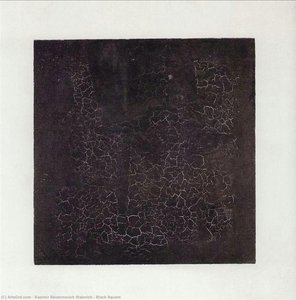
In the hands of Malevich, geometry became far more than a mathematical tool; it transformed into a sacred alphabet capable of constructing a new visual reality. The movement utilized a distilled vocabulary of fundamental shapes—the square, the circle, and the cross—to communicate complex emotional architectures. These forms were not intended to represent anything other than themselves. When we contemplate the legendary
Black Square (1915), we are not looking at a void of meaning, but at the foundational zero-point of a new artistic language. It is a concentrated essence, stripped of all ornament, presenting the absolute limit of what paint and canvas can achieve.
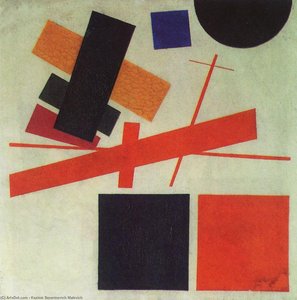
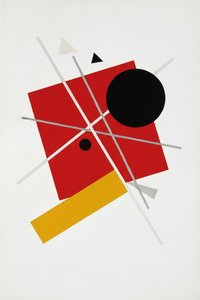
The strategic placement of these shapes creates a sense of rhythmic movement and depth without ever resorting to traditional perspective. In works such as
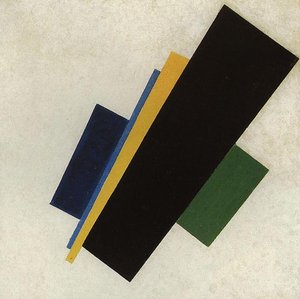
Suprematist Painting 7, the interaction of blue squares and vibrant accents generates a dynamic energy that feels both cosmic and intimate. This geometric language allows for an exploration of weightlessness and tension, where shapes appear to drift through an infinite white expanse. For the student of art history, these compositions serve as a masterclass in how balance, color theory, and spatial arrangement can create a profound sense of presence without the need for a single recognizable figure.
From Cubism to the Void: The Evolution of a Radical Vision
 Kazimir Malevich
Kazimir Malevich: A Pioneer of Abstract Art Early Life and Influences Born in Kyiv Oblast, Ukraine in 1878 to a Polish family, Kazimir Severinovich Malevich’s early life was shaped by the rural Ukrainian landscape and its rich folk culture. His upbri...
The trajectory of Malevich’s career provides a breathtaking map of the evolution of modernism. His journey was one of progressive distillation, moving from the fragmented landscapes of Cubo-Futurism toward an absolute, non-objective state. In his earlier works, such as
Woman with Pails or
Dynamic Arrangement, we see the subject being systematically deconstructed. The object is treated as a precursor to the essence; it is a stage where the artist practices the art of dissolution. As he moved through the influences of Impressionism and Symbolism, each layer of representation was peeled away, leaving behind a more potent, concentrated core of form.
This evolution reached its zenith in 1915, when Malevich introduced Suprematism as a fully realized system. This transition was mirrored by the immense social and artistic upheavals of the era, including the Russian Revolution, which seemed to demand a new visual language for a new world. The movement’s expansion also saw the rise of devoted disciples like Lazar Khidekel, who sought to translate the abstract language of Suprematism into three-dimensional realities, pushing the boundaries of the movement from the flat canvas into the realm of architectural design and volumetric form. This progression from the recognizable to the void remains one of the most daring intellectual leaps in the history of human creativity.
The Legacy of Suprematism: Impact on Modernist Architecture and Design
 Lazar Markovich Khidekel
A Visionary of Form: The Life and Legacy of Lazar Markovich Khidekel Lazar Markovich Khidekel, born in Vitebsk, Belarus in 1904, was more than just an artist; he was a philosophical architect, a daring designer, and a devoted disciple of Kazimir Male...
The echoes of Suprematist thought can be heard far beyond the edges of a painted canvas. The movement’s emphasis on pure form, geometric clarity, and the rejection of ornament laid the groundwork for much of twentieth-century modernism. Its influence permeated the development of Constructivism, influencing everything from graphic design and typography to the radical structures of avant-garde architecture. The idea that space could be organized through the tension of geometric planes became a cornerstone of modern urban planning and industrial design, proving that the "pure feeling" Malevich sought had practical, transformative power in the physical world.
Today, we see the legacy of Suprematism in the clean lines of minimalist interiors and the bold, non-representational aesthetics of contemporary digital media. It taught us that simplicity is not a lack of complexity, but rather the highest form of it. For collectors and enthusiasts of fine art, appreciating these works means recognizing the courage it took to face the void and find beauty within it. Whether through the study of a museum masterpiece or the acquisition of a high-quality oil reproduction, the spirit of Suprematism continues to challenge us to look past the surface and seek the eternal truth found in pure, unadulterated form.
At ArtsDot.com, we are dedicated to preserving this profound human legacy. We specialize in creating museum-quality, hand-painted oil reproductions of the world's most significant masterpieces. Our master artists use traditional techniques on 100% cotton canvas to capture the very texture and soul of historical movements like Suprematism. Whether you seek a breathtaking Black Square for your collection or wish to transform a personal memory into a custom masterpiece, our commitment to academic excellence ensures that every brushstroke honors the masters of the past.