The Victorian Botanical Movement: Where Scientific Inquiry Meets Aesthetic Grace
To step into the world of Victorian botanical painting is to enter a realm where the rigorous discipline of the scientist and the soulful passion of the artist exist in perfect, breathless harmony. During the nineteenth century, the expansion of the British Empire and the burgeoning fascination with natural history ignited an unprecedented era of exploration. As botanists ventured into uncharted territories, they brought back more than just specimens; they brought stories of vibrant, exotic life that demanded a new kind of visual language. This was not merely art for art's sake, but a profound attempt to document the very pulse of the planet with both anatomical accuracy and aesthetic splendor.
The movement flourished within the gilded age of discovery, fueled by a societal obsession with the natural world. It was an era defined by the tension between the known and the unknown, where every new petal or leaf discovered in a distant colony represented a triumph of human knowledge. The botanical illustrations of this period served as the primary medium for communicating these wonders to a public hungry for the exotic. Consequently, the art became a bridge between the laboratory and the drawing room, transforming cold scientific data into something deeply evocative and visually enchanting.
Mastering the Detail: The Meticulous Techniques of 19th-Century Illustrators
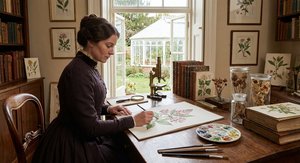
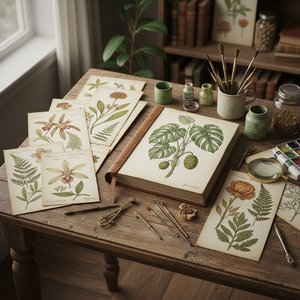
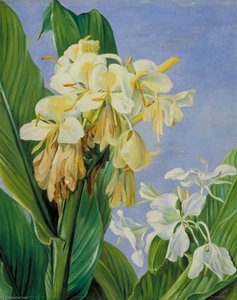
The true magic of Victorian botanical artistry lies in its staggering level of precision. Achieving such lifelike fidelity required a mastery of medium and a patience that borders on the meditative. Artists utilized fine brushes, often composed of only a few hairs, to render the delicate veins of a leaf or the microscopic texture of a stamen. Whether working in watercolor for subtle translucency or oil for a more robust, sculptural presence, the goal was always the same: to capture the essence of the living specimen.
In these works, one observes a deliberate use of light and shadow to create a sense of three-dimensional volume on a two-dimensional surface. The technique involved meticulous layering, where pigments were applied with such care that the moisture of the paint seemed to mimic the dew of a morning garden. This level of detail was not merely decorative; it was functional. For the botanist, the placement of a hair or the curve of a stem was vital for identification. For the connoisseur, these minute details provided a sense of wonder, inviting the viewer to lean closer and lose themselves in the infinite complexity of nature's design.
Flora and Fauna: Exploring Iconic Works from Marianne North to Helena Nellie Scott
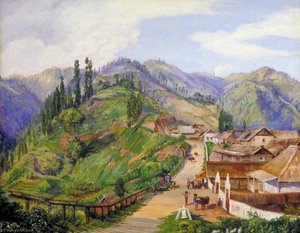
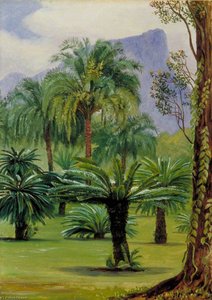
When we reflect on the titans of this era, few names resonate with as much adventurous spirit as Marianne North. Her work transcends the boundaries of traditional botanical illustration by placing flora within their native, dramatic landscapes. One might find oneself transported to the lush, humid atmosphere of the Palms in the Botanic Garden, Buitenzorg, Java, where her vibrant palette captures the tropical light with unparalleled energy. Similarly, her depiction of A Giant Kniphofia near Grahamstown showcases a breathtaking ability to marry the colossal scale of nature with an intimate, painterly touch, capturing the ruggedness of the rocky terrain alongside the delicate brilliance of the flower.
In contrast to the sweeping landscapes of North, other artists focused on the exquisite micro-worlds of insects and singular specimens. The work of Helena Nellie Scott offers a profound look into this intimate scale. Her Black Jezebel Butterfly, Delias nigrina is a masterclass in Victorian artistry, where the velvety texture of the butterfly's wings and the subtle patterns of its form are rendered with such clarity that the specimen feels as though it might take flight from the canvas. These artists, though different in scope, shared a common devotion to the truth of the natural world, creating a legacy of imagery that remains as vital today as it was in the nineteenth century.
The Language of Flowers: Symbolism and Sentiment in Botanical Artistry
Beyond the scientific utility of these paintings lay a deeper, more poetic layer of meaning: the floriography. In the Victorian era, flowers were far more than mere ornaments; they were a sophisticated language used to communicate emotions that were often too delicate or too scandalous for spoken word. A rose might whisper of enduring love, while a sprig of lavender could signal devotion or even distrust. This symbolic depth imbued botanical art with a layer of romantic mystery.
When viewing a Victorian botanical composition, the discerning eye looks for these hidden narratives. An arrangement of blooms was rarely accidental; it was often a carefully curated poem of sentiment. This intersection of botany and emotion allowed the art to permeate the domestic sphere, turning a simple painting of a lily or a violet into a profound statement of character or affection. It is this marriage of the tangible specimen and the intangible feeling that gives the genre its enduring, melancholic beauty.
Preserving Nature's Legacy: Bringing Victorian Elegance into the Modern Interior
In our contemporary, fast-paced world, there is a profound longing for the stillness and permanence represented by these classical works. Integrating Victorian botanical art into a modern interior offers more than just decoration; it provides an anchor of historical continuity and organic grace. The structured elegance of a large-scale floral oil painting can serve as a breathtaking focal point in a minimalist room, introducing texture, color, and a sense of storied history.
Whether through the acquisition of museum-quality reproductions or the commissioning of bespoke pieces that echo these historical styles, we can continue to celebrate this legacy. At ArtsDot.com, we honor this tradition by working with master artists who specialize in the academic excellence required to recreate such intricate beauty. By bringing these timeless depictions of nature into our homes, we do more than decorate a wall; we preserve the spirit of discovery and the eternal elegance of the natural world for generations to come.