Introduction
There’s a quiet power in restraint, a subtle drama found not in vibrant hues but in the nuanced interplay of grays, silvers, and muted tones. To explore paintings dominated by ‘pewter’ – that alloy of tin, often touched with lead, known for its soft sheen and enduring quality – is to enter a world where atmosphere reigns supreme. These aren't works shouting for attention; they whisper stories of introspection, resilience, and the beauty found in shadows.
The use of pewter-like palettes throughout art history has often coincided with periods of societal change or profound artistic exploration. From the somber realism of Dutch Masters grappling with mortality to the atmospheric landscapes of Romanticism reflecting a yearning for the sublime, these tones have served as vessels for complex emotions. The 17th and 19th centuries, in particular, saw artists deliberately employing limited color ranges – often dictated by pigment availability or philosophical intent – resulting in masterpieces that resonate with a timeless quality.
These paintings aren’t merely aesthetically pleasing; they are cultural touchstones. They offer glimpses into the past, reflecting the beliefs, anxieties, and aspirations of their time. The enduring appeal lies in their ability to transcend specific historical contexts, speaking directly to our shared human experience – our contemplation of life's mysteries, our connection to nature, and our search for meaning in a world often shrouded in uncertainty.
What follows is a journey through ten such works. Each painting represents a unique approach to the power of pewter tones, demonstrating how artists have harnessed this subtle palette to create images that are both deeply moving and profoundly memorable. Prepare to be captivated by the quiet eloquence of these masterpieces – paintings where less truly proves to be more.
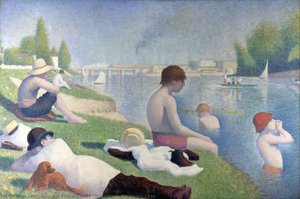
Bañistas en Asnieres, 1889 - Georges Seurat
 Bañistas en Asnieres, 1889 - Georges Seurat
Georges Seurat’s Bañistas en Asnieres (1889) isn't simply a depiction of leisure; it’s an exercise in atmospheric serenity rendered through the subtle power of pewter tones. While not overtly monochromatic, the painting’s dominance of cool grays, muted blues, and soft greens creates a uniquely tranquil mood – a quiet counterpoint to the vibrant energy of Parisian life.
Its inclusion within our ‘Top 10 Famous Paintings Dominated by Pewter Tones’ stems from Seurat's revolutionary approach to color theory. He wasn’t striving for bold statements, but rather for optical mixing – allowing the viewer’s eye to blend individual dots of pigment and create a shimmering, lifelike effect. This technique, Pointillism, relies on nuanced shades and delicate gradations, resulting in an almost ethereal quality.
Today, Bañistas en Asnieres resonates with contemporary design sensibilities that favor calm interiors and natural palettes. The painting’s subdued hues evoke a sense of peacefulness often sought after in modern homes – think soft linen textures, muted wall colors, and spaces designed for mindful relaxation. The artwork's legacy extends beyond the canvas; it foreshadowed a shift towards more introspective and emotionally resonant art, influencing generations of artists to explore the power of subtlety.
Misty Morning in Veneux - Alfred Sisley
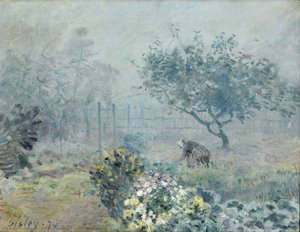 Misty Morning in Veneux - Alfred Sisley
Imagine a cool mist rising from the fields of Veneux, softening the edges of reality and enveloping everything in a gentle embrace. Alfred Sisley’s Misty Morning in Veneux (1874) doesn't simply *show* us this scene; it allows us to *feel* it – the dampness on our skin, the quiet solitude of the countryside.
What sets this painting apart within the Impressionist movement is its masterful restraint. While many of his contemporaries embraced vibrant color palettes, Sisley focused on a subtle interplay of grays, blues, and muted greens, creating an atmosphere that’s both ethereal and deeply grounding. This deliberate use of pewter tones isn't about absence of color; it’s about capturing the delicate nuances of light and shadow.
The painting’s enduring appeal lies in its ability to evoke a sense of calm contemplation. In today’s fast-paced world, Misty Morning in Veneux offers a visual sanctuary – a reminder to slow down, breathe deeply, and appreciate the beauty of simple moments. Its cool palette translates beautifully into modern interiors, lending a serene sophistication to bedrooms, studies, or any space where tranquility is desired. It’s more than just a painting; it's an invitation to pause and reconnect with nature’s quiet power.
Twittering machine 1 - Paul Klee
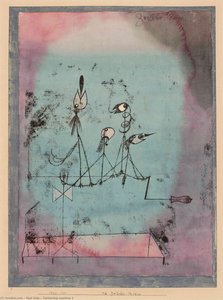 Twittering machine 1 - Paul Klee
To encounter Paul Klee’s Twittering Machine 1 (c. 1922) is to step into a world where logic dissolves and imagination takes flight. This delicate watercolor isn't merely a painting; it’s a visual poem, a whimsical exploration of modernity rendered in the most subtle of pewter tones.
Its inclusion among our ‘Top 10 Famous Paintings Dominated by Pewter Tones’ speaks to Klee’s revolutionary approach to abstraction. He wasn't interested in replicating reality but rather in evoking emotion and sparking contemplation through form, color, and line. The muted blues, grays, and pinks create an ethereal atmosphere – a dreamscape populated by hybrid creatures that seem both mechanical and organic.
The painting’s enduring power lies in its ambiguity. Is it a commentary on the dehumanizing effects of technology? A celebration of artistic freedom? Or simply a playful exploration of sound and form? Regardless, Twittering Machine 1 resonates deeply with contemporary sensibilities – particularly within refined interiors where art serves as a catalyst for conversation and introspection. Its delicate palette and intricate details lend an air of sophistication and intellectual curiosity to any space, proving that true beauty often lies in the realm of the unexpected.
Dolomite Landscape - Oskar Kokoschka
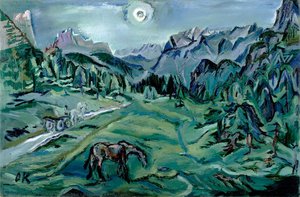 Dolomite Landscape - Oskar Kokoschka
There’s a raw energy that emanates from Oskar Kokoschka’s Dolomite Landscape (1913), a painting that doesn't simply depict mountains and valleys but rather translates the very *feeling* of being dwarfed by nature’s grandeur. The muted pewter tones – deep blues, grays, and hints of violet – aren’t about softness; they convey a sense of awe mixed with an underlying melancholy.
Its place within our ‘Top 10 Famous Paintings Dominated by Pewter Tones’ is earned through its revolutionary approach to Expressionism. Kokoschka wasn't interested in capturing photographic realism but rather in conveying inner turmoil and subjective experience through bold brushwork and distorted forms. The landscape becomes a mirror reflecting the artist’s own emotional state.
Today, Dolomite Landscape resonates with those seeking art that transcends mere decoration. It's a statement piece – a powerful reminder of our connection to the natural world and the complexities of the human spirit. At , we believe in making such masterpieces accessible, allowing you to bring this profound emotional energy into your home or office—a testament to the enduring power of art to inspire and uplift.
The Big Family - René Magritte
 The Big Family - René Magritte
There’s a quiet enigma at the heart of René Magritte’s The Big Family (1963), a painting that feels less like an observation and more like a dream remembered. The vast, cloud-formed bird suspended against a muted seascape isn't merely an image; it’s a symbol of aspiration, freedom, and the boundless realms of the imagination.
Its inclusion among our ‘Top 10 Famous Paintings Dominated by Pewter Tones’ stems from Magritte’s masterful manipulation of perception. He wasn’t interested in replicating reality but rather in challenging it – juxtaposing familiar elements in unexpected ways to provoke contemplation and unlock hidden meanings. The soft grays, blues, and greens create a dreamlike atmosphere that invites us to question the boundaries between what is real and what is not.
Today, The Big Family resonates with those seeking art that transcends the ordinary. Its subtle palette and ethereal quality lend themselves beautifully to modern interiors – creating spaces of calm reflection and intellectual curiosity. It’s a reminder that true beauty often lies in the unexpected, and that sometimes, the most profound truths are found not in what we see, but in how we choose to interpret it.
Basket of Apples - Paul Cézanne
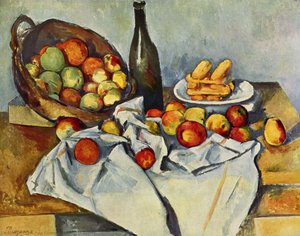 Basket of Apples - Paul Cézanne
Paul Cézanne’s Basket of Apples (1895) isn't simply a depiction of fruit; it’s an exploration of perception itself, a quiet revolution painted in muted tones. The subtle interplay of blues, grays, and the warm blush of apples creates a sense of depth and volume that belies its seemingly simple subject matter.
Its inclusion within our ‘Top 10 Famous Paintings Dominated by Pewter Tones’ is a testament to Cézanne's groundbreaking approach to form. He wasn’t interested in replicating reality but rather in capturing the underlying structure of objects – their essential geometry. This focus paved the way for Cubism and fundamentally altered the course of modern art.
Today, Basket of Apples continues to resonate with those seeking a deeper connection to the everyday. Its quiet beauty invites contemplation on themes of abundance, mortality, and the fleeting nature of time. Within a contemporary home, this painting offers more than just aesthetic appeal; it’s a conversation starter – a timeless reminder that true artistry lies in seeing the extraordinary within the ordinary.
People in the Sun - Edward Hopper
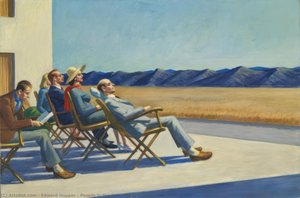 People in the Sun - Edward Hopper
Edward Hopper’s People in the Sun (1960) isn't merely a depiction of figures enjoying a moment outdoors; it’s a poignant meditation on solitude and the quiet dignity of everyday life. The muted palette – earthy tones, soft blues, and subtle grays – creates an atmosphere of serene contemplation, inviting us to reflect on our own place within the vastness of existence.
Its inclusion among our ‘Top 10 Famous Paintings Dominated by Pewter Tones’ stems from Hopper's masterful ability to capture the emotional undercurrents of modern American life. He wasn’t interested in grand narratives but rather in the subtle beauty and inherent loneliness found within seemingly ordinary scenes.
Today, People in the Sun resonates with those seeking art that speaks to the human condition. Its quiet power lends itself beautifully to contemporary interiors – creating spaces of calm reflection and understated elegance. This painting isn’t just a visual experience; it's an invitation to pause, breathe, and connect with the universal longing for peace and belonging.
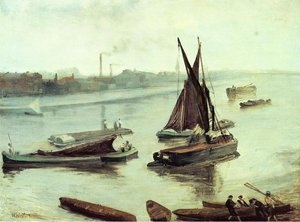
Liverpool from Wapping - John Atkinson Grimshaw
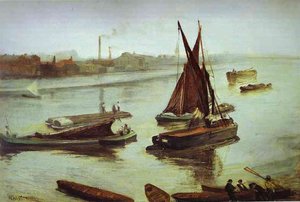
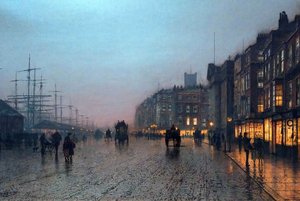 Liverpool from Wapping - John Atkinson Grimshaw
There’s a quiet magic woven into the fabric of John Atkinson Grimshaw’s Liverpool from Wapping (1875), a painting that feels less like a depiction of a city and more like a Victorian reverie. The muted palette – a symphony of grays, blues, and browns – evokes the damp cobblestones, the glow of gaslight, and the subtle energy of a bustling port town.
Its inclusion among our ‘Top 10 Famous Paintings Dominated by Pewter Tones’ stems from Grimshaw's unique ability to bridge realism and impressionism. He wasn’t simply documenting a scene; he was capturing an *atmosphere* – the mood, the light, the very soul of Liverpool.
Today, Liverpool from Wapping resonates with those seeking art that evokes a sense of nostalgia and quiet contemplation. Its sophisticated color palette lends itself beautifully to modern interiors – creating spaces of calm reflection and understated elegance. This painting isn’t just a visual experience; it's an invitation to step back in time and connect with the enduring beauty of Victorian England.
Aphrodisiac Telephone (Lobster Phone) - Salvador Dalí
 Aphrodisiac Telephone (Lobster Phone) - Salvador Dalí
A strange stillness permeates Salvador Dalí’s Aphrodisiac Telephone (Lobster Phone) , a painting that feels less like an object and more like a dream materialized. Against a muted gray backdrop, the gleaming white telephone surmounted by a vibrant lobster unlocks a complex web of desire, communication, and unsettling beauty.
Its inclusion among our ‘Top 10 Famous Paintings Dominated by Pewter’ Tones’ stems from Dalí's masterful ability to distill his obsessions into potent symbols. The cool gray foundation allows the lobster’s vivid form – a recurring motif representing sexual energy – and the telephone, a conduit for connection, to resonate with startling clarity.
Today, Aphrodisiac Telephone continues to fascinate with its dreamlike quality and psychological depth. Its subtle palette lends itself beautifully to contemporary interiors, creating spaces of intrigue and understated elegance. This painting isn’t just a visual experience; it's an invitation to explore the hidden landscapes of the subconscious.
No. 22 - Mark Rothko
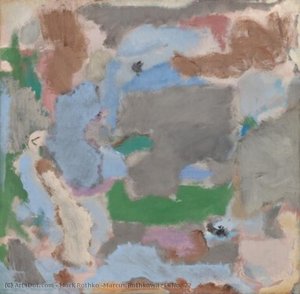 No. 22 - Mark Rothko
Mark Rothko’s ‘No. 22’, painted in 1948, isn't simply a canvas covered in color; it’s an invitation to quiet contemplation, a window into the sublime. The delicate interplay of blues, pinks, and browns – layered with textured surfaces – evokes a profound sense of emotional resonance, hinting at both vulnerability and strength.
Its inclusion among our ‘Top 10 Famous Paintings Dominated by Pewter’ Tones’ stems from Rothko's pivotal role in defining Abstract Expressionism. This work embodies his transition towards the Color Field style, a movement that profoundly influenced generations of artists seeking to express universal truths through pure color and form.
At , we believe everyone deserves to experience the power of art like ‘No. 22’ within their own home. Our faithful reproductions capture not only the colors but also the subtle textures and emotional depth of Rothko's original masterpiece, allowing you to connect with this timeless work on a deeply personal level.
Conclusion
As the light fades, mirroring the subtle gradations within these ten masterpieces, we’re reminded that art isn't confined to museum walls or historical timelines. These paintings – from Grimshaw’s atmospheric cityscapes to Rothko’s profound color fields – are living forces, whispering stories of human emotion and experience across generations.
The pewter tones that unite them aren’t merely a stylistic choice; they're an invitation to introspection, a quiet space for contemplation in a world often defined by noise. They speak to the beauty found in subtlety, the power of suggestion, and the enduring allure of the human spirit.
We hope this journey through these iconic works has sparked your own connection with their timeless beauty. And if you find yourself longing to bring a touch of that magic into your own space, we invite you to explore our full collection – where faithful reproductions await, ready to breathe new life and emotion into your home.