
The Sienese Context: A Flourishing Artistic Tradition
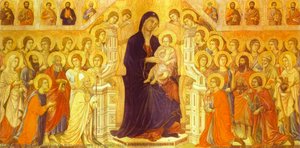
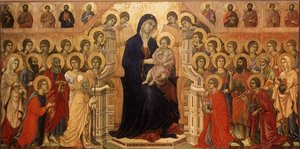
The Sienese school of painting flourished in Siena, Italy, between the 13th and 15th centuries. Its most important artists include Duccio, whose work shows Byzantine influence, his pupil Simone Martini, the brothers Pietro and Ambrogio Lorenzetti and...
To understand Simone Martini is to understand Siena itself – a vibrant, independent city-state during the late Middle Ages and early Renaissance, rivaling Florence in economic power and artistic innovation. Unlike its more commercially driven neighbor, Siena cultivated an atmosphere steeped in religious fervor and courtly refinement. This unique environment fostered a distinctive school of painting characterized by elegance, lyrical beauty, and a profound spiritual sensibility. The city’s governance, initially by the *Nove* (Nine), created a period of relative stability that allowed for unprecedented artistic patronage. Siena wasn't merely a center of trade; it was a hub of theological debate, philosophical inquiry, and sophisticated aesthetic appreciation. This context is crucial because Martini didn’t emerge in isolation; he was the culmination of a tradition nurtured by Duccio di Buoninsegna and poised to influence generations of artists across Europe.
Duccio’s Legacy & Martini’s Early Influences
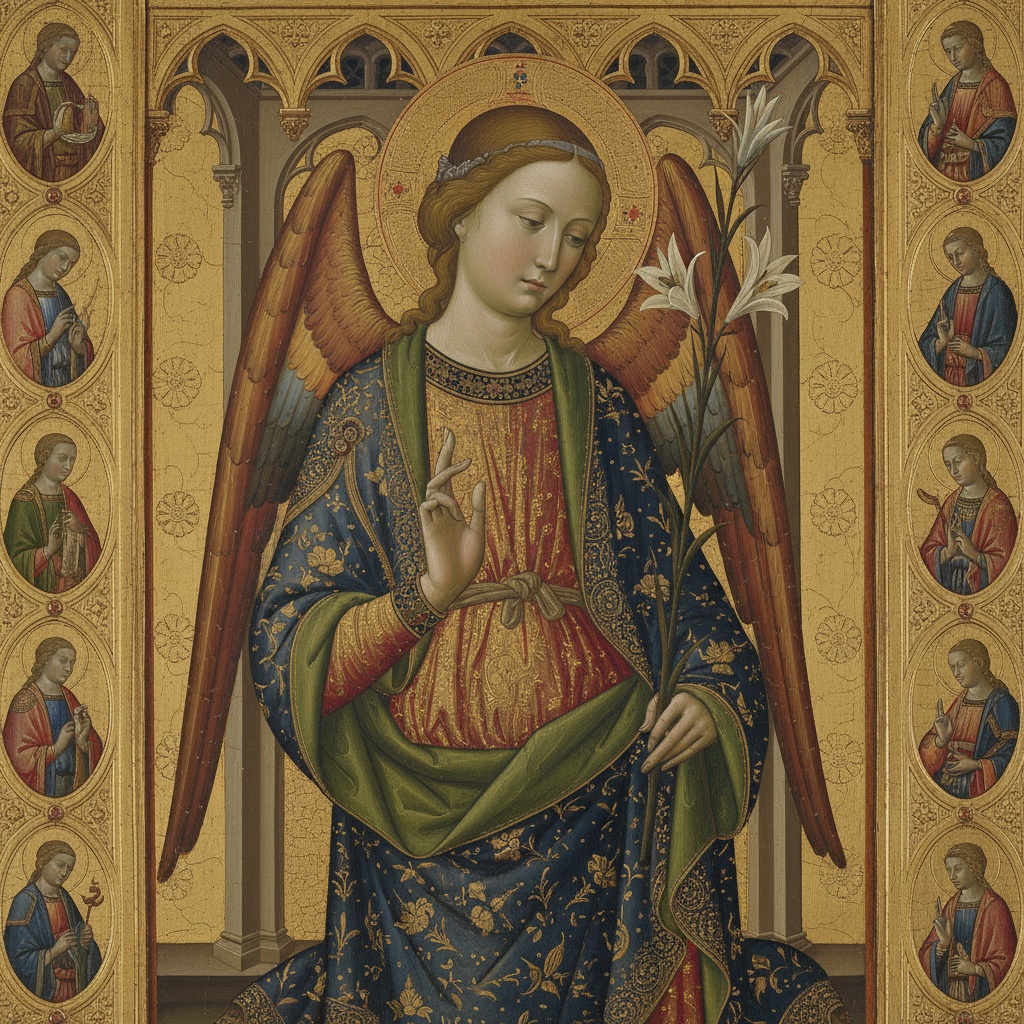
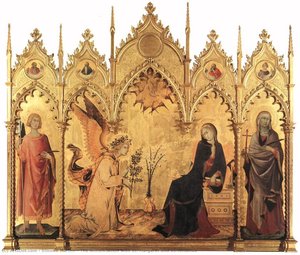 The Annunciation with St. Margaret and St. Ansanus
Explore Simone Martini’s ‘Annunciation,’ a stunning Early Renaissance panel painting. Admire its Gothic elegance, gold leaf details & hierarchical composition – a masterpiece of 1333 Siena art.
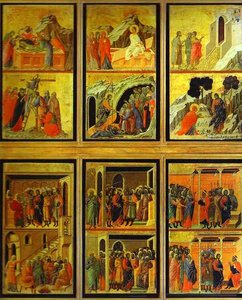
The towering figure of Duccio di Buoninsegna casts a long shadow over Sienese painting. Often hailed as the “father of Sienese art,” Duccio revolutionized panel painting with his *Maestà*, an altarpiece commissioned for Siena Cathedral in 1308-1311. His work, imbued with Byzantine elegance and nascent naturalism, provided the foundation upon which Martini built his own artistic language. While historical documentation remains sparse, it is widely believed that Martini apprenticed under Duccio, absorbing his master’s technical prowess and sensitivity to color and form. However, accounts from Giorgio Vasari suggest a possible apprenticeship with Giotto in Rome, an assertion debated by art historians but indicative of the broader artistic currents influencing Martini's development. Regardless of his precise training, Martini demonstrably synthesized these influences – the lyrical grace of Duccio and the spatial awareness associated with Giotto – forging a style uniquely his own.
Elegance and Innovation: Defining Characteristics of Martini’s Style
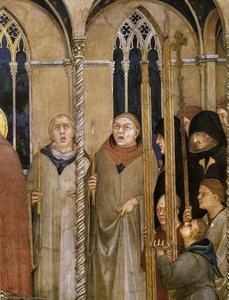 Burial of St Martin (detail)
Discover Simone Martini’s poignant *Burial of St Martin (detail)* from 1312. Explore the emotional depth & refined artistry of this International Gothic masterpiece.
Martini’s paintings are immediately recognizable for their refined elegance. He possessed an extraordinary ability to depict flowing drapery, delicate features, and expressive gestures that conveyed both spiritual devotion and aristocratic grace. Unlike the more monumental figures favored by Florentine artists, Martini's characters often exhibit a sinuous quality, their forms elongated and imbued with a sense of movement. His mastery of technique extended beyond form; he was renowned for his use of gold leaf, which not only added luminosity to his works but also symbolized divine light. The *Burial of St Martin (detail)* from 1312 exemplifies this characteristic – the poignant emotion conveyed through subtle facial expressions and the shimmering brilliance of the gold background create a deeply affecting image. He wasn’t simply replicating religious scenes; he was crafting objects of exquisite beauty designed to elevate the viewer's spiritual experience.
Spiritual Depth and Narrative Power in Martini’s Works
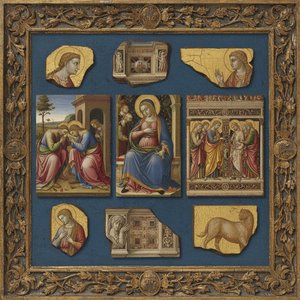
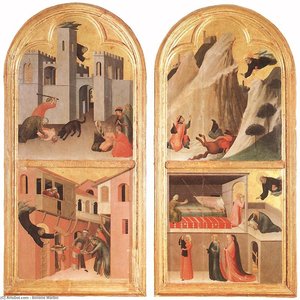
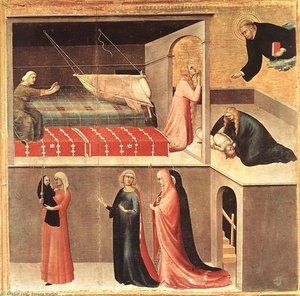 Blessed Agostino Novello Altarpiece (detail)
The altarpiece exemplifies Martini’s mastery of technique and contributes to the preservation of Italian artistic heritage. It's reproduced by ArtsDot.com offering high-quality oil painting reproductions.
Beneath the surface elegance lay a profound spirituality. Martini’s paintings weren’t merely decorative; they were imbued with theological meaning and narrative power. The *Annunciation with St. Margaret and St. Ansanus* (1333) is a prime example, showcasing his ability to convey complex religious concepts through carefully constructed compositions and symbolic details. The hierarchical arrangement of the figures – the Virgin Mary prominently positioned, flanked by the saints – emphasizes their relative importance within the divine order. The use of gold leaf creates an ethereal atmosphere, drawing the viewer into a realm beyond the earthly. Furthermore, Martini’s attention to detail—the intricate patterns on the fabrics, the delicate rendering of facial features—reflects a deep reverence for his subject matter and a desire to create images worthy of contemplation. The *Blessed Agostino Novello Altarpiece (detail)* further illustrates this commitment to both technical skill and spiritual expression.
Martini at the Courts of Naples and Avignon: A Cosmopolitan Artist
Martini’s talent extended beyond the confines of Siena, attracting commissions from prominent courts across Europe. His sojourn in Naples during 1317-1319, painting for King Robert of Anjou, marked a significant turning point in his career. This exposure to a different cultural milieu broadened his artistic horizons and introduced him to new patrons and influences. Later, he accepted an invitation to the Papal court in Avignon, where he spent the final years of his life creating frescoes for the palace chapel. These commissions demonstrate Martini’s adaptability and his ability to cater to diverse aesthetic tastes while maintaining his distinctive style. His association with figures like Petrarch – who famously praised a portrait of Laura painted by Martini (though the work itself remains lost) – further solidified his reputation as a cosmopolitan artist at the height of his powers.
The Lasting Influence of Simone Martini on International Gothic Art
Simone Martini’s impact on the development of art in Europe cannot be overstated. He is considered a key figure in the emergence of the International Gothic style, characterized by its elegance, refined naturalism, and emphasis on decorative detail. Artists like Lippo Memmi – his brother-in-law – and Niccolò di Segna directly followed in his footsteps, perpetuating his artistic legacy within Siena. Beyond Italy, Martini’s influence extended to France, Bohemia, and beyond, inspiring generations of painters with his lyrical compositions and sophisticated aesthetic sensibility. His work represents a synthesis of Byzantine tradition, Italian naturalism, and French courtly elegance – a unique blend that continues to captivate viewers centuries later. Today, experiencing a painting by Simone Martini is not merely appreciating a historical artifact; it’s encountering a masterpiece that embodies the beauty, spirituality, and artistic innovation of a bygone era. Explore reproductions of his works at ArtsDot.com, where skilled artisans meticulously recreate these timeless treasures for discerning collectors.