The Rise of Kneller: From Dutch Workshop to Royal Favor
 Wikipedia: Godfrey Kneller
Sir Godfrey Kneller, 1st Baronet (born Gottfried Kniller; 8 August 1646 – 19 October 1723) was a German-born British painter. The leading portraitist in England during the late Stuart and early Georgian eras, he served as court painter to successive ...
Sir Godfrey Kneller’s ascent to become the preeminent portraitist of late Stuart and early Georgian England was not a foregone conclusion, but rather a carefully cultivated journey from his origins in Lübeck, Germany, to the heart of London’s artistic circles. Born Gottfried Kniller in 1646, he initially trained within the Dutch artistic tradition, absorbing the meticulous realism championed by Ferdinand Bol, a former pupil of Rembrandt van Rijn. This early grounding proved pivotal; it instilled in him a technical proficiency and an understanding of light and shadow that would later define his signature style. However, Kneller wasn’t content to simply replicate existing techniques. A sojourn to Italy exposed him to the grandeur of Baroque painting – a dramatic departure from Dutch restraint – and ignited a passion for more theatrical compositions and dynamic poses. It was this fusion of Northern precision with Italian exuberance that would ultimately set him apart.
Upon arriving in England in 1676, alongside his brother John Zacharias, Kneller faced the challenge of establishing himself within an already competitive artistic landscape. His initial success hinged on securing patronage, and he shrewdly cultivated relationships with influential figures like the Duke of Monmouth. But it was his portrait of Charles II that truly cemented his position at court. He skillfully navigated the complex world of royal commissions, understanding that a portrait wasn’t merely about capturing likeness but also about projecting power, status, and legitimacy. This ability to translate political ambition onto canvas would become his hallmark.
Defining a Style: Baroque Portraiture and the Kit-Cat Club
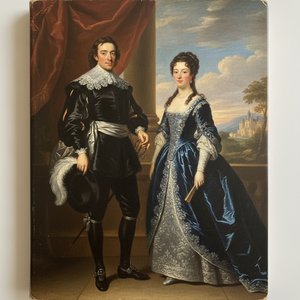
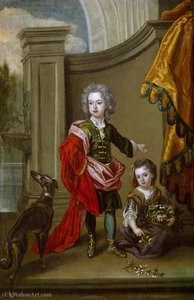 Richard Boyle, 3rd Earl of Burlington and his sister Lady Jane Boyle
Admire Richard Boyle, 3rd Earl of Burlington & his sister Lady Jane Boyle in a refined portrait by Sir Godfrey Kneller. A captivating Baroque piece showcasing aristocratic elegance.
Kneller's artistic style is inextricably linked with the broader Baroque movement that swept across Europe in the 17th century. Characterized by dramatic lighting, rich colors, and dynamic compositions, Baroque portraiture aimed to evoke emotion and convey a sense of grandeur. Kneller masterfully adapted these principles to the English context, creating portraits that were both visually striking and psychologically insightful. He moved away from the more static poses favored by his predecessors, introducing a greater sense of movement and life into his work.
Perhaps most famously associated with Kneller is the series of “Kit-Cat” portraits he painted between approximately 1700 and 1720. These half-length depictions of members of the exclusive Kit-Cat Club – a group of Whig politicians, writers, and intellectuals – became iconic representations of English society at the turn of the century. The standardized size (roughly 36 x 28 inches) allowed for easy comparison between subjects, fostering a sense of camaraderie and shared identity. More than just portraits, these paintings served as visual statements of political allegiance and intellectual prowess. The subtle details – clothing, accessories, even posture – were carefully chosen to convey the sitter’s personality and social standing.
Power Dynamics on Canvas: Representing Aristocracy and Influence
Kneller understood that portraiture was rarely a neutral act; it was inherently intertwined with power dynamics. His aristocratic patrons weren't simply seeking likenesses, they were commissioning symbols of their status, wealth, and influence. Kneller excelled at translating these desires into compelling visual narratives. He employed a range of techniques to achieve this effect – from the lavish fabrics and opulent settings that signaled affluence to the carefully chosen poses and expressions that conveyed authority and confidence.
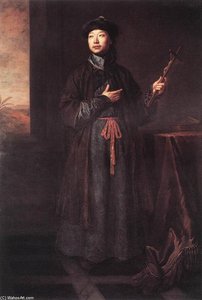
Consider his portrait of John Dryden, a literary giant of the Restoration era. The painting, with its rich colors and meticulous detail, doesn’t merely depict a writer; it presents him as a man of intellect and standing. Similarly, in portraits like The Moroccan Ambassador (1684), Kneller used dramatic composition – the nobleman on horseback, the exotic setting – to emphasize the sitter's foreign status and diplomatic importance. These were not simply representations of individuals; they were carefully constructed images designed to project power and prestige.
Beyond Likeness: Symbolism, Status & the Art of Presentation
Kneller’s skill extended beyond technical proficiency; he was a master of symbolism, subtly embedding layers of meaning into his portraits. Objects, gestures, and even background elements were carefully chosen to convey specific messages about the sitter's character, aspirations, or social position. A classical book might signify learning and intellectual prowess, while an elaborate wig could denote wealth and status. The very act of commissioning a portrait by Kneller was itself a statement – a demonstration of one’s ability to afford the services of the most sought-after artist in England.
The portraits of Richard Boyle, 3rd Earl of Burlington, and his sister Lady Jane exemplify this attention to detail. Their refined poses, elegant clothing, and carefully chosen accessories all contribute to a sense of aristocratic elegance and sophistication. Kneller wasn’t simply painting what he saw; he was constructing an idealized image that reflected the sitter's desired self-presentation. He understood that a portrait could be a powerful tool for shaping public perception.
Kneller's Legacy: Shaping English Portraiture for Generations
Sir Godfrey Kneller’s impact on English portraiture is undeniable. He established a dominant style that would influence generations of artists, setting a pattern that was followed until the emergence of William Hogarth and Joshua Reynolds. His studio system – churning out portraits with remarkable efficiency – made portraiture accessible to a wider audience, but also raised questions about authorship and originality. Despite these criticisms, his technical skill, dramatic flair, and understanding of power dynamics cemented his position as the leading portraitist of his era.
Kneller’s legacy extends beyond his paintings themselves. He founded the Kneller Academy of Painting and Drawing in 1711, providing a platform for aspiring artists to hone their skills. His influence can be seen in the work of countless subsequent portraitists, who adopted his techniques and embraced his vision of grand manner painting. Today, his portraits remain powerful testaments to the ambition, status, and artistic sensibilities of Restoration England. At ArtsDot.com, we are proud to offer high-quality reproductions of Kneller’s masterpieces, allowing you to experience the grandeur and artistry of this remarkable painter firsthand.