The Shadows of Belgium: Formative Trauma and the Seeds of Mystery
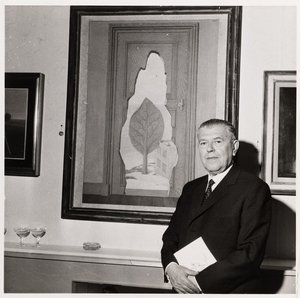 René Magritte
Early Life and the Seeds of Surrealism René Magritte, born René François Ghislain Magritte on November 21, 1898, in Lessines, Belgium, emerged into a world that would profoundly shape his enigmatic artistic vision. His early years were marked by an u...
To truly understand the enigmatic gaze of René Magritte, one must first wander through the somber, mist-laden landscapes of his youth in Belgium. Born in 1898 in Lessines, Magritte’s entry into this world was marked by a quiet, unsettling gravity that would later define the very essence of his Surrealist vision. The artist did not merely observe reality; he felt its fractures. A pivotal, haunting moment in his early life—the tragic loss of his mother when he was just thirteen—left an indelible mark upon his psyche. The imagery of her body being recovered from the River Sambre, with her dress obscuring her face, introduced a recurring motif of veiled identities and hidden realities that would permeate his later masterpieces. This early encounter with the unseen and the obscured instilled in him a lifelong fascination with the tension between presence and absence, a theme that resonates through every canvas he touched.
While his academic training at the Académie Royale des Beaux-Arts in Brussels provided him with a rigorous technical foundation, Magritte found the traditional methods of his era somewhat stifling. He experimented with the structured languages of Impressionism, Cubism, and Futurism, yet these movements served only as the technical scaffolding for his true calling. It was not until his encounter with Giorgio de Chirico’s work in 1922 that Magritte found his true artistic compass. De Chirico’s ability to render dreamlike landscapes and unsettling juxtapositions unlocked a new way of seeing—a world where the familiar could be rendered strange, and the ordinary imbued with profound mystery. This transition from the structured to the subconscious allowed him to transform the canvas into a playground for the unexpected, forever altering the course of modern art.
The Paradox of Representation: Decoding 'The Treachery of Images'
The Treachery of Images - Wikipedia--- title: The Treachery of Images - Wikipedia author: Show Authority Control Databases International Viaf Gnd National France Bnf Data url: https://en.wikipedia.org/wiki/The_Treachery_of_Images hostname: wikipedia.org sitename: Wikimedia Foundation,...
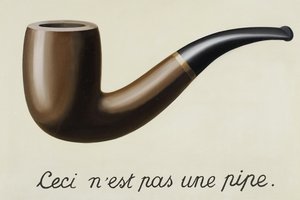
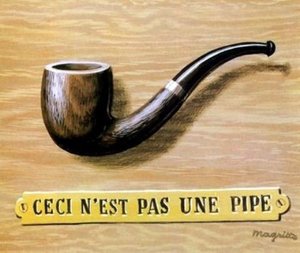
Perhaps no single artwork captures the intellectual provocation of Magritte as succinctly as his 1929 masterpiece,
The Treachery of Images. Known colloquially as
Ceci n'est pas une pipe, or "This is not a pipe," the painting presents a meticulously rendered tobacco pipe suspended in a void, accompanied by the defiant text below it. To the casual observer, the image seems to contradict itself, yet for the discerning enthusiast, it reveals a profound philosophical truth regarding the nature of representation. Magritte was not merely playing a linguistic trick; he was exposing the gap between an object and its depiction. As he famously noted, one cannot stuff a painted pipe with tobacco; it is merely a representation, a shadow of the thing itself.
This work serves as a cornerstone of Surrealist philosophy, challenging the viewer to question the very foundations of what we believe to be true. Through his hyperrealistic technique—employing a smooth surface devoid of pronounced impasto—Magritte achieves an almost unsettling clarity. By rendering the illogical with such academic precision, he forces us to confront the paradox: the more "real" a painting appears, the more it reminds us of its own artifice. This deliberate subversion of expectation invites us to look beyond the surface and recognize that our perceptions are often mere illusions, beautifully crafted but fundamentally deceptive.
Veiled Realities: The Recurring Motif of Hidden Identities
 The Lovers (Magritte)
The Lovers (French: Les Amants (French pronunciation: [lez‿amɑ̃])) is a surrealist painting by René Magritte, made in Paris in 1928. It is the first in a series of four variations, and in the painting two people can be seen kissing passionately with ...
Throughout his prolific career, Magritte returned obsessively to the concept of concealment. His work is a labyrinth of faces obscured by cloth, apples, or even birds, creating a sense of profound mystery and existential longing. This fascination with the veiled is deeply rooted in those early Belgian shadows, where the face of his mother was lost to the fabric of her own dress. In works such as
The Lovers, we see two figures attempting a passionate kiss, yet their faces are smothered by white shrouds. The barrier of fabric transforms an act of intimacy into one of frustration and isolation, representing the inherent difficulty in truly knowing another human being.
These veiled figures serve as moreals for the viewer to contemplate the layers of reality that exist beneath our daily perceptions. Whether it is a man with an apple obscuring his features or a figure lost in a landscape of shadows, Magritte uses concealment to suggest that truth is rarely found on the surface. There is always something hidden, something waiting to be uncovered, yet simultaneously something that remains forever out of reach. This tension between the visible and the invisible creates a hauntingly beautiful tapestry of thought, where every obscured detail acts as an invitation to deeper introspection.
A Symphony of Contradictions: Light, Darkness, and the Subconscious Mind
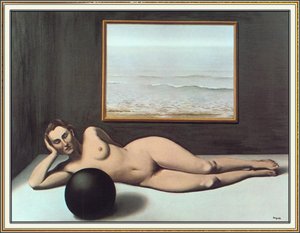 Bather between Light and Darkness
A Surrealist Meditation on Perception René Magritte’s “Bather Between Light and Darkness,” painted in 1935, stands as a quintessential example of Surrealism—a movement that sought to liberate the imagination from rational constraints and explore the ...
Magritte’s mastery over contradiction is most evident in his ability to manipulate light and shadow to create impossible atmospheres. He often played with the duality of day and night, creating visual metaphors for the human condition. In
Bather Between Light and Darkness, a luminous expanse of ocean merges seamlessly with an interior room bathed in muted tones, forcing the viewer to question the stability of their own senses. Similarly, his iconic
The Empire of Light presents a sunlit, daytime sky resting atop a nocturnal, street-lit landscape. This juxtaposition of opposites creates a sense of "surreality"—a super-reality where the contradictory conditions of dream and waking life are resolved into a single, breathtaking moment.
This use of light is never merely decorative; it is deeply psychological. The stark contrasts and subtle tonal gradations serve to highlight the tension between the known and the unknown. By placing familiar elements in unfamiliar, unexpected contexts, Magritte taps into the primal instincts of the subconscious mind. His paintings do not seek to depict dreams so much as they seek to question reality through their depiction, using the tools of light and shadow to illuminate the mysteries of the human psyche. It is a meditative approach to art, where the canvas becomes a space for profound contemplation on the nature of existence itself.
Beyond the Canvas: Magritte’s Enduring Influence on Modern Perception
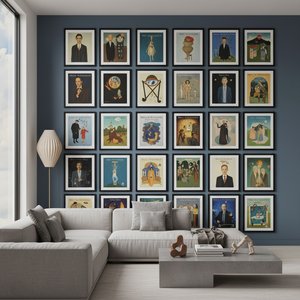 René Magritte's Masterpieces: 25 Surrealist Paintings for Art Lovers | ArtsDot
Introduction To embark on a journey through the top 25 artworks of René Magritte is to enter a realm where the familiar dissolves into the enigmatic, and reality itself becomes a question mark. These paintings are not merely images; they are portals—...
The legacy of René Magritte extends far beyond the borders of the Surrealist movement. His ability to disrupt expectation and challenge established ideologies has left an indelible mark on Pop Art, Minimalism, and Conceptual Art. In a world increasingly saturated with images and information, his art remains more relevant than ever, serving as a vital reminder that seeing is not always believing. He taught us that our perceptions are subjective, malleable, and often deceiving, encouraging a more critical and curious engagement with the visual world around us.
To engage with Magritte’s work is to embark on a lifelong journey of discovery. His paintings are not static images but portals—windows into a realm where reality itself becomes a question mark. For those of us who find beauty in the enigmatic and meaning in the mysterious, his oeuvre offers an inexhaustible source of inspiration. As we continue to navigate the complexities of our own perceived realities, Magritte’s vision stands as a testament to the power of art to transform the ordinary into the extraordinary, and the familiar into the profound.
For those who wish to bring the evocative spirit of the masters into their own homes, ArtsDot.com offers exquisite hand-painted reproductions that capture the very soul of historical masterpieces. Whether you seek the textured depth of an oil painting or the transformative magic of a custom commission, our dedication to academic excellence ensures that every brushstroke honors the legacy of the greats.