
The Genesis of a Movement: Responding to Modernity and the Great Depression
 Grant Wood & American Regionalism: Identity, Myth & the Rural Landscape
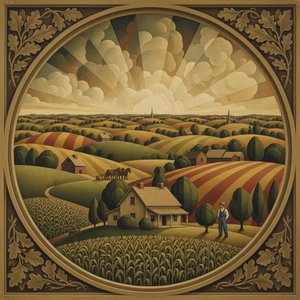
The Genesis of Regionalism: A Response to Modernity Wikipedia: Regionalism (art) American Regionalism is an American realist modern art movement that included paintings, murals, lithographs, and illustrations depicting realistic scenes of rural and s...
To understand the profound pull of American Regionalism, one must first listen to the quiet tremors of a world in flux. In the early decades of the twentieth century, the art world was swept up in a seismic shift; the avant-garde movements of Europe—Cubism, Surrealism, and Futurism—were relentlessly challenging every traditional notion of what a painting could represent. While these innovations offered a captivating intellectual challenge, they often felt like a distant, cosmopolitan detachment from the lived realities of the American experience. There was a growing disconnect between the abstract geometries of Paris and the rhythmic, grounded life of the American heartland.
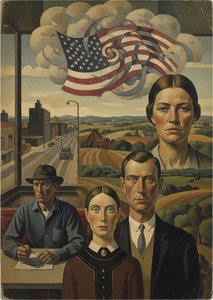
As the 1930s dawned, this tension found its resolution in a movement that sought not to dismantle convention, and instead, to reaffirm it through a distinctly American lens. The Great Depression had cast a long, somber shadow over the nation, fostering an intense yearning for stability, authenticity, and a sense of shared identity. Regionalism emerged as a vital response to this era of anxiety. It was a movement that looked inward, toward the rural and small-town landscapes of the Midwest, finding beauty in the familiar and dignity in the everyday. It was less about rejecting modernism entirely and more about filtering its energy through the lens of local experience, creating an art that felt deeply rooted in the soil of one's own home.
Grant Wood and the Midwestern Vision: Beyond the Canvas of American Gothic
 American Gothic
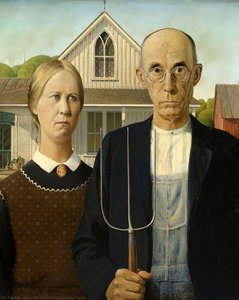
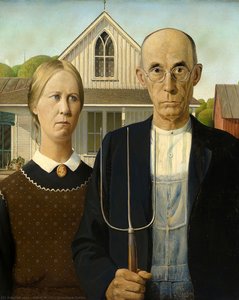
A Quintessential American Vision Grant Wood’s 1930 masterpiece, *American Gothic*, transcends its status as a painting; it is a cultural touchstone. More than just a portrait of rural life, this work encapsulates the anxieties and enduring values of ...
At the very heart of this movement stood Grant Wood, an artist whose name became inextricably linked with the spirit of the American Midwest. Born in rural Iowa, Wood possessed an intimate understanding of the rhythms of agricultural life, a connection that would later define his most celebrated works. While many recognize him through the singular lens of American Gothic, his oeuvre offers a much richer tapestry of the American soul. His work transcends mere portraiture; it is a cultural touchpiece that captures both the resilience and the subtle complexities of a generation grappling with unprecedented hardship.
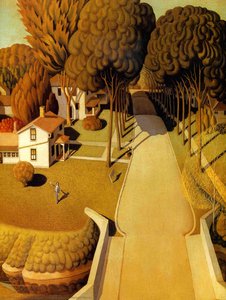
In the iconic 1930 masterpiece, American Gothic, we see more than just a farmer and his daughter standing before a Carpenter Gothic farmhouse. We see an embodiment of American identity itself. The painting utilizes a meticulous, almost photographic clarity to present a scene that is simultaneously realistic and deeply symbolic. Through the sharp lines of the pitchfork and the austere architecture of the house, Wood communicates themes of hard labor, religious faith, and moral uprightness. Yet, even in his more expansive works, such as the dreamlike The Midnight Ride of Paul Revere, Wood demonstrates an ability to blend historical reverence with a stylized, almost ethereal perspective, proving that the American scene could be both grounded in reality and elevated by myth.
Mastering the Light and Line: Flemish Influences in Regionalist Technique
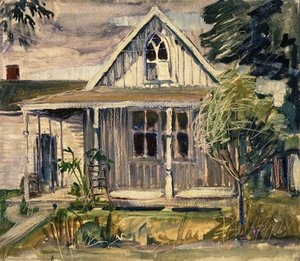
 Sketch for house in American Gothic
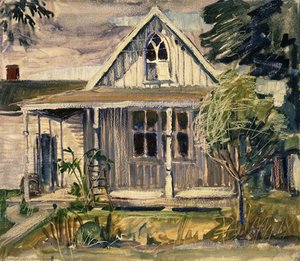
Discover the Essence of Rural America Immerse yourself in the timeless charm of rural Iowa with Grant Wood's "Sketch for House in American Gothic." This captivating study, created in 1930, is a foundational piece that led to one of America's most ico...
Though his subject matter was profoundly American, Grant Wood’s technical soul was deeply indebted to the Old Masters of Europe. He found a kindred spirit in the 15th-century Flemish master Jan van Eyck, whose precise and luminous technique offered a blueprint for capturing the world with unparalleled clarity. This influence is evident in the way Wood approached the texture of light and the meticulous rendering of surfaces. His brushwork was remarkably smooth, eschewing the visible, emotive strokes of the Impressionists in favor of a disciplined, polished finish that allowed the subject to speak with a quiet, luminous authority.
This dedication to detail gave his paintings a unique visual impact, characterized by a deliberate flattening of space and an emphasis on geometric forms. In his studies, such as the Sketch for House in American Gothic, one can observe how he used the rectangularity of architecture and the triangularity of tools to create a sense of structured permanence. By combining this European craftsmanship with Midwestern authenticity, Wood achieved a style that was both sophisticated and accessible—a way to elevate the humble landscapes of Iowa to the level of high art through the sheer power of precision and light.
The Poetics of Place: Exploring Landscape, Identity, and Local Color
American literary regionalism, often used interchangeably with the term "local color", is a style or genre of writing in the United States that gained popularity in the mid-to-late 19th century and early 20th century. In this style of writing, which ...
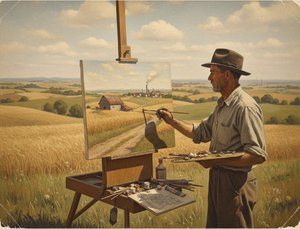
Regionalism shared a profound kinship with the literary traditions of its time, particularly the concept of "local color." Much like the writers of the late 19th century who emphasized dialect, custom, and the specificities of landscape to preserve regional identities, the Regionalist painters sought to document the unique character of their surroundings. This was an art of fidelity—a commitment to describing the world as it was felt and seen by those who inhabited it. The landscapes were not merely backdrops; they were active participants in the narrative of American life.
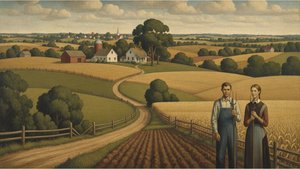
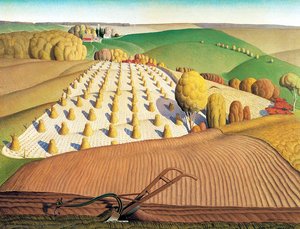
In these works, the setting becomes a vessel for memory and identity. Whether depicting the weathered charm of a small-town porch or the vast, rolling fields of the plains, the artists focused on the textures of the earth and the atmosphere of the region. There is a certain nostalgia present, a way of capturing a vanishing way of life even as it was being reshaped by industrialization. By focusing on the specific—the particular shade of a cornfield or the unique silhouette of a farmhouse—these artists created a universal language of belonging, allowing viewers to find themselves reflected in the very landscape of the American heartland.
A Lasting Legacy: The Enduring Resonance of the American Heartland
 Grant Wood
Grant DeVolson Wood (February 13, 1891 – February 12, 1942) was an American artist and representative of Regionalism, best known for his paintings depicting the rural American Midwest. He is particularly well known for American Gothic (1930), which h...
The era of high Regionalism reached its zenith between 1930 and 1935, eventually receding as the world moved into the transformative years of World War II. However, the movement's impact on the American consciousness remains indelible. It provided a much-needed sense of reassurance during one of the nation's darkest hours, offering images of strength and continuity when they were needed most. The movement did not merely document a period in history; it helped construct a visual mythology for a nation seeking to understand its own character.
Today, we continue to find profound meaning in these works. They serve as a bridge between the traditional and the modern, reminding us that art can be both deeply personal and broadly nationalistic. The legacy of Grant Wood and his contemporaries lives on in our appreciation for the dignity of the everyday and our enduring fascination with the landscapes that shape us. As we look back upon these canvases, we do not just see the past; we see a timeless celebration of resilience, identity, and the enduring beauty found within the heart of America.