

A Symphony of Light: The Dawn of Pointillism and a New Way of Seeing
 untitled (1297)
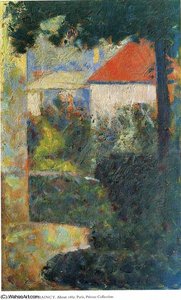
Georges Pierre Seurat’s “Untitled (1297)” – A Symphony of Light and Precision This captivating painting by Georges Pierre Seurat, tentatively titled "Untitled (1297)," offers a serene glimpse into a quiet summer scene, embodying the artist's revoluti...
In the golden twilight of the nineteenth century, a revolution was quietly unfolding in the heart of Paris. While the Impressionists had already begun to shatter the rigid constraints of academic tradition, seeking to capture the fleeting, sun-drenched moments of life, a new voice emerged—one that sought not just to observe light, but to decode it. Georges Pierre Seurat, a visionary with an almost mathematical devotion to perception, stepped onto the canvas with a purpose far more profound than mere imitation. He did not wish to simply paint a scene; he wished to compose a symphony of light, where every note was a tiny, deliberate dot of pigment, and every movement was a calculated dance of color. This era marked the birth of something transformative, moving away from the subjective "impression" toward a more structured, luminous reality.
The Science of Sight: Decoding the Magic of Optical Mixing and Color Theory
 The Science of Light: Decoding the Optical Precision of Neo-Impressionism
Beyond Spontaneity: The Transition from Impressionism to Neo-Impressionism Georges Seurat: Pointillism, Perception & the Scientific Foundations of Modern Art The Genesis of Pointillism: From Impressionism to Scientific Inquiry The late 19th century w...
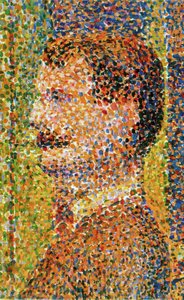
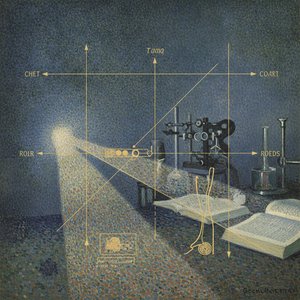
To understand Pointillism is to enter a world where art and science exist in perfect, luminous harmony. Seurat, driven by an intense intellectual rigor, looked beyond the spontaneous brushstrokes of his predecessors to explore the very mechanics of how we perceive the world. He pioneered what he called chromoluminarism, a technique predicated on the scientific study of optics. Rather than blending pigments upon a palette—a process that can sometimes dull the vibrancy of a hue—Seurat applied small, pure dabs of color directly onto the canvas.
The true magic, however, occurs not on the fabric itself, but within the eye of the viewer. Through the phenomenon of optical mixing, these adjacent dots of contrasting colors coalesce at a distance, creating a shimmering, vibrant effect that mimics the way light interacts with surfaces in nature. It is a breathtakingly complex method, requiring an almost obsessive precision to ensure that the final image achieves its intended luminosity and depth.
Masterpieces in Miniature: A Journey Through Seurat’s Luminous Landscapes
 Georges Seurat's Masterpieces: 25 Paintings That Defined Pointillism | ArtsDot
Introduction To embark on a journey through the top 25 artworks of Georges Seurat is to enter a world meticulously constructed from light, color, and an almost scientific devotion to perception. These paintings aren’t simply images; they are visual p...
When we gaze upon Seurat’s most celebrated works, such as the tranquil The Poppy Field, we are transported into a realm of dreamlike serenity. In these landscapes, the meticulous application of color creates an atmosphere that feels both grounded in reality and elevated by artifice. One might find themselves captivated by a quiet summer scene, where a modest house with a vibrant red roof is nestled amidst lush foliage, rendered not through broad strokes but through an astonishingly fine tapestry of pigment.
Each painting serves as a meditation on light; whether it is the shimmering expanse of water in a solitary boat scene or the sun-drenched pathways of a park, the artist’s dedication to detail ensures that every reflection and shadow is imbued with a sense of life. These works are not merely depictions of nature; they are carefully constructed explorations of brilliance, inviting us to step back and allow our eyes to blend the dots into a cohesive, radiant whole.
Beyond the Fleeting Moment: The Transition from Impressionist Spontaneity to Neo-Impressionist Precision
 Georges Seurat
A Pioneer of Luminous Precision: The Life and Art of Georges Seurat Georges Pierre Seurat, born in Paris on December 2, 1859, emerged as a pivotal figure in the transition from Impressionism to modern art. His brief but intensely focused career revol...
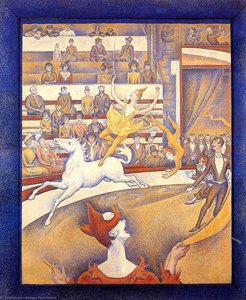
The transition from the ephemeral impressions of Monet or Renoir to the structured world of Neo-Impressionism marked a pivotal shift in the trajectory of modern art. Where the Impressionists prioritized the subjective, "blink-of-an-eye" sensations of a moment, Seurat sought a sense of permanence and structural integrity. He replaced fluidity with stability, using geometric structure and a systematic approach to color relationships to ground his subjects.
This was an era of profound change—a time of rapid industrialization and scientific advancement—and Seurat’s work reflected this evolution. His art became a bridge between the observational world of the past and the abstract explorations of the future, proving that even within a highly controlled, almost mathematical framework, one could achieve a profound emotional and aesthetic impact. He replaced the "random spontaneity" of his predecessors with a measured, intentional technique that would forever alter the direction of modern art.
The Eternal Glow: Finding Stillness and Resonance in Every Dot
Decades after his brief but intensely focused career ended, the legacy of Seurat’s luminous precision continues to resonate deeply within the hearts of art lovers. There is a profound stillness to be found in his work—a quiet grandeur that invites us to slow down, step back, and truly observe. In an age of constant motion, Pointillism offers us a moment of contemplative grace, reminding us that beauty is often found in the smallest, most deliberate details.
At ArtsDot.com, we share this enduring passion for the masters. We believe that the light captured by Seurat and his contemporaries deserves a place in our own homes, preserved through the meticulous craft of hand-painted oil reproductions. To bring such a masterpiece into your space is to invite that eternal glow into your daily life, allowing the shimmering dance of color and light to inspire wonder for generations to come.