The Genesis of Dots: Defining Pointillism and Neo-Impressionism
The history of art is often defined by moments of profound rupture, where the established rules of perception are dismantled to make way for a new way of seeing. In the late 19th century, as the fleeting, spontaneous brushstrokes of Impressionism began to saturate the Parisian art scene, a more disciplined and scientific revolution emerged: Pointillism. While the Impressionists sought to capture the ephemeral "impression" of a moment through rapid, emotive strokes, the pioneers of Neo-Impressionism—most notably Georges Seurat—sought something far more permanent and structured. They looked toward the burgeoning science of optics and color theory to create a method that was less about instinct and more about an architectural arrangement of light.
This movement, often referred to as Neo-Impressionism, was not merely a stylistic choice but a rigorous intellectual pursuit. It replaced the chaotic energy of the brush with the deliberate, rhythmic application of tiny, distinct dots of pure color. By stripping away the blended transitions of traditional painting, these artists invited the viewer's eye to become an active participant in the creation of the image. To understand Pointillism is to understand a transition from the romanticized view of nature to a structured, almost mathematical appreciation of how light interacts with the human retina. It was a movement that sought to find the eternal within the atomized, proving that even the smallest, most isolated speck of pigment could contribute to a grand, luminous whole.
The Science of Sight: Optical Mixing and Color Theory
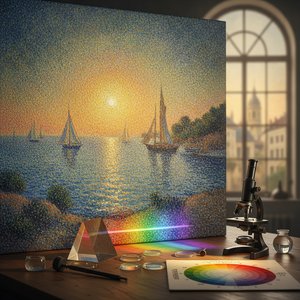
At the heart of Pointillist mastery lies a fascinating intersection between fine art and the physics of light. The movement was deeply influenced by the contemporary scientific discoveries of chemists and physicists like Michel Eugène Chevreul, whose law of "simultaneous contrast" revolutionized how artists perceived color relationships. Rather than physically mixing pigments on a palette—a process that can often lead to muddy, desaturated tones—the Pointillist artist applies separate dots of primary and secondary colors side-by-side on the canvas. This technique relies entirely on the phenomenon of optical mixing, where the human eye, when viewing the canvas from a distance, blends these discrete points into a single, vibrant hue.
This method produces a luminosity that traditional blending simply cannot replicate. When a dot of pure yellow is placed adjacent to a dot of pure blue, the viewer’s brain perceives a much more brilliant and "shimmering" green than if those two colors had been pre-mixed on a wooden board. This creates a sense of vibration, a visual pulse that mimics the way light actually dances across surfaces in the natural world. The artist becomes a conductor of light, orchestrating a symphony of color where each note is a singular dot, yet together they form a breathtakingly coherent landscape. It is a sophisticated dance of perception, requiring both the precision of a scientist and the soul of a poet to execute successfully.
Georges Seurat: The Visionary Architect of Light
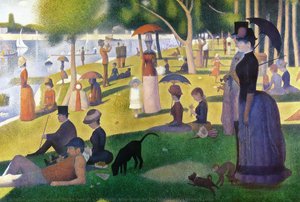
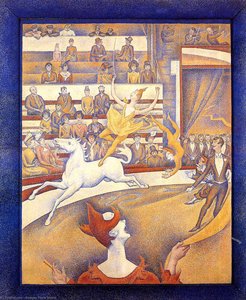
No discussion of this luminous era is complete without honoring the central figure who orchestrated this revolution: Georges Seurat. A man of immense discipline and intellectual rigor, Seurat did not view the canvas as a place for spontaneous emotion, but as a laboratory for light. His approach was almost architectural; he approached composition with the precision of an engineer, carefully calculating the placement of every figure and every shadow to achieve a sense of monumental stability. Through his work, the ephemeral subjects of modern Parisian life were elevated to the status of classical friez enough, imbued with a timeless, geometric permanence.
Seurat’s genius lay in his ability to marry the scientific with the sublime. While his technique was rooted in the cold logic of color theory, the results were profoundly emotive. He possessed an uncanny ability to capture the atmosphere of the Belle Époque—the sunlight filtering through trees, the stillness of a riverbank, and the quiet dignity of the working class. His life, though tragically short, left behind a blueprint for how art could evolve alongside science. He proved that by breaking the world down into its smallest components, an artist could actually reconstruct it with greater clarity, depth, and brilliance than ever before.
Masterpieces in Motion: Analyzing Iconic Pointillist Works
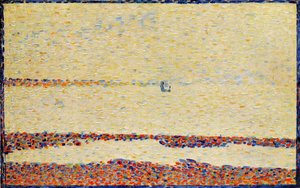
To truly grasp the magic of this technique, one must stand before the great canvases that define the era. Consider, for instance, the breathtaking La Seine à Courbevoie, where Seurat utilizes geometric forms and luminous color to transform a simple landscape into a structured vision of nature. In such works, the water is not merely painted; it is constructed from a mosaic of blues, greens, and reflected light, creating a surface that seems to ripple with life even in its stillness. Similarly, in The Poppy Field, 1884, we see the mastery of color temperature, where the warmth of the sun-drenched flora contrasts against the cool shadows, all achieved through the meticulous placement of individual pigment points.
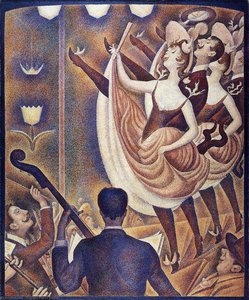
Even in more intimate subjects, such as The Rope-Colored Skirt, the Pointillist technique breathes a unique vitality into the fabric and form. The way light hits the folds of the garment is not rendered through smooth gradients, but through a complex interplay of contrasting dots that simulate the texture and sheen of the material. These masterpieces are not static images; they are dynamic experiences. As the viewer moves closer, the image dissolves into an abstract sea of color; as they step back, the dots coalesce into a vivid, breathing reality. This tension between the microscopic detail and the macroscopic vision is what makes these works eternally captivating.
The Legacy of the Dot: From Canvas to Modern Digital Aesthetics
The ripples of the Pointillist revolution extend far beyond the late 19th century, influencing countless movements that followed, from the Divisionism of Signac to the much more expressive brushwork of the Neo-Impressionists. The fundamental idea—that an image is a collection of discrete parts working toward a unified whole—is a concept that resonates deeply in our modern, digital age. Today, we live in a world of pixels, where every high-definition screen and digital photograph is essentially a contemporary form of Pointillism. Our very perception of the digital landscape is built upon the arrangement of tiny, colored light sources that our eyes blend into seamless imagery.
Furthermore, the spirit of this movement lives on in the way we appreciate art today through reproduction and preservation. At ArtsDot.com, we celebrate this enduring legacy by bringing these historical masterpieces into modern homes. Whether it is a meticulously hand-painted oil reproduction that captures the tactile, impasto texture of a Seurat, or a high-fidelity Giclée print that preserves the scientific brilliance of his color theory, our mission is to ensure that the magic of the dot continues to inspire. We provide a bridge between the masters of the past and the collectors of the present, ensuring that the luminous light of Pointillism remains a vibrant part of our global cultural tapestry.