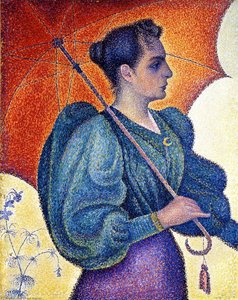
The Optical Revolution: Beyond Impressionism's Fleeting Moments
To understand the profound shift brought about by Neo-Impressionism, one must first contemplate the ephemeral nature of the Impressionist movement that preceded it. While the masters of Impressionism—Monet, Renoir, and Pissarro—captured the transient essence of light with spontaneous, broken brushstrokes, they remained tethered to a certain subjectivity, an emotional response to a passing moment. However, as the late nineteenth century approached, a new intellectual rigor began to permeate the Parisian avant-garde. A group of visionaries sought to move beyond the mere perception of light toward a systematic understanding of its very essence.
This was not merely an aesthetic evolution but a scientific rebellion. Where the Impressionists relied on intuition and the rapid application of paint to catch the sun before it dipped below the horizon, the pioneers of Pointillism sought to freeze that light within a structured, mathematical framework. They looked toward the burgeoning sciences of optics and color theory, desiring to replace the spontaneous gesture with a calculated precision. This transition marked the birth of Neo-Impressionism, a movement where the artist functioned not just as a poet of the landscape, but as an architect of luminosity, rebuilding the world one meticulous dot at a time.
The Chromatic Formula: The Physics of Color Theory and Optical Mixing
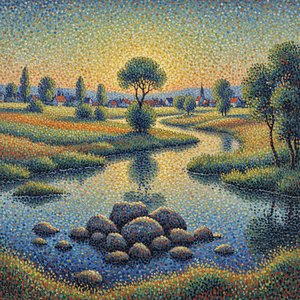
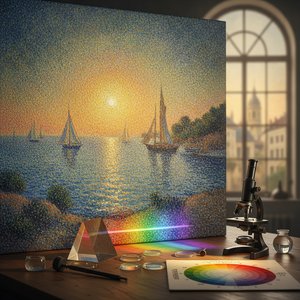
At the heart of this revolution lay a fascination with the physics of light. The artists of this era were deeply influenced by the contemporary scientific treatises of Michel Eugène Chevreul, whose law of simultaneous contrast revolutionized how we perceive adjacent hues. They understood that color is not a static property but a dynamic interaction. Instead of physically blending pigments on a palette—a process that often results in a loss of brilliance and a muddied tonal range—they pioneered the technique of optical mixing. By placing small, unblulended dots of pure, complementary colors side by side, they allowed the viewer's eye to perform the labor of synthesis.
This method creates a phenomenon known as divisionism, where the light appears to vibrate with an internal energy that traditional blending cannot replicate. When a dot of pure cadmium yellow is placed adjacent to a speck of ultramarine, the human retina perceives a luminous green that possesses a depth and radiance far superior to pre-mixed pigment. This was the science of light made manifest on canvas; it was an attempt to recreate the very way photons interact with the eye. The canvas became a laboratory of chromatic tension, where the interplay of warm and cool tones orchestrated a symphony of perceived brilliance, transforming a flat surface into a shimmering, breathing atmosphere.
Georges Seurat: The Architect of Precision and Structure
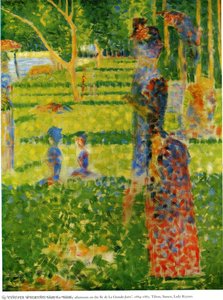
If Pointillism had a founding father, it was undoubtedly Georges Seurat. His approach was characterized by an almost monastic devotion to order and permanence. Seurat viewed the world through a lens of geometric stability, seeking to imblam the fleeting beauty of nature with the eternal dignity of classical composition. His magnum opus, A Sunday Afternoon on the Island of La Grande Jatte, serves as the definitive manifesto of this structured vision. In this monumental work, figures are rendered with a sculptural weight, their outlines defined not by heavy lines but by the rhythmic accumulation of light-drenched points.
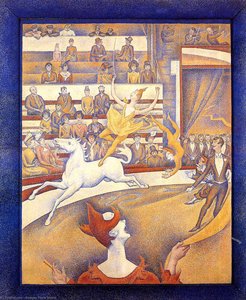
Seurat’s technique was far from accidental; it was an arduous, disciplined process of construction. In works such as The Channel at Gravelines and Artist at Work, one observes a profound sense of stillness and monumentalism. He utilized the dot to build form, using darker, denser clusters of pigment to create shadow and lighter, more dispersed applications to suggest sunlit surfaces. This meticulousness gave his subjects a timeless, almost hieratic quality, elevating everyday Parisian leisure to the status of ancient friezes. Through Seurat, the ephemeral became eternal, and the chaotic light of the outdoors was captured within a rigorous, mathematical architecture.
Paul Signac: Expanding the Vibrancy of the Neo-Impressionist Vision
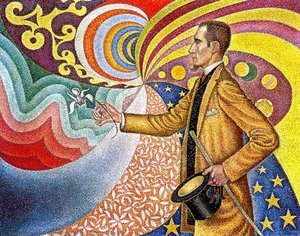
While Seurat provided the structural foundation, Paul Signac brought an unparalleled sense of coloristic exuberance to the movement. If Seurat was the architect, Signac was the colorist, pushing the boundaries of the Pointillist technique toward a more mosaic-like and vibrant expression. His works often feature larger, more distinct strokes of color, which transitioned the movement from the fine, almost microscopic dots of Seutrat toward a more rhythmic and decorative application. This evolution allowed for an even greater emphasis on the emotional impact of pure hue.
Signac’s landscapes, such as his evocative depictions in Comblat and the valley of the Cere, showcase a mastery of coastal light and Mediterranean brilliance. His palette was often bolder, utilizing the contrast between saturated blues and fiery oranges to evoke the intense heat of the French countryside. Signac understood that by enlarging the "dots" into more mosaic-like tesserae, he could direct the viewer's eye through the composition with greater fluidity. His influence ensured that Neo-Impressionism remained a living, breathing movement, capable of expressing both scientific precision and profound atmospheric joy.
The Legacy of the Dot: From Pointillism to Modern Abstraction
The ripples caused by the Pointillist revolution extended far beyond the late nineteenth century, fundamentally altering the trajectory of modern art. By deconstructing the image into its most basic constituent parts—the dot and the color—Seurat and Signac paved the way for the abstraction that would define the twentieth century. The realization that a painting could be composed of autonomous marks, rather than just representational forms, laid the groundwork for everything from the Divisionist experiments of the Fauves to the rhythmic textures of the Abstract Expressionists.
Furthermore, the movement’s emphasis on the autonomy of color and the physical properties of paint challenged the very definition of "reality" in art. It taught subsequent generations that the artist's role is not merely to mirror the world, but to reconstruct it through a unique, personal logic. The legacy of the dot lives on in our modern digital age, where pixels—the contemporary descendants of Seurat’s points—form the very fabric of our visual reality. The scientific rigor of the Neo-Impressionists remains a testament to the idea that art and science are not opposing forces, but two different languages describing the same magnificent light.
Bringing the Masterpieces Home: Preserving the Luminosity of Light
For the discerning collector, the allure of Pointillism lies in its ability to transform a space with its inherent luminosity. A hand-painted reproduction of a Neo-Impressionist masterpiece offers more than mere decoration; it provides a window into a period of unparalleled intellectual and aesthetic discovery. At ArtsDot.com, we honor this legacy by providing museum-quality, hand-painted oil reproductions that capture the true essence of these works—the visible brushstrokes, the depth of tone, and the vibrant optical mixing that defines the style.
Our master artists, trained in the finest academies, meticulously recreate the texture and light of Seurat and Signac on premium cotton canvas. Whether you seek a large-scale centerpiece to anchor a grand hall or a delicate multi-panel set for a contemporary staircase, our commitment to authenticity ensures that the scientific brilliance of the original movement is preserved in every dot. We invite you to explore our vast collection and experience the transformative power of light in your own home, backed by our 100% satisfaction guarantee and a heritage of excellence spanning decades.