The Genesis of Pointillism: From Impressionism to Scientific Inquiry
The late 19th century was a period of profound upheaval, not just in the socio-political landscape but also within the artistic realm. The established norms of academic painting were being challenged by a new generation seeking to capture the fleeting moments of modern life. Impressionism, with its emphasis on light and color, had already begun to dismantle traditional techniques, yet for artists like Georges Seurat, it wasn’t enough. He perceived a lack of underlying structure, a certain arbitrariness in the application of paint that he believed could be refined through rigorous scientific study. This dissatisfaction didn't stem from a rejection of Impressionism’s goals—rather, it was a desire to elevate them, to ground the subjective experience of light and color within an objective framework. Seurat wasn’t simply interested in *seeing* how light affected objects; he wanted to understand *why* it did, and to translate that understanding into a new visual language.
His early training provided him with a solid foundation in traditional techniques, but his independent study of color theory – particularly the works of Michel Eugène Chevreul on simultaneous contrast and Ogden Rood’s exploration of optics – proved pivotal. These scientists demonstrated how colors interact with one another, how the eye blends pigments optically rather than physically on the palette. This revelation sparked a radical idea: what if paintings weren't about mixing colors *before* applying them to the canvas, but about meticulously placing individual dots of pure color that would blend in the viewer’s perception? This wasn’t merely an aesthetic choice; it was a deliberate attempt to harness the power of human vision itself.
Decoding Chromoluminarism: Seurat’s Theory of Optical Mixing
Seurat termed his technique “chromoluminarism,” a name that underscores its scientific underpinnings. It wasn't simply about applying dots; it was about understanding the precise relationships between those dots to achieve maximum luminosity and harmony. He believed that by separating colors into their purest forms and juxtaposing them strategically, he could create a more vibrant and intense visual experience than traditional mixing methods allowed. The key lay in avoiding muddy tones – the result of combining pigments on the palette – and instead relying on the eye’s natural ability to synthesize color.
This process demanded an extraordinary level of control and calculation. Seurat wasn't painting intuitively; he was meticulously planning each composition, considering not only the local color of objects but also the effects of light, shadow, and atmospheric perspective. He developed a complex system for dividing colors based on their wavelengths and intensities, aiming to create a balanced and harmonious whole. His palette consisted primarily of pure pigments – chrome yellows, cobalt blues, cadmium oranges – colors that hadn’t been widely available before the 19th century, further enhancing his ability to achieve vibrant results. The technique wasn't about speed or spontaneity; it was a slow, deliberate process akin to scientific experimentation.
A Sunday Afternoon on the Island of La Grande Jatte: A Masterpiece of Divisionism
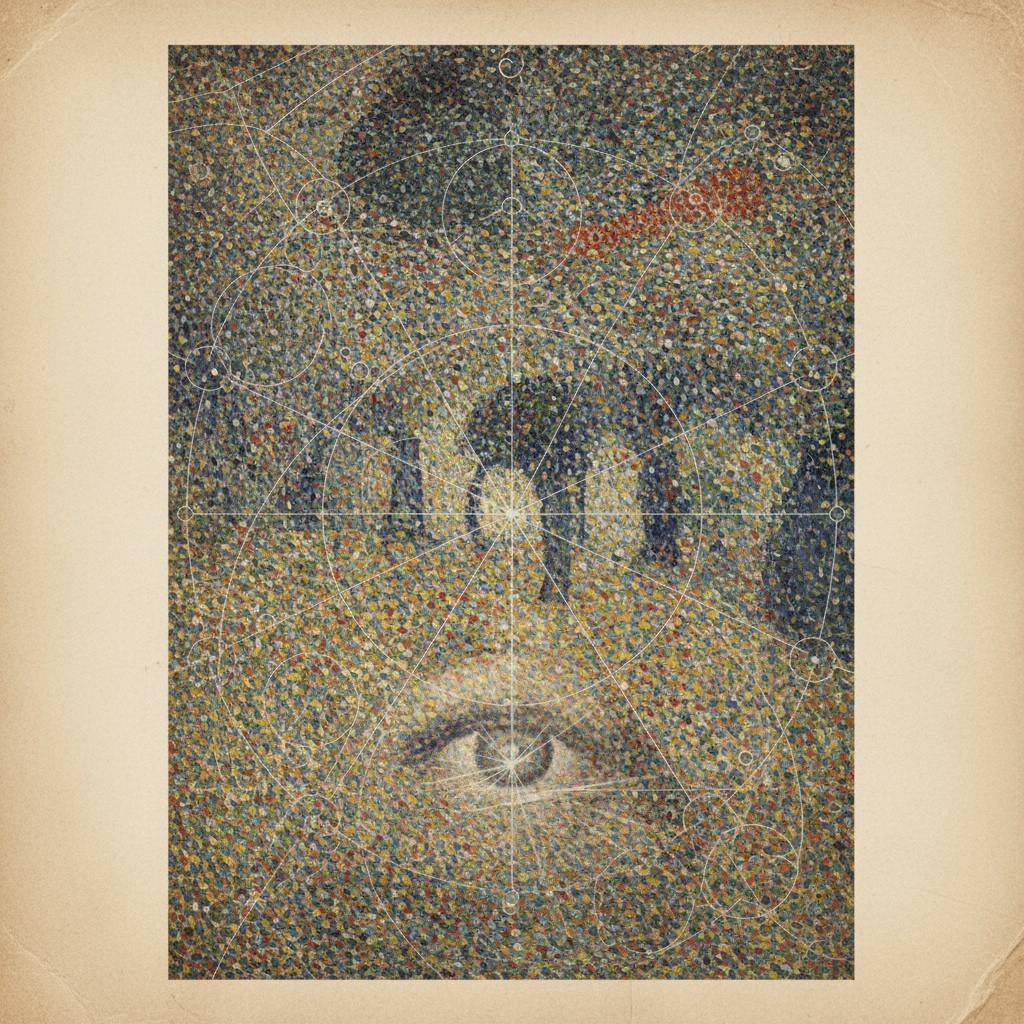
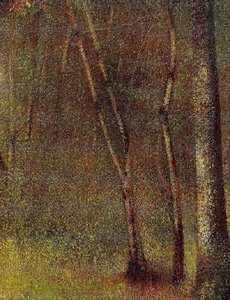 In the Woods at Pontaubert
Explore Seurat's 'In the Woods at Pontaubert,' a captivating Post-Impressionist painting showcasing his pointillism technique and atmospheric woodland scene, now at the Metropolitan Museum of Art.
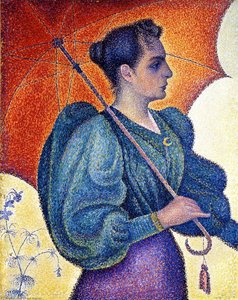
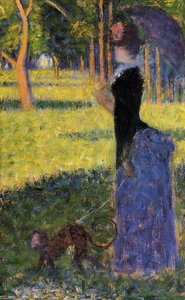
A Sunday Afternoon on the Island of La Grande Jatte (1884-1886) stands as the quintessential example of Seurat’s chromoluminarist technique, and arguably the defining work of Neo-Impressionism. The painting depicts a leisurely scene along the Seine River, populated by Parisians enjoying a sunny afternoon. However, it's not the subject matter that makes this work so revolutionary; it’s *how* it’s painted. The entire canvas is composed of thousands of tiny dots – yellows, oranges, blues, greens – meticulously applied in patterns to form an image.
Upon close inspection, the painting appears almost abstract, a chaotic field of color. But step back, and the figures begin to emerge, bathed in shimmering light. The eye blends the individual dots, creating a sense of vibrancy and luminosity that is unlike anything seen before. Seurat’s deliberate use of complementary colors – placing blue next to orange, red next to green – intensifies their visual impact, creating a dynamic interplay of light and shadow. The painting isn't just a representation of a scene; it’s an exploration of perception itself, a testament to the power of the human eye.
Beyond the Dots: The Influence of Color Theory and Perception
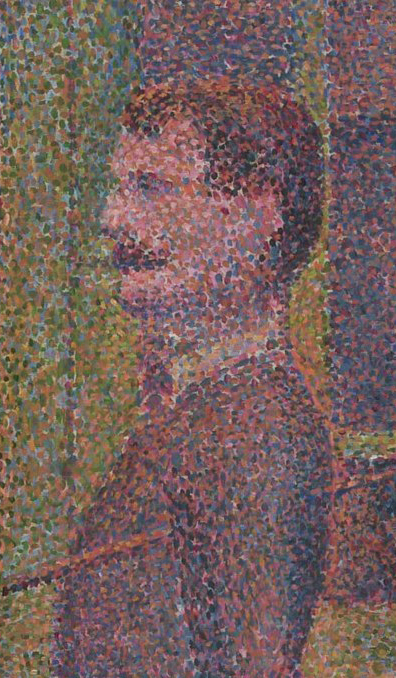 Wikipedia: Pointillism
Pointillism (, also US: ) is a technique of painting in which small, distinct dots of color are applied in patterns to form an image. Georges Seurat and Paul Signac developed the technique in 1886, branching from Impressionism. The term "Pointillism...
Seurat’s work wasn’t simply about aesthetics; it was deeply rooted in scientific principles. He understood that color isn't inherent in objects but is rather a product of how light interacts with them and how our brains interpret those interactions. His meticulous application of dots aimed to exploit this phenomenon, creating an optical mixture that was more vibrant and intense than traditional painting methods. This approach challenged the conventional understanding of color as a physical property and instead emphasized its subjective nature.
Furthermore, Seurat’s work anticipated later developments in psychology and visual perception. His exploration of simultaneous contrast and afterimages foreshadowed Gestalt principles of organization, which demonstrate how the brain actively constructs meaning from fragmented information. He wasn't just a painter; he was a pioneer in the field of visual science, using his art as a laboratory to test and refine his theories.
The Neo-Impressionist Circle: Signac, Luce, and the Expansion of the Technique
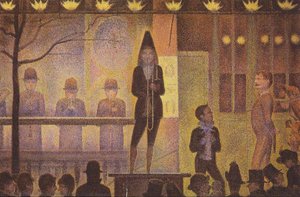
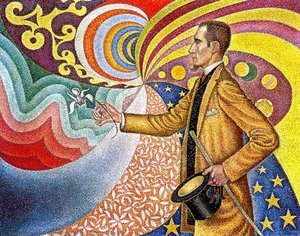
While Seurat is often credited with founding Pointillism, he wasn’t alone in pursuing this innovative technique. Paul Signac became a close collaborator and ardent advocate for chromoluminarism, further developing its theoretical foundations and promoting it through his own paintings and writings. Signac rejected the label “Pointillist,” preferring “divisionism” to emphasize the systematic separation of colors. He believed that Neo-Impressionism wasn’t about simply dotting paint onto a canvas but about carefully dividing tones to achieve luminosity and harmony.
Other artists, such as Maximilien Luce, also embraced divisionism, expanding its application beyond landscapes and portraits. Luce focused on urban scenes, capturing the dynamism of modern life with his vibrant brushstrokes. These artists formed a cohesive circle, sharing ideas and techniques, and collectively pushing the boundaries of painting. They organized exhibitions to showcase their work, challenging the established art world and paving the way for new artistic movements.
Legacy and Lasting Impact: Pointillism’s Contribution to Modern Art
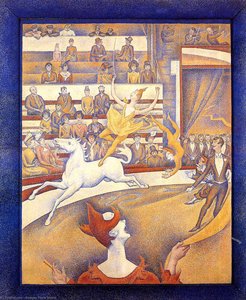
Georges Seurat's tragically short life – he died at the age of 31 – belies his profound impact on modern art. Although Pointillism didn’t achieve widespread popularity during his lifetime, it laid the groundwork for many subsequent artistic developments. His emphasis on scientific principles and optical mixing influenced Fauvism, Cubism, and even Abstract Expressionism.
More importantly, Seurat challenged the very notion of representation in art. He demonstrated that painting wasn’t simply about depicting reality but about exploring the subjective experience of perception itself. His meticulous technique demanded a new level of engagement from the viewer, forcing them to actively participate in the creation of meaning. Today, A Sunday Afternoon on the Island of La Grande Jatte remains an iconic masterpiece, a testament to the power of scientific inquiry and artistic innovation. Explore the world of Seurat and his contemporaries at ArtsDot.com, where museum-quality reproductions bring these revolutionary works to life.