

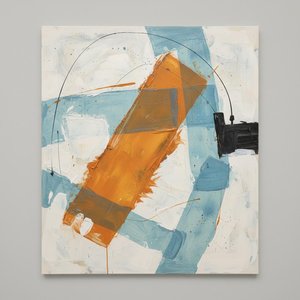


The Genesis of Motion: Deconstructing the Cubo-Futurist Synthesis
To understand the profound impact of Cubo-Futurism, one must first appreciate the seismic shifts occurring in the early 20th century, a period where the stability of the old world was dissolving into the frantic energy of the new. This movement was not merely an aesthetic choice but a philosophical response to a world suddenly accelerated by electricity, the automobile, and the relentless pulse of industrialization. While Cubism, pioneered by masters like Picasso and Braque, sought to dismantle the singular perspective in favor of a multi-faceted, static analysis of form, Futurism arrived with a different hunger. The Futurists craved the blur of speed, the roar of engines, and the visceral sensation of movement itself.
The synthesis of these two seemingly disparate ideologies birthed Cubo-Futurism—a sophisticated visual language that married the structural rigor of geometric fragmentation with the rhythmic vitality of motion. It was a delicate dance between the fixed and the fluid. By adopting the Cubist technique of breaking objects into overlapping planes, artists were able to represent not just what an object looked like from various angles, but how it occupied space through time. This intersection created a revolutionary way of seeing, where the canvas ceased to be a window onto a still scene and instead became a dynamic arena of temporal experience.
Geometric Architecture: The Structural Language of Fragmentation
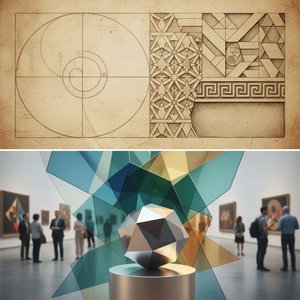
At the heart of this movement lies a profound architectural sensibility. Every composition serves as a blueprint of energy, utilizing sharp angles, intersecting lines, and interlocking polygons to construct a sense of depth without relying on traditional chiaroscuro. This geometric precision provides the necessary scaffolding for the chaos of motion; without the disciplined structure of the plane, the sensation of speed would dissolve into mere abstraction. The viewer’s eye is invited to navigate a labyrinth of shapes, where each edge and vertex acts as a directional vector, guiding the gaze through a complex, multi-dimensional landscape.
This structural approach demands an intellectual engagement from the collector. One does not simply observe a Cubo-Futurist work; one decodes it. The fragmentation of the subject—be it a cityscape, a figure, or a machine—allows for a simultaneous presentation of multiple moments in time. This technique creates a sense of architectural permanence even within a depiction of fleeting movement. It is this very tension between the immutable geometry and the ephemeral subject matter that gives these works their enduring, sophisticated allure, making them much more than mere decorations, but rather profound meditations on the nature of reality.
Kinetic Aesthetics: Capturing Speed and the Machine Age
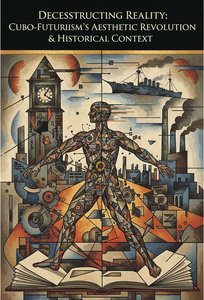
The true soul of Cubo-Futurism resides in its kinetic energy. The movement was deeply enamored with the "beauty of speed," a concept that celebrated the aggressive, rhythmic vibrations of the modern machine age. Artists utilized repetitive lines, radiating patterns, and overlapping translucent layers to simulate the visual phenomenon of motion blur. In these works, a locomotive or a cyclist is not a static entity but a series of energetic traces left upon the retina. The brushwork often becomes more urgent and directional, echoing the very velocity it seeks to portray.
This fascination with the machine was not merely superficial; it was an attempt to capture the new heartbeat of humanity. The rhythmic repetition of shapes evokes the mechanical precision of a piston or the spinning of a wheel, creating a visual pulse that resonates with the viewer. For the discerning collector, these pieces offer a window into a period of unprecedented optimism and terror, where the boundaries between man and machine were beginning to blur. To possess such a work is to hold a fragment of that transformative era, captured in a state of perpetual, breathless motion.
The Italian Legacy: From Abstract Geometry to Modern Dynamism
While the roots of Cubism are firmly planted in France, the spirit of Cubo-Futurism found its most vibrant and aggressive expression within the Italian avant-garde. Artists such as Manlio Rho and Gianni Monnet carried forward this legacy, blending the geometric abstractions of the early century with a uniquely Mediterranean warmth and architectural boldness. The influence of this era can be seen in the way later abstract artists utilized bold colors and heavy, structural forms to evoke movement, much like the dynamic compositions found in the works of Marino Guandalini.
The Italian contribution was vital in evolving geometric abstraction from a purely formal exercise into an emotive experience. By integrating architectural influences—seen in the way Monnet’s work echoes the monumentalism of Naples' Duomo—the movement bridged the gap between the cerebral and the visceral. This lineage of art, characterized by its ability to use shape as a vessel for emotion, continues to influence contemporary abstraction today. It reminds us that geometry, far from being cold or clinical, can be the most potent tool for expressing the warmth, light, and life of the human experience.
Curating the Avant-Garde: Integrating Cubo-Futurism into Contemporary Collections
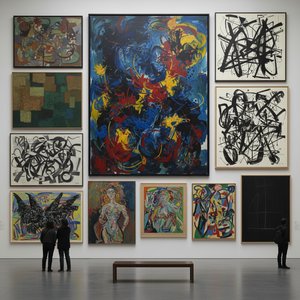
Integrating works of such high intellectual and visual intensity into a modern collection requires a sophisticated eye for balance. Because Cubo-Futurist pieces are inherently "loud" in their energy and structural complexity, they serve best as focal points within a curated space. In a minimalist contemporary interior, the sharp angles and fragmented planes can provide a necessary counterpoint to clean, static lines, injecting much-needed vitality into the room. Conversely, in more traditional settings, these works act as bold, modern interventions that bridge the gap between historical grandeur and contemporary relevance.
When selecting pieces for a collection, one should consider the interplay of color and texture. The ability to find works that utilize a specific palette—perhaps the warm, earthy tones found in the studies of Carla Badiali or the bold, primary contrasts of later abstract movements—allows a collector to create a cohesive narrative across their walls. Whether through the acquisition of original historical fragments or the commissioning of high-quality, textured oil reproductions that capture the tactile impasto of the era, the goal is to preserve the living quality of the movement. Ultimately, curating Cubo-Futurism is about more than collecting shapes; it is about curating the very essence of motion and the enduring power of human innovation.
For those seeking to bring the profound energy of these historical movements into their private residences or professional spaces, ArtsDot.com offers an unparalleled gateway. From meticulously handcrafted oil reproductions that replicate the tactile depth of the masters to bespoke commissions that allow you to reimagine personal imagery through a Cubist lens, we specialize in preserving the soul of art history for the modern connoisseur.