The Sacred Canvas: Understanding the Spiritual Intent of Late Medieval Art
To gaze upon a Late Medieval masterpiece is to step through a portal into a world where the boundary between the earthly and the divine was intentionally blurred. During this transformative era, art was rarely conceived as mere decoration; rather, it served as a profound theological instrument designed to facilitate communion with the heavens. The canvas—or more frequently, the wooden panel—was treated as a sacred space where the liturgy of the Church found its visual echo. Every brushstroke was an act of devotion, and every composition was structured to guide the viewer’s soul from the material realm toward spiritual contemplation. The intent behind these works was deeply pedagogical. In an age where literacy was a privilege of the few, the visual arts functioned as the Biblia Pauperum, or the Bible of the Poor. Through the depiction of saints, martyrs, and biblical narratives, artists provided a window into the divine mysteries. This period saw a shift from the rigid, stylized abstractions of the early Middle Ages toward a more emotive and accessible form of storytelling. The goal was to evoke pietas—a deep, heartfelt piety—allowing the faithful to feel the weight of Christ's suffering or the serene grace of the Virgin Mary through the very textures of the paint itself.Symbolism and Subtext: Decoding the Hidden Language of Gothic Imagery
Beneath the surface beauty of Gothic paintings lies a complex, sophisticated language of symbols that requires an attentive eye to decode. To the medieval mind, nothing in the natural world was accidental; every flower, bird, and color carried a weight of theological significance. A single lily, for instance, was not merely a botanical specimen but a potent emblem of the Virgin Mary’s purity, while a pomegranate, with its many seeds bursting from a single rind, often symbolized the unity of the Church or the resurrection of Christ. This intricate semiotics extended to the very placement of figures within a composition. The use of hierarchical scaling—where the most spiritually significant figures are rendered larger than their attendants—reminded the viewer of the cosmic order. Even the subtle presence of certain animals, such as the lamb representing sacrifice or the peacock signifying immortality, acted as silent sermons. Understanding this subtext transforms the viewing experience from a passive observation of beauty into an active intellectual and spiritual engagement, as the observer learns to read the hidden whispers of the divine embedded within the pigment.Mastery of Light and Texture: The Evolution of Realism in Religious Panels
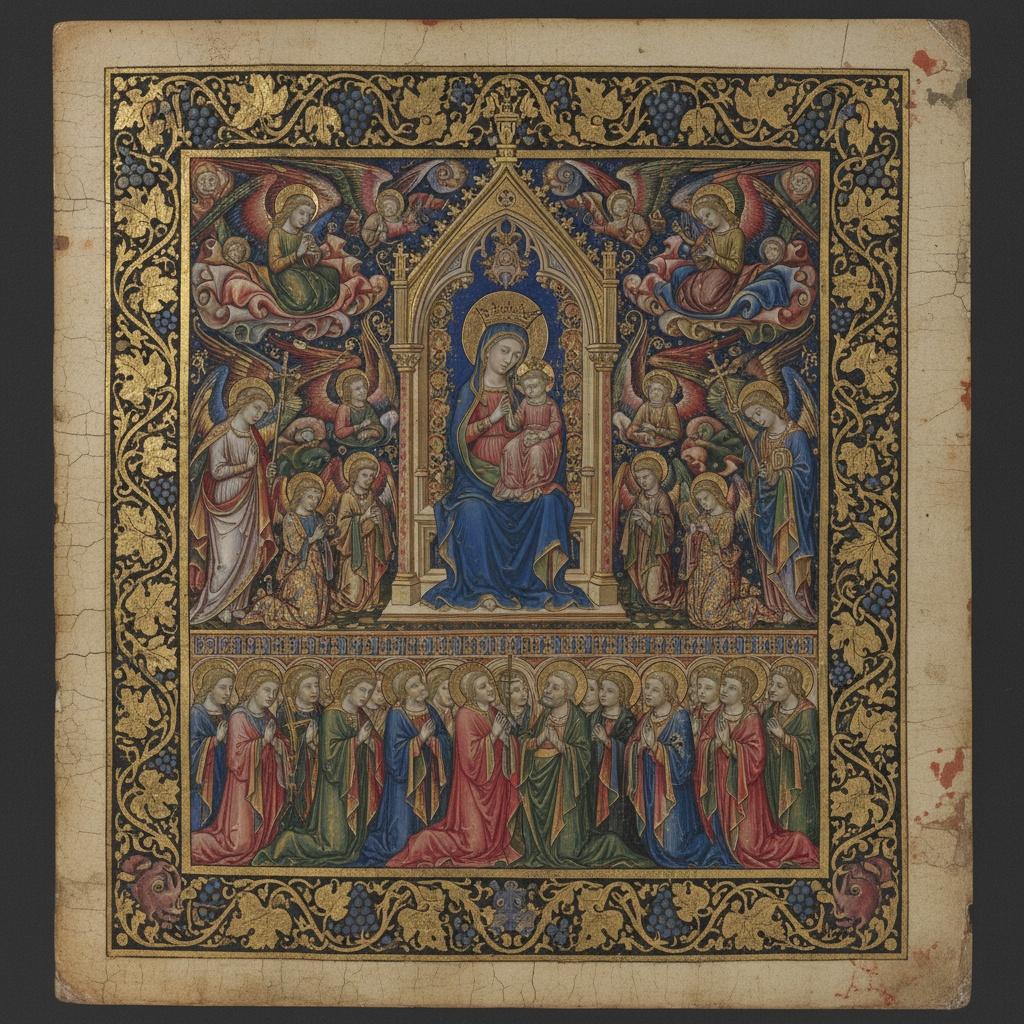
As the Late Gothic period progressed, a remarkable technical evolution began to take shape, characterized by an increasing fascination with the physical world. Artists began to move away from flat, gold-leafed backgrounds toward more atmospheric settings that suggested depth and volume. This era witnessed the birth of a new realism, where the play of light on fabric, the translucency of skin, and the tactile quality of precious stones were rendered with unprecedented precision. The mastery of light became a metaphor for divine presence; light was no longer just an illumination of the scene but a manifestation of God’s grace permeating the material world. This pursuit of realism was achieved through meticulous layering techniques that gave the paintings a "living" quality. The introduction of more sophisticated oil glazes allowed artists to capture the subtle gradations of shadow and the luminous glow of candlelight. When we examine works such as those by the Master of the Aix-en-Chapelle Altarpiece, we see an exquisite attention to detail where the intricate Gothic ornamentation feels almost tangible. This burgeoning naturalism did not diminish the spiritual focus; instead, it grounded the divine in a reality that the viewer could recognize and relate to, making the miraculous feel intimately present.The Altar as Narrative: Exploring Retables and Devotional Altarpieces
Perhaps no medium captures the grandeur of this era more effectively than the altarpiece or retable. These monumental structures were the focal points of liturgical life, designed to unfold like a sacred drama before the eyes of the congregation. Whether in the form of a single large panel or a complex polyptych consisting of multiple hinged wings, these works were engineered for narrative impact. During feast days, the opening of these wings would reveal hidden layers of splendor, much like a theatrical revelation, transitioning from somber scenes of penance to the radiant glory of the saints. A magnificent example of this narrative power can be found in the Retaule De Pere Serra at the Monestir De Sant Cugat, which showcases the Virgin and Christ Child with a profound sense of majesty. These altarpieces functioned as much more than backdrops for the Mass; they were architectural extensions of the sanctuary itself. Through the use of complex compositions, artists could guide the eye through a chronological or hierarchical journey, leading the faithful from the historical events of the Gospels to the eternal truths of the afterlife. The altarpiece was, in essence, a frozen moment of liturgy, capturing the intersection of time and eternity.From Gold Leaf to Naturalism: Technical Innovations of the Late Gothic Era
The transition from the high medieval period to the late Gothic era was marked by significant technical breakthroughs that redefined the boundaries of what could be achieved on a panel. The early reliance on heavy gold leaf, which created a flattened, otherworldly space, began to give way to more complex landscapes and architectural settings. This shift allowed for a greater sense of realism and symbolic depth, as seen in the works of artists like Lukas Moser, whose Meerfahrt Der Heiligen demonstrates a pioneering use of landscape to enhance religious narrative. The refinement of tempera and the increasing use of oil mediums allowed for a much finer level of detail—what we might call "divine details." Artists could now render the delicate veins in a leaf or the intricate embroidery on a liturgical robe with microscopic accuracy. This era also saw the rise of specialized workshops where masters trained apprentices in the rigorous chemistry of pigments and the preparation of supports. These innovations ensured that the artworks were not only visually stunning but also structurally resilient, allowing the spiritual messages they carried to endure through centuries of devotion. As we look back on this period, we celebrate a time when technical brilliance and profound faith converged to create some of the most enduring legacies in human history.About ArtsDot.com
ArtsDot.com is a global leader in art reproduction, dedicated to making the beauty of the Old Masters accessible to collectors worldwide. From exquisite hand-painted oil reproductions that capture every tactile brushstroke to museum-quality Giclée prints, we specialize in preserving human creativity. Whether you are seeking a custom portrait or an expert consultation to find the perfect piece for your home, our academy-trained artists and professional curators ensure that every masterpiece meets the highest standards of historical accuracy and artistic excellence.