The Golden Age of Sail: An Introduction to 19th-Century Maritime Romanticism
To gaze upon a nineteenth-century marine painting is to embark on a voyage through an era defined by exploration, conquest, and the sublime power of the natural world. This period, often referred to as the Golden Age of Sail, provided the perfect stage for the Romantic movement, where artists sought to capture not merely the physical reality of the ocean, but the profound emotional response it evokes within the human soul. The sea, in the eyes of the nineteenth-century master, was a dual entity: at once a serene cradle of commerce and a terrifying, untamable force of chaos.
During this epoch, the expansion of global trade routes and the height of naval supremacy transformed the maritime landscape into a theater of high drama. Artists were captivated by the silhouette of a billowing sail against a setting sun or the skeletal remains of a shipwreck tossed by relentless waves. This was an age where the boundaries between man and nature were tested daily upon the salt spray, and the canvas became the medium through which these existential struggles were immortalized. Through the lens of Romanticism, every cresting wave and every gust of wind carried a symbolic weight, representing the eternal struggle between human ambition and the infinite mysteries of the deep.
Masters of the Tides: Analyzing the Technique and Realism of Marine Luminaries
The true brilliance of nineteenth-century maritime art lies in the meticulous technical prowess of its practitioners. These artists were not merely illustrators; they were scholars of light, water, and atmosphere. To achieve a sense of historical realism, painters had to master the complex physics of translucency—how sunlight penetrates a breaking wave or how mist softens the distant horizon. The use of glazing techniques allowed for a luminous depth, creating an illusion of liquid movement that seems to pulse beneath the surface of the oil paint.
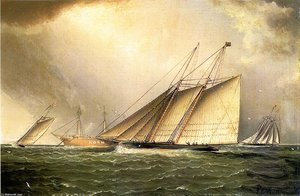
Consider the works of masters such as John Wilson Carmichael, whose piece The Ship Isabella At Sea exemplifies the Victorian dedication to maritime realism. In such works, one observes a profound attention to detail, from the tension in the rigging to the specific texture of the churning foam. Similarly, the delicate grisaille approach seen in James Edward Buttersworth’s The Irene demonstrates how tonal mastery can evoke a sense of historical gravity without the need for vibrant color. The ability to manipulate light and shadow—the chiaroscuro of the sea—allowed these artists to guide the viewer's eye through the composition, ensuring that the structural integrity of the vessel remained as commanding as the atmosphere surrounding it.
Drama on the High Seas: Capturing Tempestuous Weather and Naval Grandeur
There is perhaps no greater subject in art history than the maritime tempest. For the nineteenth-century painter, a storm was an opportunity to explore the sublime—that specific aesthetic quality that blends awe with a sense of overwhelming danger. The canvas would erupt with heavy impasto, thick applications of paint used to sculpt the violent energy of whitecaps and the dark, brooding weight of storm clouds. In these compositions, the ship often serves as a symbol of human resilience, a fragile wooden sanctuary navigating a world of liquid fury.
<Beyond the chaos of the storm, there existed a profound fascination with naval grandeur and the disciplined beauty of war fleets. Artists like Frederick J. Tudgay specialized in capturing the intricate details of Blackwall frigates and the structured life of naval maneuvers. These paintings offered a sense of order and national pride, documenting the architectural majesty of the great sailing vessels that defined the era's geopolitical power. Whether depicting the terrifying roar of a gale or the silent, rhythmic motion of a fleet in formation, these artists captured the heartbeat of an age where the ocean was the ultimate frontier.
Portraits of Commerce: The Quiet Majesty of Harbors and Merchant Vessels
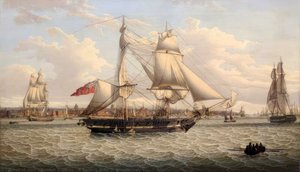
While the tempest offered drama, the harbor offered a different, more contemplative beauty. Marine art also found its soul in the quietude of maritime life within protected waters. Paintings such as Robert W. Salmon’s Ships in a Port invite the viewer into a world of luminous realism and peaceful industry. Here, the focus shifts from the struggle for survival to the rhythmic pulse of global commerce. The play of light on still water, the reflections of masts in the harbor basin, and the bustling activity of merchant vessels create a sense of stability and prosperity.
These scenes serve as historical portraits of a bygone way of life. They capture the architectural essence of port cities and the intricate dance of logistics that once fueled empires. There is a profound dignity in these depictions of merchant ships—vessels that, while perhaps less celebrated than warships, were the true engines of human connection across the oceans. Through the careful rendering of textures—the weathered wood of the docks, the heavy hemp of the ropes, and the soft glow of lanterns at dusk—artists provided a window into the economic lifeblood of the nineteenth century.
The Legacy of the Sea: Preserving Maritime History Through Fine Art Reproduction
Today, the majesty of these nineteenth-century maritime masterpieces continues to resonate with collectors and art enthusiasts worldwide. The enduring appeal of these works lies in their ability to transport us to a time of discovery and unparalleled craftsmanship. However, the preservation of such historical grandeur requires more than mere memory; it requires the physical presence of these works within our modern spaces.
At ArtsDot.com, we believe that the profound beauty of the Old Masters should be accessible to all. Our mission is to bridge the gap between history and the contemporary home through exquisite, hand-painted oil reproductions. Each piece is a labor of passion, meticulously recreated by artists trained in the highest academic traditions. By employing authentic techniques—from the careful layering of oils on 100% cotton canvas to the intentional use of visible brushstrokes—we ensure that the tactile depth and emotional resonance of the original maritime masters are preserved. Whether you seek a large-scale mural to evoke the scale of the Atlantic or a delicate portrait of a historic vessel, our commitment to quality allows the legacy of the sea to sail into the modern era.