Early Influences & Whistler's Shadow: The Foundations of Sickert’s Style
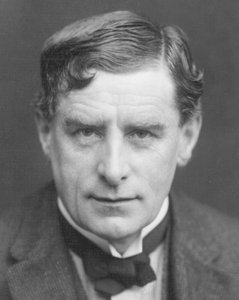 Walter Richard Sickert
Discover Walter Richard Sickert (1860-1942), a pivotal British painter influenced by Whistler & Degas. Known for evocative scenes of London life, music halls, and interiors, he was central to early 20th-century avant-garde art.
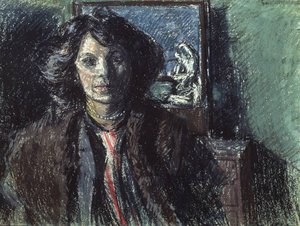
Walter Richard Sickert, born in 1860 amidst the burgeoning artistic currents of Munich, arrived on the British art scene as a figure destined to challenge convention. His early life was marked by a cosmopolitan upbringing – his father, Oswald Sickert, a Danish artist, instilled a foundational appreciation for visual expression, while his mother’s lineage connected him to a world of intellectual and aesthetic pursuits. However, it was his apprenticeship under James Abbott McNeill Whistler that proved truly formative. Whistler's emphasis on tonal harmony, atmospheric effects, and the rejection of narrative in favor of pure aesthetic experience profoundly shaped Sickert’s initial artistic direction. Sickert wasn’t merely absorbing technique; he was internalizing a philosophy – an insistence on *art for art’s sake* that would become a recurring theme throughout his career. This period saw him experimenting with nocturnes and delicate studies, mirroring Whistler's style, but even then, a nascent desire to move beyond pure abstraction hinted at a different path. The influence wasn’t simply stylistic; Whistler’s battles with the art establishment – most famously the libel suit brought by John Ruskin – demonstrated the power of artistic independence and a willingness to provoke, lessons Sickert would later embrace wholeheartedly.
London Life, Music Halls & the Everyday: Capturing a Changing City
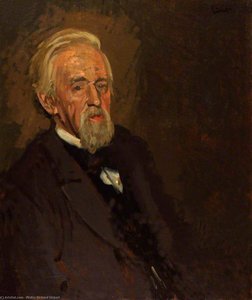
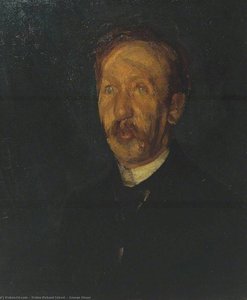 George Moore
Introspective portrait of George Moore by Walter Richard Sickert, circa 1890. Explore the somber mood and loose brushstrokes of this Post-Impressionist masterpiece.
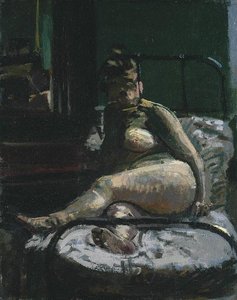
Sickert's true voice began to emerge when he turned his attention to the vibrant, often gritty realities of London life. He eschewed the grand historical narratives and idealized landscapes favored by many of his contemporaries, instead focusing on the overlooked corners of the metropolis – the bustling music halls, the cramped lodgings of working-class neighborhoods, and the transient lives unfolding within them. Paintings like those depicting the interiors of music halls weren’t simply depictions of entertainment; they were social commentaries, capturing a rapidly changing urban landscape and the burgeoning leisure culture of the late Victorian era. He possessed an uncanny ability to imbue these scenes with a sense of psychological tension, often focusing on isolated figures lost in thought or caught in moments of quiet desperation. This fascination with the ordinary, coupled with his masterful use of light and shadow, created a uniquely compelling aesthetic that resonated with a growing audience seeking authenticity over artifice. The portraits he undertook during this period, such as those of George Moore – a somber introspection captured with loose brushstrokes – reveal a keen understanding of human character and a willingness to portray subjects without embellishment.
Dieppe & Venice: Expanding Horizons and Impressionistic Techniques
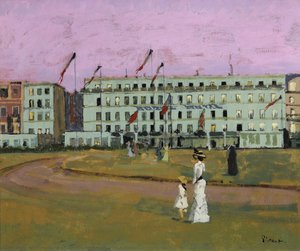 L'Hotel Royal, Dieppe, France
Walter Sickert's 'L'Hotel Royal, Dieppe' (1894) captures the bustling French coastal town with realistic detail and subtle Impressionistic charm. Explore this masterpiece at Sheffield City Art Galleries.
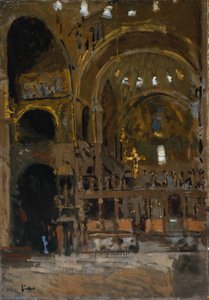
Seeking respite from the constraints of London, Sickert embarked on extended periods in Dieppe, France, and later, Venice. These sojourns weren’t merely geographical shifts; they represented a deepening engagement with Impressionistic principles. In Dieppe, he found himself captivated by the bustling harbor, the transient light reflecting off the water, and the everyday lives of fishermen and dockworkers. L'Hotel Royal, Dieppe, painted in 1894, exemplifies this period – a realistic depiction of a French coastal town imbued with subtle Impressionistic charm. The loose brushwork and focus on atmospheric effects demonstrate his evolving technique, while the subject matter remained firmly rooted in his fascination with ordinary life. Venice offered a different kind of inspiration. The Horses of St Mark’s, painted in 1905, showcases his ability to capture architectural grandeur with bold colors and intricate detail. However, even here, Sickert resisted a purely picturesque approach, infusing the scene with a sense of melancholy and isolation. These travels weren't about replicating idyllic beauty; they were about exploring the complexities of place and the human condition within it.
The Camden Town Group & A Rejection of Victorian Convention
By the early 20th century, Sickert had become a central figure in the burgeoning British avant-garde movement. He joined forces with artists like Augustus John and Lucien Pissarro to form the Camden Town Group, a collective dedicated to challenging the established norms of Victorian art. The group’s manifesto – though never formally written – was one of radical honesty and an uncompromising commitment to depicting modern life in all its complexity. They rejected the sentimentalism and moralizing tendencies of earlier generations, embracing instead a gritty realism that often shocked and offended conservative critics. Sickert's contribution to the Camden Town Group was pivotal. He provided not only artistic leadership but also a theoretical framework for their endeavors, arguing passionately for the importance of focusing on “gross material facts” – the scullery, the dunghill, anything but the drawing-room. This rejection of polite society and embrace of the unconventional paved the way for a new generation of British artists who dared to challenge the status quo.
Controversy & Legacy: Beyond Realism – Sickert’s Enduring Impact
Sickert's career was not without its controversies. His fascination with Jack the Ripper, and subsequent theories linking him to the infamous murders, cast a long shadow over his later life, though these claims remain largely unsubstantiated. However, even this notoriety underscores his enduring ability to provoke and challenge conventional thinking. More significantly, his influence on distinctively British styles of avant-garde art in the mid and late 20th century is undeniable. Artists like Lucian Freud and Francis Bacon acknowledged a profound debt to Sickert’s unflinching realism and psychological intensity. He wasn't simply a painter of scenes; he was a chronicler of the human condition, capturing moments of vulnerability, isolation, and quiet desperation with unparalleled skill. His legacy extends beyond his paintings themselves – it lies in his insistence on artistic independence, his willingness to challenge convention, and his unwavering commitment to portraying the complexities of modern life. Today, Walter Sickert stands as a pivotal figure in British art history, a master of atmosphere, and a painter whose work continues to resonate with audiences seeking authenticity and emotional depth. Explore the world of Sickert further – discover the power of realism, the beauty of imperfection, and the enduring legacy of a truly remarkable artist.