Introduction: The Rise of Watercolour & William Henry Hunt’s Unique Vision
William Henry Hunt (London 28 March 1790 – 10 February 1864), was an English watercolourist. Hunt was one of the key figuresin nineteenth-century English ...
The early nineteenth century witnessed a burgeoning appreciation for watercolour painting, a medium previously relegated to the realm of amateur pursuits. This shift wasn't merely about technique; it reflected a growing desire for intimacy, immediacy, and a closer connection with nature. At the forefront of this transformation stood William Henry Hunt (1790-1864), an English artist whose delicate touch and unwavering commitment to naturalism redefined the possibilities of watercolour. Unlike many of his contemporaries who favored grand historical narratives or sweeping landscapes, Hunt found beauty in the everyday – a humble still life, a fleeting moment captured in a figure study, the subtle play of light on ordinary objects. His work wasn’t about spectacle; it was about seeing, truly *seeing*, and conveying that vision with unparalleled sensitivity.
Early Life and Training: Foundations in Landscape and the Monro Circle
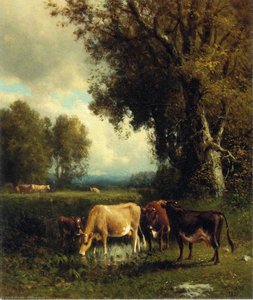 Cows in the Meadow
Discover 'Cows in the Meadow' by William Hart (1878), a serene Hudson River School landscape showcasing Impressionistic beauty & rural life. Explore this oil painting’s tranquil charm.
Born in London to a tin-plate worker, Hunt's early life offered little indication of the artistic path he would forge. A physical disability hampered his ability to assist in his father’s trade, leading to an apprenticeship with the watercolourist John Varley in 1806. This proved pivotal. Varley instilled in him a love for sketching from nature – “go to nature for everything,” as Varley famously advised – and introduced him to Dr. Thomas Monro, a physician who fostered a vibrant artistic community within his home. Monro’s informal academy attracted a constellation of young talents, including J.M.W. Turner and Peter de Wint, creating an environment where experimentation and mutual encouragement flourished. Hunt benefited immensely from this nurturing atmosphere, honing his skills in landscape painting while developing a keen eye for detail. The idyllic countryside surrounding Bushey, Hertfordshire, became a frequent subject, with Monro often arranging transport to facilitate outdoor sketching sessions – a testament to the importance placed on direct observation.
The Pursuit of Naturalism: Hunt's Detailed Still Lifes and Figure Studies
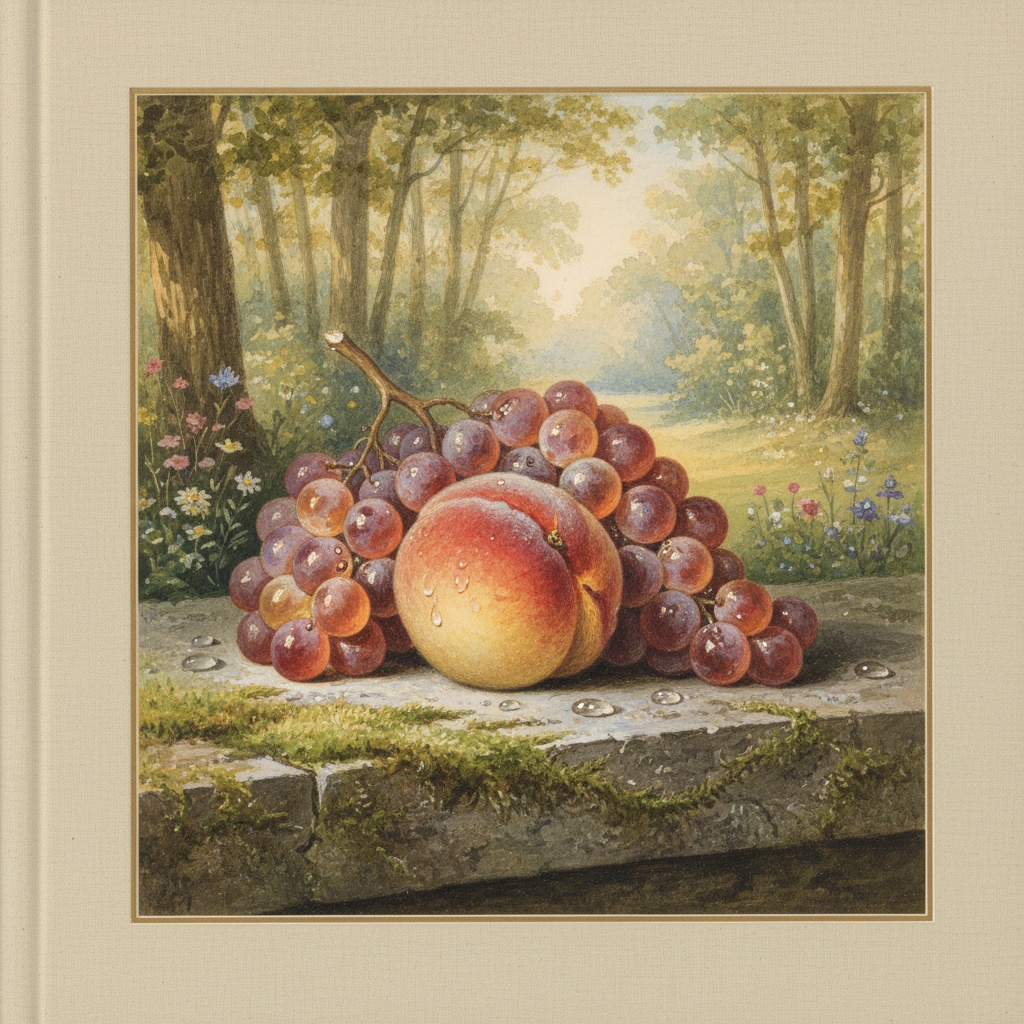
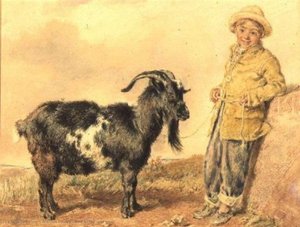
While initially exhibiting oil paintings at the Royal Academy, Hunt gradually gravitated towards watercolour as his primary medium. By the 1820s, he had largely abandoned expansive landscapes in favor of more intimate subjects. This wasn’t a rejection of nature, but rather a focused exploration of its minutiae. His still lifes – arrangements of fruit, flowers, and birds' nests – are remarkable for their almost photographic realism. He didn’t merely depict these objects; he captured their very essence, the velvety texture of a peach, the delicate fragility of a blossom. Equally compelling were his figure studies, often featuring Black models. A particularly poignant example, “Study of a Young Model” (ca. 1830), reveals Hunt's sensitivity to human form and his willingness to challenge societal norms by portraying individuals from marginalized communities. The sitter’s unmarred appearance suggests a profession beyond manual labor, perhaps a street performer, highlighting Hunt’s interest in capturing the dignity of everyday life.
Hunt’s Technique: Layering Pigment for Luminous Effects
Hunt's mastery wasn’t simply about observation; it was also rooted in his innovative technique. He eschewed traditional watercolour washes, instead employing a unique layering process that created extraordinary luminosity and depth. He began with a base of white gouache, upon which he meticulously applied successive layers of pure, vibrant pigment. This “colour over colour” approach allowed him to build up intense hues and subtle gradations, achieving an effect that was both delicate and remarkably lifelike. Critics at the time lauded his ability to render colours “as brilliant as the pigments employed,” a testament to his skillful manipulation of light and shadow. This technique demanded patience and precision, but it resulted in paintings that possessed an unparalleled sense of freshness and vitality.
Influence & Legacy: Connecting Hunt to the Hudson River School & Beyond
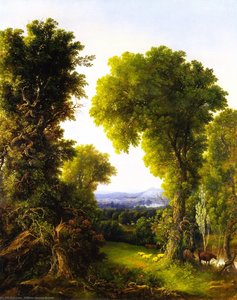
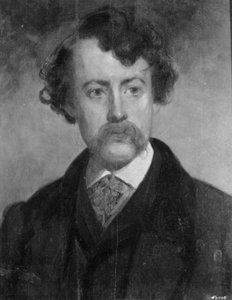 William Stanley Haseltine
Explore William Stanley Haseltine (1835-1900), an American Luminist & Hudson River School painter known for detailed landscapes of New England & Italy. Discover his realistic depictions of nature!
Although primarily associated with English watercolour painting, Hunt’s influence extended across the Atlantic, resonating with artists of the burgeoning Hudson River School. While stylistic differences exist, both movements shared a commitment to naturalistic representation and a reverence for the beauty of the American landscape. Artists like James McDougal Hart, known for his detailed cattle paintings, and William Stanley Haseltine, celebrated for his realistic depictions of New England scenes, demonstrate a similar attention to detail and atmospheric effects. Hunt’s emphasis on direct observation also foreshadowed the principles of Impressionism, inspiring artists to capture fleeting moments and the subjective experience of light and colour. His work served as a bridge between the traditions of English landscape painting and the innovations of modern art.
Collecting William Henry Hunt Today: Appreciation and Market Value
Today, William Henry Hunt’s paintings are highly sought after by collectors who appreciate his technical skill, sensitivity to subject matter, and enduring aesthetic appeal. His works can be found in major museums worldwide, including the Metropolitan Museum of Art and the Tate Britain. While prices vary depending on size, condition, and subject matter, they generally range from €25,000 to over €100,000 for exceptional examples. The increasing recognition of his contribution to 19th-century art has fueled a growing demand for his paintings, making him an increasingly prominent figure in the art market. At ArtsDot.com, we offer high-quality reproductions of Hunt’s masterpieces, allowing you to experience the beauty and luminosity of his work firsthand. Whether you are a seasoned collector or simply appreciate fine art, William Henry Hunt's paintings offer a timeless glimpse into a world seen with extraordinary clarity and grace.