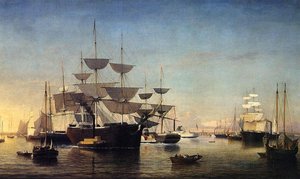
The Genesis of Luminism: Lane’s Early Life & Artistic Formation
 Wikipedia: Fitz Henry Lane
Fitz Henry Lane (born Nathaniel Rogers Lane; also formerly, mistakenly, known as Fitz Hugh Lane; December 19, 1804 – August 14, 1865) was an American painter and printmaker of a style that would later be called Luminism, for its use of pervasive ligh...
Fitz Henry Lane, born Nathaniel Rogers Lane in 1804 Gloucester, Massachusetts, occupies a singular position within the pantheon of American landscape painters. His story is not one of formal academic training or privileged upbringing, but rather a testament to the power of keen observation and self-directed artistry forged amidst the rhythms of maritime life. From his earliest years, Lane was inextricably linked to the sea; his father, Jonathan Dennison Lane, was a sailmaker, and the family’s proximity to Gloucester Harbor instilled in the young Nathaniel an intimate understanding of light, water, and the vessels that navigated them. This early immersion wasn't merely geographical—a childhood illness left him with a permanent leg disability, subtly redirecting his energies inward, fostering a heightened sensitivity to the visual world around him. While initially apprenticed as a shoe-maker, Lane’s innate talent for drawing soon led him to Boston and an apprenticeship at Pendleton’s Lithography shop. This formative experience provided crucial technical skills—the precision of line, the understanding of tonal values—that would later define his unique style.
The decision to legally change his name to Fitz Henry Lane in 1832, though its precise motivations remain somewhat elusive, signals a deliberate act of artistic self-fashioning. It was a conscious step away from the commonplace and towards an identity more befitting the aspiring artist he had become. This period also saw him establishing himself as a marine painter, meticulously documenting the bustling harbor scenes that were his immediate surroundings. However, Lane’s ambition extended beyond mere topographical representation; even in these early works, one detects a nascent concern with atmosphere, light, and the subtle emotional resonance of the sea.
Mastering Maritime Light: Technique, Observation & Salem Harbor's Legacy
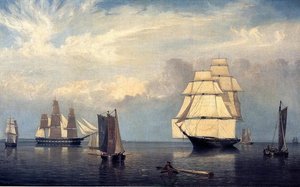 Salem Harbor
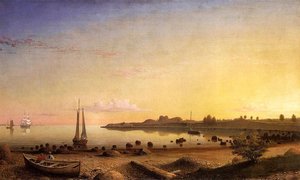
Admire Fitz Henry Lane’s "Salem Harbor" (1853), a luminous maritime masterpiece capturing Salem's beauty. Explore Luminism & classic New England art.
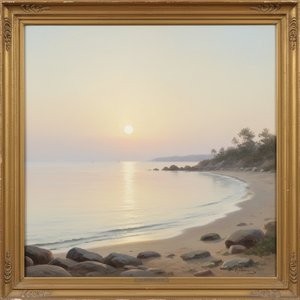
Lane’s mastery lies not in grand gestures or dramatic compositions—characteristics often associated with his contemporaries within the Hudson River School—but rather in a profound sensitivity to light and its transformative effects. He wasn’t interested in capturing the raw power of nature so much as its ethereal beauty, the quiet moments of stillness that reveal a deeper truth. This is exquisitely exemplified in “Salem Harbor” (1853), a work that transcends simple depiction to become an almost meditative experience. The painting isn't merely *of* Salem Harbor; it’s an evocation of a specific time and place, imbued with a luminous quality that seems to emanate from within the canvas itself.
Technically, Lane achieved this effect through meticulous layering of glazes—thin washes of oil paint applied over one another to create subtle gradations of color and tone. He eschewed visible brushstrokes, striving for a smooth, polished surface that further enhances the sense of clarity and atmosphere. His attention to detail is remarkable; each ship is rendered with precision, its rigging and sails accurately depicted, yet they are never allowed to dominate the composition. Instead, they exist within a larger framework of light and water, contributing to the overall harmony of the scene. The impasto texture in some areas adds depth and dimension, subtly highlighting the interplay of sunlight on the waves and hulls of the vessels.
Beyond the Coastline: Expanding Horizons and Penobscot Bay's Dramatic Scenes
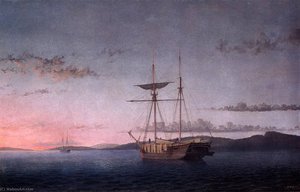 Lumber Schooners at Evening on Penobscot Bay
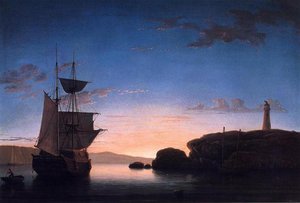
Fitz Henry Lane’s "Lumber Schooners at Evening" (1860) captures a dramatic Penobscot Bay scene in Romantic Luminism. Observe the impasto texture, ship details & evocative light. A stunning maritime painting for art collectors.
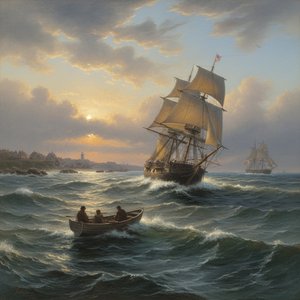
While Gloucester and Salem remained central subjects throughout his career, Lane’s artistic horizons expanded in the late 1850s with journeys further afield. His paintings of Penobscot Bay, particularly “Lumber Schooners at Evening on Penobscot Bay” (1860), demonstrate a growing confidence in handling more complex compositions and dramatic lighting effects. The scene is imbued with a Romantic sensibility—the towering cliffs, the vast expanse of water, the silhouetted schooners against the fiery sunset—yet it remains grounded in Lane’s characteristic realism.
“Lumber Schooners” showcases his ability to capture not just the visual appearance of a scene but also its emotional weight. The painting evokes a sense of both tranquility and foreboding, hinting at the challenges and uncertainties faced by those who made their living on the sea. The meticulous detail in the ship construction is again apparent, reflecting Lane’s deep understanding of maritime life. However, it's the evocative light—the way it plays across the water, illuminates the sails, and casts long shadows—that truly elevates this work to a masterpiece.
Lane in Context: The Hudson River School & His Unique Position Within American Landscape Painting
The Hudson River School was a mid-19th-century American art movement embodied by a group of landscape painters whose aesthetic vision was influenced by Romanticism. Early on, the paintings typically depicted the Hudson River Valley and the surroundi...
Often discussed in relation to the Hudson River School, Fitz Henry Lane occupies a somewhat unique position within that broader movement. While sharing their reverence for the American landscape and their commitment to realistic depiction, Lane diverged from the grand scale and dramatic narratives favored by artists like Thomas Cole and Albert Bierstadt. He was less interested in portraying the sublime power of nature than in capturing its quiet beauty, its moments of stillness and reflection.
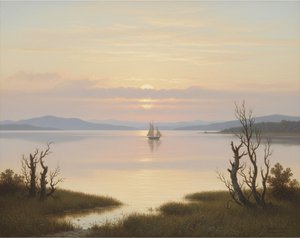
The term “Luminism” – coined retrospectively in 1954 by John Baur—aptly describes Lane’s style and that of a group of independent American painters who shared his emphasis on clarity of light and atmosphere. Artists like Martin Johnson Heade and John Frederick Kensett, with their serene marsh scenes and tranquil landscapes, are often considered contemporaries of Lane, sharing similar aesthetic concerns. However, Lane's focus remained steadfastly rooted in the maritime world, distinguishing him from those who explored other facets of the American landscape.
The Enduring Appeal of Lane’s Work: Collecting Luminism Today
Today, Fitz Henry Lane is recognized as one of the most important and influential American painters of the 19th century. His works are highly sought after by collectors, museums, and art enthusiasts alike. The enduring appeal of his paintings lies in their ability to transport viewers to another time and place—to evoke a sense of tranquility, beauty, and emotional resonance.
Investing in Lane’s work is not merely acquiring a beautiful object; it's owning a piece of American history, a testament to the power of observation, artistry, and the enduring allure of the sea. His paintings offer a unique window into a bygone era—a time when maritime life was central to the nation’s economy and identity. ArtsDot offers meticulously crafted reproductions of Lane's masterpieces, allowing collectors to experience the luminous beauty of his work firsthand. Whether you are a seasoned art collector or just beginning your journey, exploring the world of Fitz Henry Lane is an enriching and rewarding experience.