The Sculptural Soul of the Pacific
Ann Verdcourt (1934–2022) was far more than a ceramicist; she was a storyteller who utilized the tactile medium of clay to bridge the gap between the tangible world and the depths of human imagination. Born in Bedfordshire, England, her artistic journey began with formal training at the Luton School of Art and later the Hornsey School of Art in London, where she earned an NDD Diploma in sculpture and ceramics. This rigorous academic foundation provided her with the technical mastery required to transform humble earth into monumental narratives. In 1965, Verdcourt’s life took a transformative turn when she emigrated to New Zealand alongside her husband, the fellow ceramicist John Lawrence. This move to the edge of the Pacific Ocean would fundamentally reshape her creative vision, as the turbulent, awe-inspiring waters of her new home became the primary muse for her most profound explorations.
The establishment of Lawrence & Verdcourt Ceramics on Waiheke Island served as a crucible for her experimental spirit. While her early years were marked by a deep engagement with craft traditions, her work gradually evolved from functional pottery into complex, sculptural storytelling. A pivotal moment in her career occurred during an exhibition at the Manawatu Art Gallery in the early 1980s, where she was tasked with creating vessels inspired by the stillness of Morandi. This challenge pushed her toward a more conceptual approach, leading her to explore how three-dimensional forms could illustrate historical epics and mythological terrors. Her work became a sophisticated dialogue between art history and natural phenomena, drawing subtle allusions to masters such as Constantin Brâncuși, Henri Matisse, and even the primal energy of the Venus of Willendorf.
Terrors of the Sea and the Mastery of Clay
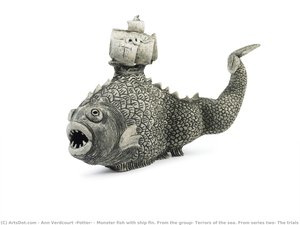
Verdcourt’s most enduring legacy lies in her ability to capture what she called the “Terrors of the Sea.” These works were not mere biological studies of marine life but were visceral explorations of primal anxiety and the overwhelming power of nature. Through her meticulous technique of layering hand-crafted clay slabs, she achieved a textural complexity that mimicked the ruggedness of coral and the sleekness of predator skin. Her use of iridescent glazes—dominated by deep blues, emerald greens, and shimmering teals—allowed her sculptures to catch the light in ways that suggested the undulating movement of seawater. In these pieces, the viewer is confronted with the raw, unpredictable essence of the ocean, where beauty and danger are inextricably linked.
Beyond the marine realm, Verdcourt’s repertoire was remarkably diverse, often tackling grand historical themes through a ceramic lens. One of her most significant achievements was her commission for the New Zealand Pavilion at the Seville Expo '92, where she produced a series centered on the voyages of Christopher Columbus. Rather than presenting a dry historical account, she treated the subject as an unfolding drama, using clay to depict the tension, discovery, and peril of the first great maritime expeditions. This ability to translate complex human histories into a visual language that requires no words cemented her reputation as a visionary artist capable of profound communication.
A Lasting Legacy in Ceramic Art
The historical significance of Ann Verdcourt’s work resides in its refusal to be confined by the traditional boundaries of pottery. She elevated ceramics from a decorative craft to a medium of high-concept sculpture, capable of carrying the weight of myth, history, and psychological depth. Her contributions to the New Zealand art landscape are preserved in prestigious institutions such as Te Papa Tongarewa, where her collections serve as a testament to her technical brilliance and imaginative reach.
Reflecting on her life’s work, several key elements define her artistic identity:
- Technical Innovation: The masterful use of hand-layered clay slabs and iridescent glazing to create lifelike textures.
- Narrative Depth: The ability to transform historical events, such as the voyages of Columbus, into tangible, sculptural stories.
- Thematic Complexity: An exploration of the duality between the breathtaking beauty and the terrifying power of the natural world.
- Artistic Lineage: A profound connection to art history, weaving influences from classical sculpture into contemporary ceramic practice.