Menu
FREE ART CONSULTATION

conrad faber von creuznach

Quick Facts

  • Copyright status: Under copyright
  • Nationality: Germany
  • Museums on APS: Metropolitan Museum of Art
  • Also known as: conrad faber
  • More…
  • Top-ranked work: Untitled (D2WVRD)
  • Works on APS: 2
  • Top 3 works:
    • Untitled (D2WVRD)
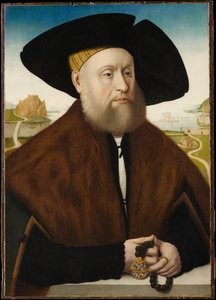
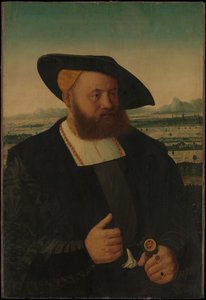
    • Portrait of a Man with a Moor's Head on His Signet Ring
  • Born: Krefeld, Germany

Art Quiz

There is only one correct answer for each question.

Question 1:
What was Conrad Faber von Kreuznach primarily known for during his artistic career?
Question 2:
Conrad Faber von Kreuznach worked closely with which influential printer?
Question 3:
In what year did Conrad Faber marry Catherine, a daughter of a wool weaver?
Question 4:
What prestigious citizenship did Conrad Faber acquire due to his marriage?
Question 5:
Which notable artwork by Conrad Faber von Kreuznach depicts the view of Frankfurt am Main?

Conrad Faber von Kreuznach: A Frankfurt Cartographer and Painter of the Renaissance

Conrad Faber von Kreuznach (c. 1500 in Kreuznach, Germany – between September 10, 1552 and May 15, 1553 in Frankfurt am Main) was a German painter and woodcut designer who achieved renown as “Master of Holzhausen Portraits,” marking him as one of the most prominent artists active during the early Renaissance in Frankfurt. Despite scant biographical details preceding 1524—scholars speculate he honed his craft as a woodcarver and illustrator for Peter Schöffer, a former employee of Johannes Gutenberg—Faber’s legacy rests upon remarkably detailed topographical city views and evocative portraits that capture the spirit of his era.

Early Life and Training

Information regarding Faber's formative years remains elusive. He was born in Kreuznach, Rhineland-Palatinate, around 1500, though precise birthdate is uncertain. His early career likely involved apprenticeship as a woodcarver and illustrator, possibly under Hans Fyoll in Frankfurt—a connection bolstered by Schöffer’s patronage. This association with Gutenberg's printing press undoubtedly exposed him to the burgeoning humanist ideals of the time and fostered an appreciation for visual representation as a tool for conveying knowledge and documenting the world around him.

The Holzhausen Portraits and Artistic Style

Faber gained considerable fame through his series of portraits depicting members of the Holzhausen family—a wealthy Frankfurt merchant clan. These paintings exemplify Faber’s meticulous attention to detail, capturing not merely physical likeness but also psychological nuance. His technique combined realism with expressive brushwork, utilizing chiaroscuro – dramatic contrasts between light and dark – to imbue his subjects with depth and emotion. The Holzhausen portraits stand as a testament to Faber's mastery of portraiture and solidify his position among the leading artists of Frankfurt during this period.

Frankfurt City Views: A Pioneering Achievement

Perhaps Faber’s most enduring contribution to art history lies in his ambitious project—commissioned by Sebastian Münster—to create a comprehensive map of Frankfurt. This monumental undertaking resulted in “The Template View of Frankfurt,” considered one of the earliest and most accurate topographical panoramas produced in Europe. Faber skillfully blended observation with artistic license, employing aerial perspective to convey spatial depth and capturing the bustling activity of the city’s marketplace and streets. This artwork represents a pivotal moment in the development of urban landscape painting and foreshadowed later developments in cartography and visual representation.

Later Years and Legacy

Faber's life was marked by financial difficulties following the Reformation, which severely curtailed his artistic income stream. Despite facing hardship, he continued to produce significant works—primarily portraits and cityscapes—demonstrating unwavering dedication to his craft. His marriage to Catherine Laßmann in 1537 brought him stability and citizenship of Frankfurt, reflecting the broader cultural shifts occurring during this transformative period. Faber’s son, Louis, inherited his father's artistic talent and continued his legacy, securing a place for Faber’s work within the artistic canon of the Renaissance. Sadly, Faber died around May 1553, leaving behind considerable debts—only 50 guilders were paid to Catherine Laßmann by Frankfurt City Council for her efforts in managing his estate. His son Louis subsequently pursued further education abroad, inheriting Faber's oeuvre and upholding his artistic heritage.

Concluding Remarks

Conrad Faber von Kreuznach remains a fascinating figure whose life intersected with the intellectual and artistic currents of the Renaissance. Though biographical details are sparse, his enduring achievement—the Template View of Frankfurt—continues to inspire admiration for its pioneering approach to urban landscape painting and serves as a poignant reminder of an artist grappling with both opportunity and adversity amidst the momentous changes reshaping Europe in the mid-16th century.