A Poet Among Emperors: The Artistic Soul of Emperor Reigen
In the grand, sweeping tapestry of Japanese imperial history, few figures emerge with a spirit as profoundly intertwined with aesthetic refinement as Emperor Reigen. Born in 1654 as Satohito, he ascended to the Chrysanthemum Throne in 1663, a period marked by the complex political shifts of the early Edo era. While his reign from 1663 to 1687 was defined by the heavy responsibilities of sovereignty and the navigation of internal strife, his true legacy resides not in the decrees of state, but in the delicate strokes of his calligraphy and the rhythmic grace of his poetry. He was a ruler who viewed the world through the lens of a scholar-artist, finding the divine in the minimalist beauty of a landscape or the silent resonance of a Zen verse.
The foundations of Reigen’s cultural sensitivity were laid within the illustrious halls of the imperial court. As the sixteenth son of Emperor Go-Manizunoo, he was raised amidst a lineage that prioritized the preservation of classical traditions. His mother, Lady Kuniko, brought with her the diplomatic and intellectual prestige of the Minister Sonomotooto, ensuring that Reigen’s upbringing was as much an education in literature and art as it was in imperial protocol. This rich heritage instilled in him a deep reverence for the waka poetic tradition and the disciplined elegance of calligraphy, forming the bedrock of a creative life that would eventually transcend his political station.
The Mastery of Ink and Verse
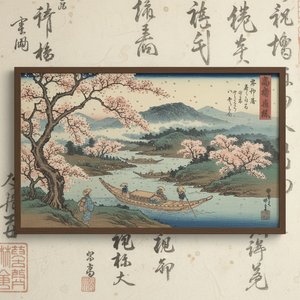
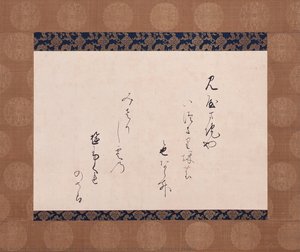
To observe the works attributed to Emperor Reigen is to witness a masterclass in the Zen-influenced aesthetics of his era. His artistic output was characterized by a seamless marriage between text and space, often manifesting in exquisite scrolls where calligraphy and minimalist imagery coexisted in perfect harmony. As a calligrapher, he possessed the rare ability to imbue ink with emotion, using varying pressures and fluid motions to convey the ephemeral nature of existence. His works on kaishi paper, for instance, are celebrated for their ability to capture the quietude of a landscape while simultaneously delivering profound poetic truths.
His patronage extended far beyond his own hand, as he became a vital pillar for the flourishing Noh theatre. Recognizing Noh as a medium capable of conveying spiritual and moral complexities, Reigen actively supported troupes and commissioned productions that utilized music, dance, and poetry to touch the sublime. This devotion to the performing arts mirrored his personal literary pursuits; whether composing verse or directing the focus of the court toward new artistic heights, he sought to create an environment where beauty served as a bridge to the spiritual realm.
A Lasting Legacy of Cultural Renaissance
The historical significance of Emperor Reigen lies in his role as a guardian of Japanese cultural identity during a time of transition. While the political power of the Emperor was increasingly shadowed by the Tokugawa shogunate, Reigen ensured that the imperial court remained the beating heart of Japan's aesthetic and intellectual life. He was the last emperor to hold the title of Cloistered Emperor, a role that allowed him to maintain a unique influence over both the religious and cultural landscapes of his time.
His life, marked by an extraordinary personal scale—including thirteen sons and fourteen daughters—ensured the continuation of a dynasty dedicated to the arts, most notably through his son, Emperor Higashiyama. Today, we remember Satohito not merely as a monarch of the 112th succession, but as a visionary who understood that the true strength of a civilization is found in its capacity for beauty, reflection, and the enduring power of the written word.