A Florentine Soul Embraced by Spanish Baroque
The story of Francisco Camilo is one of profound cultural synthesis, a narrative woven from the threads of Italian humanism and the dramatic intensity of the Spanish Golden Age. Born in Madrid around 1615, Camilo was the product of a unique artistic lineage. His father, Domenico Camilo, was an Italian painter who brought the refined traditions of Florentine Mannerism to the heart of Spain. This heritage gifted the young artist with a foundational mastery of anatomy, perspective, and a meticulous eye for detail that would become the hallmark of his mature style. However, the trajectory of his life was irrevocily altered by personal loss; following his father's death, Camilo’s mother married the esteemed Madrid painter Pedro de las Cuevas. Under the guidance of his stepfather, Camilo did not merely learn a trade but was immersed in the academic principles of the Spanish school, preparing him to navigate the complex and prestigious artistic landscape of 17th-century Madrid.
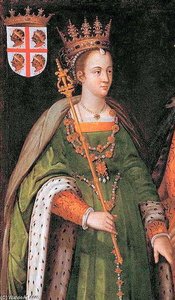
As Camilo matured, his talent began to command the attention of the most powerful figures in the Spanish court. His early career was marked by a remarkable ability to marry spiritual devotion with theatrical grandeur. At the tender age of eighteen, he was entrusted with a commission for the high altar of the Jesuits’ house in Madrid, creating an evocative depiction of Saint Francis Borgia. This work served as a precursor to his later mastery of religious themes, demonstrating an early grasp of the Baroque preoccupation with emotive expression and dramatic composition. His reputation continued to ascend through the patronage of the Count-Duke of Olivares, the political titan of the era, who recognized in Camilo a painter capable of translating royal authority into visual splendor. This period saw Camilo producing regal portraits of Spanish monarchs, works designed to decorate the Hall of Comedies at the Alcázar, where he successfully conveyed the weight of sovereignty through subtle dignity and commanding presence.
The Grandeur of Fresco and Myth
Perhaps the most ambitious chapter of Camilo’s career was defined by his foray into large-scale monumental decoration. In a feat of immense technical difficulty, he was tasked with adorning the western gallery of the Palace of Buenretiro. Working alongside Julio César Semini, Camilo executed a series of fourteen breathtaking frescoes inspired by Ovid’s Metamorphoses. These works represented a departure from his purely religious subjects, allowing him to explore the fluid, transformative nature of classical mythology through the lens of Baroque dynamism. Although much of this magnificent cycle was tragically lost to time, its historical impact remains significant; it is recorded that even King Philip IV, known for his discerning eye, was deeply moved by the sheer scale and narrative complexity of these compositions. This period solidified Camilo’s status not just as a painter of altarpieces, but as a master of architectural storytelling.
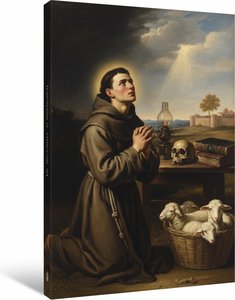
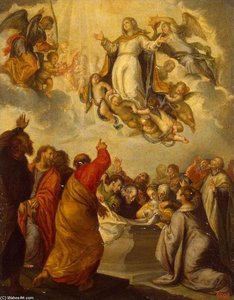
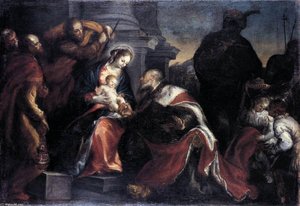
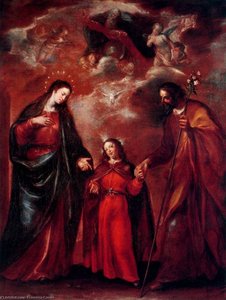
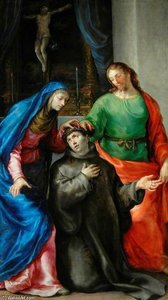
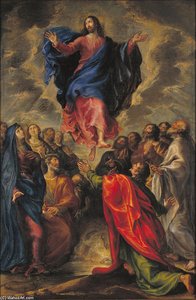
Beyond the palace walls, Camilo’s influence permeated the religious fabric of Spain. His brush traveled through the monasteries of Madrid, Toledo, Alcalá, and Segovia, leaving behind a legacy of devotion. He possessed a rare ability to breathe life into sacred figures, creating works such as the Virgin of Bethlehem for the church of San Juan de Dios—a piece so profoundly resonant that it became an object of widespread veneration and imitation. Whether he was depicting the celestial ascent in his Assumption of the Virgin or capturing the somber intensity of saints in various convents, Camilo’s work consistently bridged the gap between the earthly and the divine. His ability to navigate both the intimate scale of devotional painting and the epic scale of palace frescoes ensures his place as a pivotal figure in the evolution of the Spanish Baroque, a painter who truly embodied the intersection of Italian grace and Spanish passion.