The Architect of Roman Baroque in France
François Perrier stands as a pivotal figure in the seventeenth-century French artistic landscape, a man credited with importing the breathtaking grandeur and dynamic energy of the Roman Baroque into the heart of Parisian ateliers. Born in Pontarlier, his early years were steeped in the intellectual currents of humanist scholarship and the rediscovery of classical antiquity. His formative training within the Fontainebleau school, where he absorbed the meticulous stylistic precepts of artists like Francesco Francia and Jean Fouquet, provided him with a foundation in Mannerist precision. This early exposure to fine detail and expressive pigment would later serve as the essential scaffolding upon which he built his more expansive, dramatic style.A Roman Pilgrimage and Stylistic Evolution
The true metamorphosis of Perrier’s artistry occurred during his transformative journey to Rome between 1620 and 1625. This pilgrimage allowed him to encounter the epicenter of artistic innovation, where the influence of Giovanni Lanfranco became a profound catalyst for his development. By absorbing the principles of academic Baroque classicism, Perrier began to move away from the rigidities of Mannerism toward an approach defined by idealized forms and harmonious, yet deeply emotional, compositions. His work began to pulse with the theatricality characteristic of the era, utilizing chiaroscuro—the dramatic interplay of light and shadow—to sculpt figures and heighten the psychological tension within his narratives.The Enduring Legacy of Line and Light
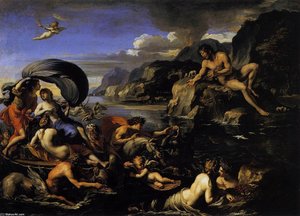
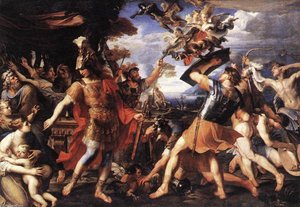
While his canvases captured the imagination, Perrier’s legacy as a meticulous draftsman and printmaker remains equally monumental. He possessed a singular ability to translate the weight and grace of antique sculptures into the medium of print, creating groundbreaking collections that served as visual repertories for generations of European artists. His prints after classical models provided an essential bridge between antiquity and the burgeoning Baroque movement.This mastery of both the brush and the burin is perhaps most vividly realized in his mythological works, such as “Acis, Galatea, and Polyphemus” (1645). In this masterpiece, Perrier achieves a visceral plunge into drama, where rugged landscapes and intensely emotional palettes converge to tell a story of vulnerability and looming threat. Through his dual mastery of painting and printmaking, Perrier ensured that the spirit of the Roman Baroque would forever leave its mark on the French soul.