A Shared Vision: The Collaborative World of Franz and Johannes Riepenhausen
The names Franz (1786-1831) and Johannes Riepenhausen (1787-1860) resonate within the annals of 19th-century German art, not as individual masters forging distinct paths, but as a partnership—a brotherly confluence of talent that flourished amidst the artistic fervor of Rome. Born in Göttingen to Ernst Ludwig Riepenhausen, a respected engraver specializing in the works of William Hogarth, their early lives were steeped in the meticulous discipline of line and form. This foundational training under their father proved crucial, shaping their technical prowess before they ventured towards broader artistic horizons. Their formal education continued at the Academy in Kassel, followed by studies in Dresden, experiences that laid the groundwork for their eventual Roman sojourn—a pilgrimage undertaken with fellow artist Ludwig Tieck in 1807. It was in Rome, the heart of Western art history, that the Riepenhausen brothers truly found their artistic voice and dedicated themselves to studying the masters, particularly Raphael.
Echoes of Antiquity and Romantic Sensibility
The collaborative spirit between Franz and Johannes defined much of their output. Their work wasn’t merely imitation; it was a considered dialogue with the past, filtered through the burgeoning sensibilities of the Romantic era. One of their earliest joint endeavors, the ambitious project to reconstruct the lost paintings of Polygnotus at Delphi based on Pausanias' descriptions, exemplifies this approach. This undertaking, initially praised by Goethe himself—though his critique extended to the accompanying commentary—demonstrated a commitment to reviving and reinterpreting classical narratives for a contemporary audience. Their *Geschichte der Malerei in Italien* (History of Painting in Italy), published in 1810, featuring twenty-four outline drawings after Italian masters predating Perugino, further illustrates their scholarly dedication to art history and their desire to make these influences accessible. Beyond the classical realm, they also turned their attention to religious subjects, producing a series of etchings depicting *The Life and Death of Saint Genevieve* in 1806, showcasing their versatility across different thematic landscapes. Their collaborative masterpiece, “The Glorification of Raphael,” stands as a testament to their profound admiration for the Renaissance master, while "Henry the Lion Protecting Frederick Barbarossa Against the Romans," commissioned for the Guelph Hall in Hanover, reveals a capacity for historical narrative and cultural depth.
A Legacy Continued: Johannes After Franz
The untimely death of Franz Riepenhausen in 1831 marked a turning point, but did not extinguish the artistic flame. Johannes continued to work, carrying forward their shared vision while also developing his own distinct style. He completed and published *Vita di Raffaello*—a project begun with his brother—presenting fourteen plates that served as both a tribute and an exploration of Raphael’s genius. Johannes' independent works further demonstrate his evolving artistic maturity. Paintings like “Raphael’s Death” (1836) are imbued with poignant emotion, capturing the sorrowful passing of their idol. "Destruction of the Cenci Family" (1839), a dramatic and emotionally charged scene, showcases his narrative skill and ability to convey complex human drama on canvas. These later works reveal a deepening engagement with Romantic themes—a focus on intense emotionality, historical spectacle, and the sublime power of nature.
Historical Significance and Enduring Appeal
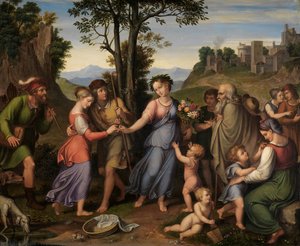
The Riepenhausen brothers occupy a unique position in art history. They were not revolutionary innovators overturning established conventions, but rather skilled synthesizers who bridged the gap between classical ideals and Romantic expression. Their dedication to studying and reinterpreting the Old Masters—particularly Raphael—contributed significantly to the ongoing dialogue surrounding artistic tradition and influence. Their etchings and paintings, while perhaps less widely recognized than those of their contemporaries, offer valuable insights into the intellectual and aesthetic currents of the early 19th century. Today, their works can be found in notable collections such as the Staatliche Kunsthalle Karlsruhe, offering modern audiences a glimpse into the collaborative spirit and artistic vision of these two German masters. The enduring appeal of pieces like “The Foreign Girl” lies not only in their technical execution—the masterful use of light and shadow, the rich color palettes—but also in their ability to evoke a sense of timeless beauty and profound emotional resonance. Their story is one of shared passion, artistic dedication, and a lasting contribution to the cultural landscape of Europe.