 Preview
 Send
Send Share
Share
 Details

 Download
 Similars
 X-Ray
X-Ray Diaporama
The Foreign Girl


 Read More
Hand Made Oil Reproduction
Hand-painted oil on canvas in your size and frame, made to order by our artists. ( Buy Print Buy Image)




P118B $10

P118H $10

P118W $10

P438Z $10

P508JH $12

P508YH $12

P805H $10

P805Z $10

P919BZ $10

P919G $10

P919XJ $10

P959ZH $10

P968JZ $12

W106C $8

W218G $10

W218JH $8

W218Y $10

W307PJ $10

W316G $10

W316PJ $8

W316Y $10

W398PJ $8

W4111J $10

W500HY $15

W500JH $15

W692G $12

W849H $8

W940BG $15

W953PJ $8




Pick from our preset sizes that match the artwork's original proportions.

You may enter your own dimensions to fit a specific frame or space. If your selected size does not match the original image's proportions, we will either crop the artwork or extend the painting with additional hand-painted elements. A digital mockup will be sent for your approval before production begins.
Please note that the on-screen preview does not reflect the actual cropping or extension. Only the mockup will accurately show the final composition.
While custom sizes are available, we recommend selecting a dimension from the predefined list to preserve the original proportions.
After order, ArtsDot.com team will email client for instructions and provide a mockup preview
Worldwide Delivery () in 3/4 weeks instead of standard 5 weeks. (16 August). No compromise on quality.

Free Worldwide Express Shipping

High-Quality Linen Canvas

Full Shipping Insurance

Customs Tax Refund Guarantee

True Color Matching Guarantee

60-Day Return Policy (Defects Only)

100% Money-Back Guarantee

Bulk Discount Offer
 Glass option is only available in size under 110 CM

The Foreign Girl
Reproduction Medium
Reproduction Size
-


Total Price
$ 463
Artwork Description
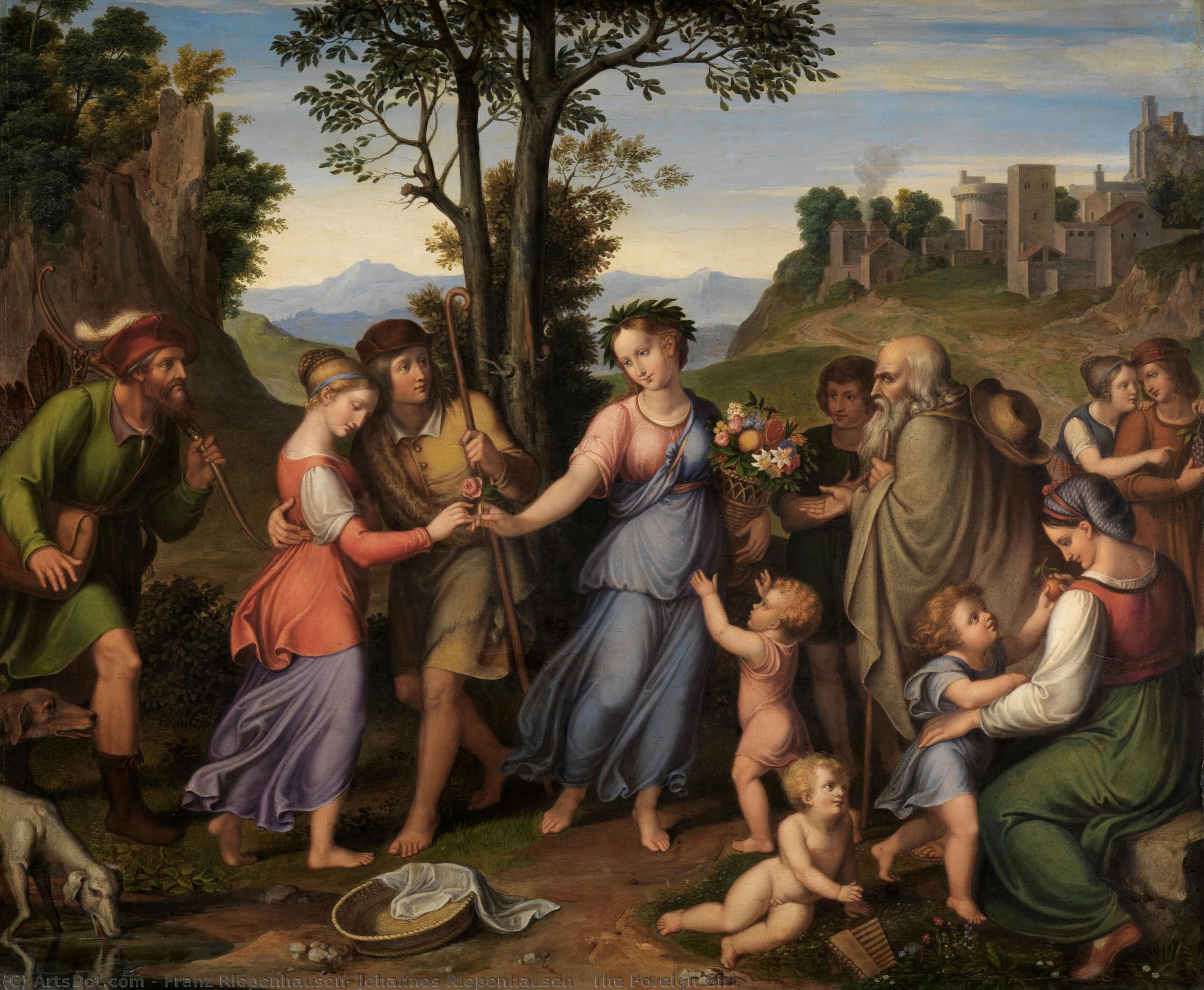
A Moment of Grace: The Foreign Girl by Franz Riepenhausen
Franz Riepenhausen’s “The Foreign Girl,” completed in 1810, is more than just a depiction of the Presentation of Christ; it's a meticulously crafted window into the artistic and spiritual currents of early 19th-century Rome. Executed on canvas with oil paints, this remarkably detailed work—measuring 5 x 73 cm—captures a pivotal biblical scene with an almost palpable sense of reverence. The painting’s scale invites contemplation, drawing the viewer into a world where faith and artistic mastery converge.
- Subject Matter: The composition centers around the Virgin Mary presenting her infant son, Jesus, to religious figures within the Temple. This iconic scene, rendered with profound sensitivity, speaks to themes of divine grace, sacrifice, and the beginning of salvation’s journey.
- Renaissance & Baroque Fusion: Riepenhausen skillfully blends Renaissance compositional principles – notably the pyramidal structure directing the eye towards Mary – with the dramatic lighting and heightened emotionalism characteristic of the burgeoning Baroque style. This harmonious fusion elevates the work beyond a simple historical representation, imbuing it with an enduring sense of theatricality.
Technical Brilliance: A Masterclass in Oil Painting
The technical execution of “The Foreign Girl” is nothing short of extraordinary. Riepenhausen’s command of oil paint is evident in every brushstroke, showcasing a deep understanding of blending, glazing, and layering techniques. The smooth, polished textures achieved on the figures' skin and drapery contribute significantly to the painting’s realism and luminosity. Strong highlights emphasize facial features and clothing, creating a powerful sense of depth and volume that seems to leap from the canvas.
- Perspective & Light: The artist employs linear perspective with precision, constructing a believable three-dimensional space that recedes into the mountainous landscape and distant city. Dramatic lighting, reminiscent of Caravaggio’s influence, intensifies the emotional impact and draws attention to key elements within the scene.
- Materiality: Constructed from oil paints on canvas, the artwork demonstrates meticulous attention to detail, reflecting a mastery of traditional painting techniques.
Symbolism & Emotional Resonance
Beyond its technical prowess, “The Foreign Girl” is rich in symbolic meaning. The basket of flowers offered as a gift represents reverence and devotion, while the shepherd’s staff symbolizes guidance and protection. The overall emotional tone is one of profound piety and solemnity, conveying a sense of divine grace and spiritual contemplation. Riepenhausen's ability to evoke such powerful emotions through his art speaks to the enduring power of religious iconography.
- Color Palette: The warm earth tones – ochre, browns, and golds – dominate the palette, contrasted by cooler blues and greens in the landscape and figures’ robes. This carefully considered color scheme enhances the painting's visual impact and reinforces its spiritual themes.
A Legacy of Collaboration
Franz Riepenhausen, alongside his brother Johannes, represents a significant chapter in German art history. Their shared artistic vision, nurtured within the Roman landscape and informed by their father’s engraving expertise, resulted in works that are both technically accomplished and deeply imbued with spiritual meaning. “The Foreign Girl” stands as a testament to their collaborative spirit and enduring legacy.
Related Artworks

Artist Biography
A Shared Vision: The Collaborative World of Franz and Johannes Riepenhausen
The names Franz (1786-1831) and Johannes Riepenhausen (1787-1860) resonate within the annals of 19th-century German art, not as individual masters forging distinct paths, but as a partnership—a brotherly confluence of talent that flourished amidst the artistic fervor of Rome. Born in Göttingen to Ernst Ludwig Riepenhausen, a respected engraver specializing in the works of William Hogarth, their early lives were steeped in the meticulous discipline of line and form. This foundational training under their father proved crucial, shaping their technical prowess before they ventured towards broader artistic horizons. Their formal education continued at the Academy in Kassel, followed by studies in Dresden, experiences that laid the groundwork for their eventual Roman sojourn—a pilgrimage undertaken with fellow artist Ludwig Tieck in 1807. It was in Rome, the heart of Western art history, that the Riepenhausen brothers truly found their artistic voice and dedicated themselves to studying the masters, particularly Raphael.Echoes of Antiquity and Romantic Sensibility
The collaborative spirit between Franz and Johannes defined much of their output. Their work wasn’t merely imitation; it was a considered dialogue with the past, filtered through the burgeoning sensibilities of the Romantic era. One of their earliest joint endeavors, the ambitious project to reconstruct the lost paintings of Polygnotus at Delphi based on Pausanias' descriptions, exemplifies this approach. This undertaking, initially praised by Goethe himself—though his critique extended to the accompanying commentary—demonstrated a commitment to reviving and reinterpreting classical narratives for a contemporary audience. Their *Geschichte der Malerei in Italien* (History of Painting in Italy), published in 1810, featuring twenty-four outline drawings after Italian masters predating Perugino, further illustrates their scholarly dedication to art history and their desire to make these influences accessible. Beyond the classical realm, they also turned their attention to religious subjects, producing a series of etchings depicting *The Life and Death of Saint Genevieve* in 1806, showcasing their versatility across different thematic landscapes. Their collaborative masterpiece, “The Glorification of Raphael,” stands as a testament to their profound admiration for the Renaissance master, while "Henry the Lion Protecting Frederick Barbarossa Against the Romans," commissioned for the Guelph Hall in Hanover, reveals a capacity for historical narrative and cultural depth.A Legacy Continued: Johannes After Franz
The untimely death of Franz Riepenhausen in 1831 marked a turning point, but did not extinguish the artistic flame. Johannes continued to work, carrying forward their shared vision while also developing his own distinct style. He completed and published *Vita di Raffaello*—a project begun with his brother—presenting fourteen plates that served as both a tribute and an exploration of Raphael’s genius. Johannes' independent works further demonstrate his evolving artistic maturity. Paintings like “Raphael’s Death” (1836) are imbued with poignant emotion, capturing the sorrowful passing of their idol. "Destruction of the Cenci Family" (1839), a dramatic and emotionally charged scene, showcases his narrative skill and ability to convey complex human drama on canvas. These later works reveal a deepening engagement with Romantic themes—a focus on intense emotionality, historical spectacle, and the sublime power of nature.Historical Significance and Enduring Appeal
The Riepenhausen brothers occupy a unique position in art history. They were not revolutionary innovators overturning established conventions, but rather skilled synthesizers who bridged the gap between classical ideals and Romantic expression. Their dedication to studying and reinterpreting the Old Masters—particularly Raphael—contributed significantly to the ongoing dialogue surrounding artistic tradition and influence. Their etchings and paintings, while perhaps less widely recognized than those of their contemporaries, offer valuable insights into the intellectual and aesthetic currents of the early 19th century. Today, their works can be found in notable collections such as the Staatliche Kunsthalle Karlsruhe, offering modern audiences a glimpse into the collaborative spirit and artistic vision of these two German masters. The enduring appeal of pieces like “The Foreign Girl” lies not only in their technical execution—the masterful use of light and shadow, the rich color palettes—but also in their ability to evoke a sense of timeless beauty and profound emotional resonance. Their story is one of shared passion, artistic dedication, and a lasting contribution to the cultural landscape of Europe.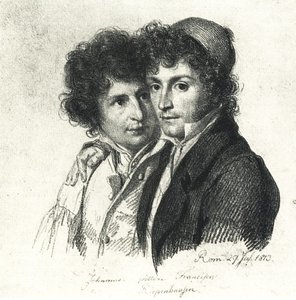
Franz Riepenhausen, Johannes Riepenhausen
1786 - 1831 , Germany
Quick Facts
- Artistic Movement Or Style: Classicism, Romanticism
- Artists Who Influenced This Artist:
- William Hogarth
- Raphael
- Date Of Birth: 1786-1831
- Full Name: Franz & Johannes Riepenhausen
- Nationality: German
- Notable Artworks:
- The Foreign Girl
- Raphael's Death
- Destruction of Cenci Family
- Place Of Birth: Göttingen, Germany
Related Articles

The Enduring Legacy of Oil on Canvas: Technique, History & Aesthetic Impact
Explore the rich history & techniques of oil painting – from Renaissance masters to Impressionism. Discover pigments, layering methods, and why this timeless medium endures. Expert insights for artists & art enthusiasts.

Oil on Canvas: A Historical & Technical Exploration of a Timeless Artistic Medium
Explore the rich history & enduring techniques of oil painting on canvas. Discover the science behind its longevity, conservation practices, and contemporary relevance. Expert insights for art enthusiasts.

The Enduring Power of Painting: A Historical & Contemporary Exploration of Form and Emotion
Explore the rich history & enduring techniques of oil painting with ArtsDot. Discover masterpieces, learn about art collecting, and find authentic handmade reproductions crafted by skilled artists.
The Enduring Legacy of Classicism: Principles, Evolution & Influence in Western Art
Explore the enduring legacy of Classicism in Western art! Discover its historical context, key principles, iconic masterpieces & lasting influence. Learn about Renaissance and Neoclassical movements with ArtsDot.
Neo-Classicism's Greatest Hits: 10 Masterpieces for Your Home |
Journey through Neo-Classicism's finest! Explore 10 iconic masterpieces by David, Ingres & Canova. Discover art history, techniques & timeless beauty – perfect for inspiring your home decor. Find museum-quality reproductions at