Menu
FREE ART CONSULTATION

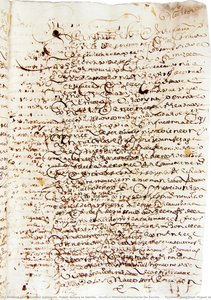
gabriel salmerón, public notary in seville. (archivo histórico provincial de sevilla.)

Quick Facts

  • Works on APS: 1
  • Born: Spain
  • Museums on APS: Archivos Estatales
  • Nationality: Spain
  • More…

Gabriel Salmerón: Notary, Artist, and the Echoes of Seville’s Legal Soul

Gabriel Salmerón (born in Seville, Spain – details of his birth year remain elusive within readily available historical records) stands as a fascinating figure bridging the worlds of law and art. More than simply a notary public, he was a man deeply embedded within the rich tapestry of 17th-century Seville, a city pulsating with legal activity and artistic fervor. His legacy isn’t one of grand canvases or celebrated exhibitions, but rather through meticulously preserved documents – payment bonds, contracts, and legal pronouncements that offer a unique window into the daily life and intellectual currents of his era. His work as a notary, a profession holding immense authority in a society governed by tradition and custom, intertwined inextricably with an artistic sensibility, creating a distinctive blend rarely encountered today. Salmerón’s professional trajectory is primarily documented through the archives of the Archivo Histórico Provincial de Sevilla. Here, amongst countless other legal records, his name appears repeatedly, signifying his consistent presence within the city's legal framework. He wasn’t merely executing formalities; evidence suggests a careful and considered approach to his work, reflecting an eye for detail and perhaps even a subtle aesthetic appreciation – qualities that would later manifest in his artistic endeavors. The most notable surviving document associated with him is a payment bond from Miguel de Cervantes Saavedra, the renowned author of *Don Quixote*, demonstrating Salmerón’s association with prominent figures of the Spanish literary scene. This particular bond, meticulously crafted and preserved, provides tangible proof of his role in facilitating transactions and safeguarding interests within Seville's commercial landscape. The document itself is a testament to the era – a beautiful example of early Baroque calligraphy and legal procedure, showcasing Salmerón’s skill as both a scribe and a guardian of legal order.

A Dual Identity: Law and Artistic Expression

While his primary profession was that of notary public, limited historical accounts suggest a parallel artistic practice – though the specifics remain shrouded in mystery. The archival records offer tantalizing glimpses into this dual identity. Salmerón’s name appears alongside descriptions of legal documents bearing stylistic elements indicative of artistic influence. Some scholars theorize that he may have been involved in illuminated manuscripts or perhaps even produced decorative seals for official correspondence, subtly incorporating artistic motifs within the framework of his legal duties. The connection between law and art during this period was particularly strong in Seville; the city served as a vital hub for trade, culture, and intellectual exchange, fostering an environment where these disciplines often intersected. The meticulous attention to detail demanded by his role as a notary likely honed his observational skills and appreciation for beauty – qualities that undoubtedly informed his artistic pursuits. It’s important to note that Salmerón's artistic output wasn't widely publicized or formally recognized during his lifetime, contributing to the relative obscurity surrounding his creative life.

The Legacy of a Provincial Archivist

Gabriel Salmerón’s lasting significance lies not in grand masterpieces but in the quiet preservation of historical records. His documents – particularly the Cervantes bond – offer invaluable insights into 17th-century Seville, revealing details about its legal practices, economic activities, and social dynamics. The Archivo Histórico Provincial de Sevilla considers him a key figure in documenting the city’s history, acting as a silent witness to pivotal moments in Spanish society. His work serves as a reminder that historical narratives are often constructed through the mundane – the everyday actions of individuals who played crucial roles within their communities.

Further Research and Unanswered Questions

Despite extensive research into archival records, several aspects of Gabriel Salmerón’s life remain shrouded in mystery. The precise details surrounding his birth date, family background, and artistic output are largely unknown. Contemporary accounts offer little beyond his profession as a notary public, leaving much to speculation and scholarly interpretation. Ongoing efforts by historians and archivists continue to uncover new information about this intriguing figure, promising to shed further light on his life and work. The digital archive of the Archivo Histórico Provincial de Sevilla is an invaluable resource for researchers seeking to delve deeper into Salmerón’s legacy, offering a wealth of primary source material that speaks volumes about the man and the era in which he lived. His story serves as a compelling example of how seemingly ordinary individuals can leave an enduring mark on history through their contributions to the legal and cultural landscape of their time.

Art Quiz

There is only one correct answer for each question.

Question 1:
Gabriel Salmerón was primarily known for his work as a:
Question 2:
In which city did Gabriel Salmerón primarily practice his profession?
Question 3:
What historical period is Gabriel Salmerón most associated with?
Question 4:
The archive where many of Gabriel Salmerón's documents are housed is:
Question 5:
What type of legal documents did Gabriel Salmerón commonly handle?