The Ethereal Legacy of a Romantic Visionary
In the grand tapestry of Austrian Romanticism, few threads shimmer with as much poignant brilliance and tragic brevity as the life of Johann Evangelist Scheffer von Leonhartshof. Born in Vienna, his existence was a fleeting but luminous spark that left an indelible mark on the European art landscape. While some historians debate the exact dates of his birth, his presence in the early nineteenth century is undeniable, characterized by a profound sensitivity to the spiritual and the sublime. His journey was not merely one of technical mastery, but a soulful pursuit of the divine through the medium of paint and line, a quest that saw him move from the academic traditions of Vienna to the revolutionary heart of the Nazarene movement in Rome.
The early years of Scheffer’s life were steeped in the intellectual ferment of a changing Europe. Though he emerged from a noble family that faced financial hardship, his spirit remained unburdened by material lack, fueled instead by an insatiable thirst for beauty and meaning. His formal training at the Academy of Fine Arts, Vienna, under the guidance of Hubert Maurer, provided him with a rigorous foundation in anatomy and classical composition. However, the rigid structures of academicism could not contain his burgeoning Romantic sensibilities. He sought a deeper, more primordial connection to art—one that favored the purity of religious devotion and the emotional resonance of historical narrative over the mere imitation of classical form.
The Nazarene Spirit and the Roman Influence
The true metamorphosis of Scheffer’s style occurred during his transformative travels through Italy. It was in the sun-drenched landscapes of Venice and the ancient, storied streets of Rome that he found his true artistic kin. He became a vital participant in the Nazarene movement, a group of German-speaking artists who sought to revitalize Christian art by looking back to the sincerity and spiritual depth of the late Middle Ages and early Renaissance. Within this circle, particularly under the influence of Friedrich Overbeck, Scheffer was affectionately known as "Raffaelino," a testament to his ability to evoke the grace and clarity of Raphael while infusing it with a modern, Romantic intensity.
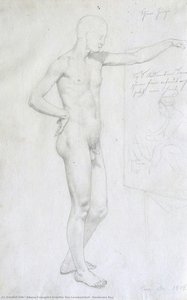
This period of his life was marked by an intense focus on the sanctity of the human form. His work began to move away from cluttered, complex compositions toward a more focused, monumental simplicity. He embraced the idea that a single, well-rendered figure could convey the entirety of a spiritual truth. This philosophy is perhaps most beautifully realized in his depictions of biblical figures, where every gesture and every shadow serves to heighten the sense of sacredness. His time in Italy was not without its shadows, however; it was during these travels that he likely contracted the tuberculosis that would eventually claim his life, adding a layer of tragic vulnerability to his artistic output.
Mastery of Emotion and Historical Significance
Scheffer’s technical prowess was characterized by a remarkable ability to blend disegno—the precision of drawing—with a soft, emotive use of color. His canvases often possess a luminous quality, as if the light itself were an emissary of the divine. Whether he was working on large-scale religious commissions or intimate sketches, his dedication to capturing the "sublime" remained constant. He possessed a rare gift for rendering textures—the heavy fold of a saint's robe, the delicate skin of a cherub, or the cold steel of a warrior's armor—with such accuracy that the physical world seemed to dissolve into a spiritual vision.
The significance of his contribution to art history lies in his role as a bridge between the classical past and the Romantic future. His achievements include:
- Integration of Nazarene Ideals: He successfully brought the spiritual purity of the Nazarene movement into the broader Austrian artistic consciousness.
- Development of Monumental Simplicity: He pioneered a style that utilized fewer, more powerful figures to create a sense of profound emotional and moral weight.
- Lasting Influence on Religious Art: His works, such as those found in the Belvedere, continue to serve as touchstones for artists seeking to express religious fervor through classical beauty.
Though his life was cut short in his early twenties, leaving behind a body of work that feels both complete and tantalizingly unfinished, Johann Evangelist Scheffer von Leonhartshof remains a titan of the Romantic era. He taught us that art is not merely a reflection of what we see, but a window into what we feel and believe. His legacy survives in every brushstroke that seeks to capture the eternal within the ephemeral.