The Rise of Viennese Portraiture: Amerling's Early Life & Training
Friedrich Ritter von Amerling (14 April 1803 – 14 January 1887) was an Austrian portrait painter in the court of Franz Josef. He was born in Vienna and was court painter between 1835 and 1880. With Ferdinand Georg Waldmüller, he is one of the outstan...
Friedrich Ritter von Amerling, a name synonymous with the refined elegance of 19th-century Vienna, didn’t emerge from artistic isolation. His story begins not in the grand salons he would later immortalize, but within the workshop of his father, Franz Amerling, a skilled goldsmith and silversmith. This early exposure to meticulous craftsmanship—the delicate precision required for intricate metalwork—laid a foundational aesthetic sensibility that would profoundly shape his approach to painting. Born in 1703, young Friedrich’s artistic inclinations were nurtured through formal study at the Academy of Fine Arts Vienna from 1815, though his education wasn't confined to Austrian borders. Journeys to Prague further honed his skills before a pivotal sojourn in London (1827-1828) introduced him to the portraiture of Thomas Lawrence, whose influence is subtly discernible in Amerling’s later works—a lightness of touch and an ability to capture not merely likeness, but character.
However, it was his travels to Paris and Rome that truly cemented his artistic direction. In Paris, he absorbed the lessons of Horace Vernet, while Rome provided a deep immersion in classical ideals – a reverence for form and composition that became hallmarks of his style. These experiences weren’t merely about acquiring technique; they were about understanding the *spirit* of portraiture—the power to convey status, intellect, and personality through carefully constructed imagery. Upon returning to Vienna around 1828, Amerling began building a reputation, initially catering to a diverse clientele before securing commissions from the Austrian court and aristocracy.
A Court Painter’s Palette: Amerling’s Academic Realism & Style
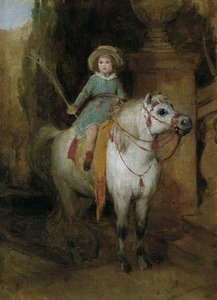 Oil sketch for the portrait of Prince Johann II of Liechtenstein on a Schimmelpony
Oil sketch of Prince Johann II riding a horse by Friedrich Ritter von Amerling (1844). Captures 19th-century aristocratic life in muted tones, classical style & Rococo details. A unique art piece!
Amerling's success wasn’t accidental. He was a master of academic realism, but his paintings transcend mere technical proficiency. His portraits aren’t simply accurate depictions; they are carefully curated representations designed to project an image of sophistication and grace. He possessed an extraordinary ability to render textures – the sheen of silk, the weight of velvet, the delicate flush of skin—creating a sense of tangible presence. This meticulous attention to detail was coupled with a subtle understanding of color theory, employing muted tones that evoke a sense of intimacy and warmth.
Consider his oil sketch for Prince Johann II of Liechtenstein on a Schimmelpony (1844). While a preliminary study, it encapsulates the essence of Amerling’s style: aristocratic life rendered with classical composure. The Rococo details—the ornate saddle, the refined posture of both horse and rider—speak to a world of privilege and leisure. But beyond the surface elegance lies a deeper skill – the ability to capture the personality of the Prince, his quiet confidence and inherent dignity. This wasn’t simply about painting what he *saw*, but what he *understood* about his subject.
Patronage and Society: The Aristocratic World Depicted by Amerling
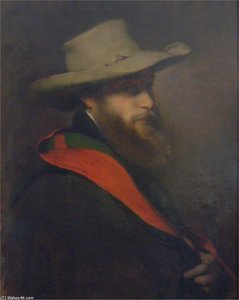 Viennese art dealer Georg Plach
To understand Amerling is to understand the society that commissioned him. The Biedermeier period (roughly 1815-1848) was a time of political repression following the Napoleonic Wars, yet it also fostered a flourishing of domestic life and artistic expression within the confines of private spheres. The aristocracy and burgeoning middle class sought to solidify their status through portraiture, and Amerling became *the* painter to do so. His studio wasn’t merely a place of artistic creation; it was a social hub where power, wealth, and taste converged.
The portraits themselves functioned as statements—declarations of belonging and refinement. Amerling understood this implicitly, crafting images that not only pleased his patrons but also reinforced their position within the complex social hierarchy. His relationship with art dealer Georg Plach was crucial in navigating this world, facilitating commissions and ensuring access to Vienna’s most influential families. The portraits he created weren't just likenesses; they were investments—symbols of a family’s legacy and cultural capital.
Beyond the Canvas: Travel, Self-Portraiture, and Artistic Exploration
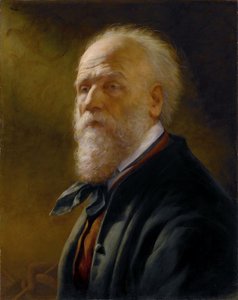
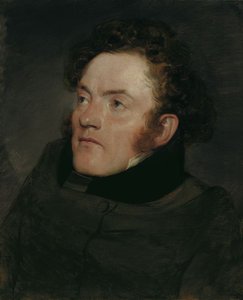 Portrait of the Painter Peter Fendi
This portrait appeals to collectors of 19th-century European art, those interested in historical portraits, and anyone seeking a sophisticated and timeless piece for their home or office. The subject's thoughtful expression and the painting’s elegant
Amerling wasn’t content to remain solely within the confines of his studio. Throughout his career, he embarked on numerous journeys – Italy (1836 & 1838), the Netherlands (1838), Munich (1839), Rome (1840-43), Spain (1882), England (1883), Greece (1884), and even as far afield as Norway’s North Cape (1885) and Egypt & Palestine (1886). These travels weren't simply for leisure; they were opportunities to broaden his artistic horizons, study different cultures, and refine his technique. He wasn’t merely replicating what he saw but absorbing it into his evolving aesthetic.
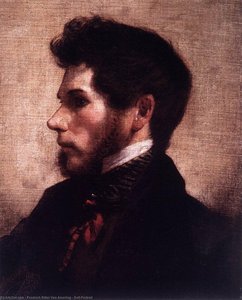
Intriguingly, Amerling also painted a remarkable series of self-portraits throughout his life—a fascinating record of his own aging process and artistic development. These weren't vanity projects; they were studies in character, explorations of light and shadow, and perhaps even reflections on the fleeting nature of time. His portrait of the painter Peter Fendi offers another glimpse into his world – a sensitive depiction of a fellow artist that reveals Amerling’s respect for his peers and his ability to capture intellectual depth.
Amerling's Legacy: Influence on Austrian Art & Rediscovery
By 1878, Amerling had been elevated to the nobility—a testament to his artistic achievements and social standing. He received numerous honors throughout his life, becoming a central figure in Vienna’s cultural landscape. However, despite his widespread acclaim during his lifetime, his fame waned in the decades following his death in 1887. It wasn't until the mid-20th century that a concerted effort was made to reassess his work, spearheaded by scholars like Günther Probszt.
Today, Friedrich von Amerling is recognized as one of the outstanding Austrian portrait painters of the 19th century, alongside Ferdinand Georg Waldmüller. His influence can be seen in the works of subsequent generations of artists, including Hans Makart and Gustav Klimt. His paintings—over 1000 in total—remain highly sought after by collectors worldwide, prized for their exquisite detail, subtle elegance, and ability to capture the spirit of a bygone era. ArtsDot offers stunning reproductions of Amerling’s masterpieces, allowing you to bring the timeless beauty of Viennese Biedermeier art into your own home. Explore our collection today and discover the enduring legacy of this remarkable artist.