Lajos Mack & Sándor Apáti Abt: Pioneers of Eosin Glaze and Pyrogranite at Zsolnay
The late 19th and early 20th centuries witnessed a remarkable flowering of ceramic artistry, driven by technological innovation and a burgeoning interest in decorative arts. Within this vibrant landscape emerged Lajos Mack and Sándor Apáti Abt, two Hungarian artists whose collaboration with the renowned Zsolnay porcelain factory at Pécs produced some of the most exquisite and technically daring works of the era. Their legacy lies not just in their beautiful creations but also in their groundbreaking introduction of eosin glazing and pyrogranite ceramics – techniques that fundamentally altered the possibilities of color and texture within porcelain.
Born in Hungary, Lajos Mack (dates unknown) and Sándor Apáti Abt (1870-1916) initially pursued separate artistic paths. Mack’s early career involved work as a painter and designer, while Abt honed his skills as a sculptor and craftsman. Their meeting at the Zsolnay factory in 1898 proved to be a pivotal moment, sparking a creative partnership that would yield extraordinary results. Zsolnay, already a leader in porcelain production, was actively seeking new methods of achieving richer colors and more complex surface effects. The duo’s expertise – Mack's design sensibilities and Abt’s technical proficiency – perfectly aligned with this ambition.
The Dawn of Eosin Glaze
Perhaps the most significant contribution of Mack and Abt to the ceramic world was their pioneering work with eosin glaze. Prior to their experimentation, achieving vibrant pinks and reds on porcelain was exceedingly difficult. Traditional methods often resulted in dull, unsatisfactory hues. The pair meticulously investigated the properties of eosin, a synthetic pigment derived from nitrobenzene, discovering that when applied under specific conditions – typically involving high firing temperatures and careful control of the glaze composition – it produced an intense, luminous pink unlike anything previously seen. This breakthrough was not merely aesthetic; it demanded significant adjustments to Zsolnay’s manufacturing processes, showcasing their collaborative spirit and technical acumen.
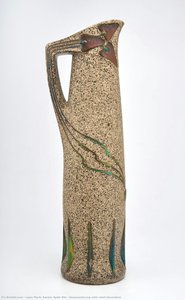
Their initial experiments with eosin glaze were documented in a 1899 ornamental jug featuring relief decoration – a piece that remains a celebrated example of their early work. The jug's surface is dominated by the striking pink of the eosin glaze, contrasted against intricate floral and geometric designs rendered in cobalt blue and other complementary colors. This single object demonstrated the potential of their new technique and quickly garnered attention within the art world.
Pyrogranite: A Revolutionary Texture
Alongside their work with eosin glaze, Mack and Abt developed another revolutionary technique: pyrogranite ceramics. This involved layering porcelain slips – liquid clay mixtures – of varying colors and thicknesses onto a mold, then firing them at extremely high temperatures. The intense heat caused the layers to fuse together, creating a textured surface resembling polished stone or marble. This process allowed for the creation of incredibly realistic depictions of natural forms – foliage, flowers, animals – with an unprecedented level of detail and depth.
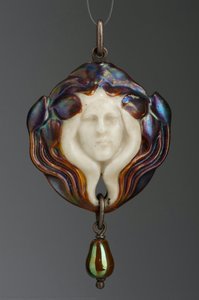
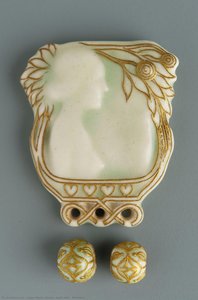
The “Pendant (Crocus)” exemplifies this technique brilliantly. The delicate petals of the crocus are rendered with astonishing precision, capturing both their form and texture through a masterful combination of layering and firing. Similarly, their "Necklace" showcases the pyrogranite’s ability to mimic the intricate patterns found in nature, creating an illusion of three-dimensionality that was revolutionary for its time.
A Legacy of Innovation
The impact of Lajos Mack and Sándor Apáti Abt extends far beyond their individual creations. Their innovations – eosin glazing and pyrogranite ceramics – fundamentally changed the possibilities of porcelain decoration, influencing generations of ceramic artists. Zsolnay quickly adopted these techniques, establishing them as core elements of its production. The duo’s work is now recognized as a cornerstone of Art Nouveau ceramics and a significant contribution to Hungarian decorative arts.
Despite their relatively short careers, Mack and Abt left an indelible mark on the world of ceramics. Their dedication to experimentation, combined with their artistic vision, cemented their place as pioneers – artists who dared to push the boundaries of technique and aesthetics, forever changing the way porcelain was made and appreciated.