Charles Louis François Le Carpentier: A Painter of the Sublime and the Human
Charles Louis François Le Carpentier (1744-1822) stands as a pivotal, yet often overlooked, figure in the history of French art. More than simply a painter, he was a master of marine scenes, a dedicated humanitarian through his artistic endeavors, and a keen observer of the human condition – qualities that coalesce to create a body of work both technically impressive and profoundly moving. His legacy resides not just in the beauty of his paintings but also in his commitment to depicting the world with empathy and a deep understanding of its complexities.
Born in Lausanne, Switzerland, into a family marked by artistic talent – his father was an architect – Le Carpentier’s early life instilled within him a sensitivity to form and composition. He spent his formative years in Paris, immersing himself in the vibrant intellectual and artistic circles of the era. This period witnessed the rise of Neoclassicism, yet Le Carpentier quickly transcended its rigid constraints, developing a distinctly personal style characterized by dramatic lighting, dynamic brushwork, and an acute awareness of atmospheric effects. His early training likely involved studying under established masters, though specific details remain somewhat elusive – a common challenge when dealing with artists who often worked outside the formal structures of academic institutions.
Le Carpentier’s artistic career unfolded against the backdrop of significant social and political upheaval in France. The late 18th and early 19th centuries were marked by revolution, war, and profound societal change. This tumultuous period profoundly shaped his artistic vision. He witnessed firsthand the devastating consequences of conflict – particularly the Haitian Revolution – and this experience fueled a deep-seated concern for human suffering. This is most powerfully reflected in his series of paintings depicting scenes of maritime disaster and the plight of shipwrecked sailors, often portraying them with remarkable realism and compassion. These works weren’t merely depictions of dramatic events; they were poignant meditations on loss, resilience, and the vulnerability of humanity.
The Maritime Vision: Seascapes and Humanitarianism
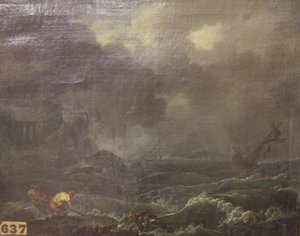
Le Carpentier's most celebrated work lies within his extensive series of marine paintings. He possessed an extraordinary ability to capture the raw power and unpredictable beauty of the sea – its shimmering surfaces, towering waves, and ominous skies. His compositions are often characterized by a sense of dramatic tension, achieved through carefully orchestrated diagonals, contrasting light and shadow, and a masterful use of color. He wasn’t simply painting seascapes; he was attempting to convey the *experience* of being at sea – the exhilaration, the terror, the sublime awe.
However, Le Carpentier's maritime paintings are inextricably linked to his humanitarian concerns. He frequently depicted scenes of shipwrecks and maritime disasters, not as sensationalistic events, but as opportunities to highlight the suffering of those involved. His painting “L’aide aux mères de famille” (Aid to Families), for example, vividly portrays a group of women tending to the survivors of a shipwreck, their faces etched with grief and exhaustion. This work is particularly noteworthy for its emotional intensity and its subtle critique of societal indifference to human suffering. He wasn't interested in glorifying naval prowess; he sought to expose the human cost of ambition and conflict.
His depictions of naval battles were equally complex, often showing not just the clash of ships but also the devastation wrought upon civilian populations. He avoided simplistic heroic narratives, instead presenting a more nuanced and unsettling view of warfare’s impact on ordinary people. This approach distinguished him from many of his contemporaries who tended to romanticize military glory.
Technique and Influences
Le Carpentier's artistic technique evolved considerably throughout his career. Initially influenced by the Neoclassical style, he gradually embraced a looser, more expressive brushstroke – a hallmark of Romanticism. He was particularly adept at capturing light and shadow, creating a sense of depth and atmosphere that imbues his paintings with remarkable realism. His use of color was often dramatic and evocative, employing contrasting hues to heighten emotional impact.
While he largely worked independently, Le Carpentier’s artistic development was undoubtedly shaped by the prevailing trends of his time. The influence of Jacques-Louis David, a leading figure in Neoclassicism, is evident in his early works, particularly in their careful attention to detail and classical composition. However, he quickly moved beyond these constraints, drawing inspiration from the Romantic painters – notably Théodore Géricault and J.-L. David – whose emphasis on emotion, drama, and social commentary resonated deeply with his own artistic sensibilities.
Furthermore, Le Carpentier’s exposure to musicology—he was a keen student of musical theory—influenced his approach to composition, particularly in the way he used line and movement to create a sense of dynamism. His paintings often possess a rhythmic quality that mirrors the structure of musical scores.
Legacy and Historical Significance
Despite his considerable talent and artistic achievements, Le Carpentier’s work has remained relatively obscure for much of the 20th century. This is partly due to the challenges inherent in researching artists who operated outside the established academic system. However, recent scholarship has begun to shed light on his significant contributions to French art history.
Le Carpentier's paintings offer a unique window into the social and political landscape of 18th and 19th-century France. His depictions of maritime disasters and humanitarian crises reflect a deep concern for human suffering – a theme that remains remarkably relevant today. His ability to combine technical mastery with emotional depth makes him a compelling figure in the history of French painting, deserving of greater recognition as one of the era’s most insightful and compassionate artists.
His work continues to be exhibited in museums around the world, offering viewers a powerful reminder of the enduring power of art to illuminate the human condition.