The Enigmatic Master of Antwerp's Shadows
In the bustling, mercantile heart of the sixteenth-century Low Countries, a painter emerged whose brush captured the tension between spiritual devotion and worldly greed. Marinus van Reymerswaele, an artist whose very name evokes the coastal town of Reimerswaal where he was born, remains one of the most fascinating enigmas of the Dutch Renaissance. While his life follows the typical trajectory of a skilled craftsman—studuring in Leuven and finding professional footing within the prestigious Antwerp Guild of Saint Luke—his true legacy lies in the atmospheric, often caricatural worlds he constructed on wood panels. He did not merely paint scenes; he staged moral dramas that reflected the anxieties of an era caught between medieval piety and the rising tide of capitalism.
The traces of his early development suggest a man deeply rooted in the traditions of Northern Europe. Registered as a pupil of the glass painter Symon van Daele, Reymerswaele possessed an eye for detail and light that would later define his mastery of texture. As he established himself in Antwerp, the epicenter of European trade, his work began to mirror the city's own complex identity. He operated a prolific workshop, a bustling studio capable of producing numerous versions of his most celebrated themes. This industriousness allowed his specific visual language—a blend of meticulous realism and biting social commentary—to permeate the collections of the era, influencing how generations would perceive the faces of those who handled the era's wealth.
A Gallery of Greed and Grace
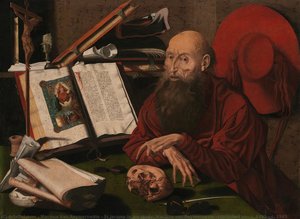
To look upon a work attributed to Reymerswaele is to enter a space where the sacred and the profane collide. He was a master of a very specific, recurring iconography that captured the imagination of the sixteenth-century public. His compositions often centered on four pivotal themes: the intense study of St. Jerome, the bustling activity of tax collectors, the domesticity of the money changer and his wife, and the professional solitude of a lawyer in his office. In these works, the artist utilized a technique that emphasized the tactile nature of the world—the heavy folds of velvet, the cold glint of coins, and the weathered skin of men consumed by their labors.
His depictions of financial figures are particularly striking for their psychological depth and almost grotesque characterizations. In his scenes of tax collectors and bankers, one finds a sense of theatrical tension. These figures are often portrayed with exaggerated features, their faces etched with a hunger for profit that borders on the predatory. Yet, there is an undeniable artistry in this caricatural approach; he captures the very essence of the era's shifting morality. Conversely, his religious compositions, such as his many versions of St. Jerome in his study, offer a more contemplative counterpoint. Here, the artist uses the same precision to render the scholarly tools of the saint—books, inkwells, and manuscripts—to create an atmosphere of profound intellectual and spiritual devotion.
Legacy and Artistic Influence
Though he worked in the shadow of giants like Quinten Massys and drew inspiration from the monumental works of Albrecht Dürer, Reymerswaele carved out a niche that was entirely his own. He did not seek to replicate the idealized beauty of the Italian Renaissance; instead, he embraced the gritty, textured reality of Northern life. His ability to weave moralizing allegories into genre scenes helped shape the visual vocabulary of the Netherlands for decades. The widespread popularity of his themes meant that his workshop's output acted as a cultural mirror, reflecting the societal shifts brought about by the expansion of global trade and the complexities of new financial systems.
The historical significance of Marinus van Reymerswaele lies in his role as a chronicler of the human condition during a period of immense transition. Through his eyes, we see the tension of a world where the pursuit of gold and the pursuit of God were inextricably linked. His works remain vital touchstones for understanding the Northern Renaissance, serving as both a window into the material culture of Antwerp and a profound meditation on the enduring struggle between our earthly desires and our spiritual aspirations. Even today, the sharp, piercing gaze of his tax collectors continues to challenge and captivate the modern viewer.