The Visionary Eye of Mark Catesby
In the golden age of scientific discovery, few figures captured the raw, untamed essence of the New World as vividly as Mark Catesby. Born in the quiet landscapes of Essex, England, around 1683, Catesby possessed a spirit that could not be contained by the borders of Europe. While his early education in classical studies and mathematics provided him with the analytical rigor necessary for scientific inquiry, it was an innate passion for ornithology that would ultimately lead him across the Atlantic. His journey was more than a mere expedition; it was a profound artistic and scientific pilgrimage that sought to bridge the gap between the known European natural world and the mysterious, vibrant ecosystems of North America.
Catesby’s arrival in Virginia in 1712 marked the beginning of a transformative era for both natural history and botanical art. Moving through the tidewater regions and eventually venturing into the lush territories of Carolina, Florida, and the Bahama Islands, he acted as both an explorer and a chronicler. Unlike many of his contemporaries who relied on dried specimens or second-hand descriptions, Catesby sought the living pulse of nature. He observed birds in flight, reptiles amidst foliage, and the delicate interplay between flora and fauna, translating these fleeting moments into permanent, exquisite records that would stun the scientific community upon their return to England.
A Masterpiece of Scientific Illustration
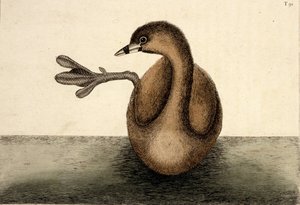
The crowning achievement of Catesby’s career remains his monumental publication, The Natural History of Carolina, Florida and the Bahama Islands. Produced between 1729 and 1747, this work was a revolutionary treatise that fundamentally altered the Western understanding of American biodiversity. Through a painstaking process of collecting specimens and rendering them in detailed watercolors and etchings, Catesky produced 220 plates of unparalleled beauty and accuracy. Each plate served as a window into a world previously unseen by European eyes, featuring an array of birds, reptiles, amphibians, fish, insects, and plants.
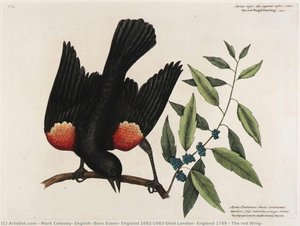
His technique was characterized by a remarkable marriage of scientific precision and artistic grace. Catesby did not merely illustrate subjects in isolation; he often depicted them within their ecological context, showing the symbiotic relationships between plants and the creatures that inhabited them. This approach predated many modern ecological concepts and gave his work a narrative depth that set it apart from purely taxonomic drawings. The vibrant colors and meticulous textures of his watercolors—such as those seen in his famous depiction of the Red Winged Starling—conveyed a sense of life and vitality that made his scientific observations feel deeply personal and emotionally resonant.
Legacy and Historical Significance
The impact of Mark Catesby’s work reverberated through the centuries, establishing him as a foundational figure in the tradition of naturalistic illustration. Before the arrival of John James Audubon, whose Birds of America would later become a legendary standard, Catesby’s volumes stood as the most significant illustrated record of North American life. His ability to document the habits and environments of species with such fidelity earned him a permanent place in the annals of both art and science. He paved the way for future generations of naturalists, proving that rigorous scientific observation could be elevated through the medium of fine art.
Beyond his technical contributions, Catesby’s life represents the quintessential Enlightenment pursuit: the quest to categorize, understand, and celebrate the wonders of the natural world. His legacy is found not only in museum archives but in the very way we perceive the beauty of the wild. Through his eyes, the flora and fauna of the New World were transformed from mere curiosities into subjects of profound scientific importance and aesthetic wonder, ensuring that his name remains synonymous with the dawn of American natural history.