Pavel Otdelnov: Echoes of Industry and Memory
Born in 1979 in Dzerzhinsk, Russia—a city inextricably linked to the Soviet Union’s industrial heartland—Pavel Aleksandrovich Otdelnov’s artistic vision is deeply rooted in a landscape scarred by both progress and decline. His work, encompassing painting, drawing, video installation, and photography, doesn't simply depict scenes; it excavates memory, confronting viewers with the lingering traces of Soviet history and the unsettling beauty of abandoned industrial spaces. Otdelnov’s journey as an artist began not in a rarefied studio but within the shadow of chemical plants—a legacy that profoundly shapes his thematic concerns and artistic language.
Dzerzhinsk, situated in the Nizhny Novgorod region, holds a particularly poignant significance for Otdelnov. His family’s history is interwoven with the city's industrial past; generations worked within the sprawling chemical factories that defined its identity. This familial connection—a direct link to the labor and struggles of those who built and then witnessed the dismantling of Soviet industry—forms the bedrock of his artistic exploration. The subsequent economic hardship and desolate beauty of the post-Soviet landscape became a crucial source of imagery, representing not just physical decay but also the erosion of collective memory and the psychological impact of rapid societal shifts.
Otdelnov’s formal training laid the foundation for his distinctive style. He began his artistic education at the Nizhny Novgorod Art College in 1994, where he studied under Pavel Rybakov, a teacher who instilled in him an appreciation for traditional painting techniques and a keen eye for composition. Later, he continued his studies at Moscow State Academic Institute of Fine Arts named after V. Surikov, under the guidance of Pavel Nikonov and Yuri Shishkov, absorbing the influence of Soviet painting masters from the 1920s and 30s—a period characterized by monumental scale, social realism, and a powerful engagement with the collective experience. This early exposure to the formal vocabulary of Socialist Realism provided a crucial counterpoint to his later explorations of memory and decay.
The "Promzona" Project: Confronting Industrial Ghosts
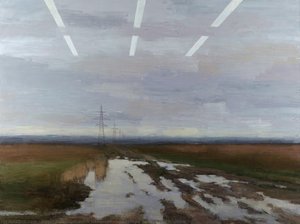
A pivotal moment in Otdelnov’s artistic development arrived with the “Promzona” project (2015-2020), an ambitious undertaking that served as a deeply personal investigation into his family history and the broader narrative of Soviet industrialization. The term "Promzona" itself—meaning "industrial zone"—evokes images of vast, desolate landscapes dominated by abandoned factories, decaying infrastructure, and the ghosts of those who once toiled within their walls. Otdelnov’s work during this period moved beyond mere documentation; he sought to capture the emotional resonance of these spaces, imbuing them with a sense of melancholy, loss, and haunting beauty.
The project involved extensive research into his family's past, tracing their involvement in the chemical industry of Dzerzhinsk. This intimate connection fueled a desire to represent not just the physical reality of the abandoned factories but also the human stories behind them—the lives, hopes, and sacrifices of those who contributed to this industrial behemoth. His paintings from this period often feature stark, almost brutalist compositions, utilizing bold colors and textured brushstrokes to convey the weight of history and the enduring presence of memory.
Technique and Evolution: From Socialist Realism to Personal Narrative
Initially trained within the framework of Socialist Realism—a style emphasizing idealized representations of Soviet life—Otdelnov’s artistic language underwent a significant evolution over time. His early works, characterized by meticulous detail and adherence to established conventions, gradually shifted towards a more expressive and subjective approach. This transformation wasn't simply a stylistic change; it reflected a deeper engagement with personal memory and the complexities of representing history.
During the 2000s, Otdelnov began experimenting with new techniques, moving away from the rigid formalism of his earlier training. He explored the properties of paint itself—its texture, color, and ability to create layers of meaning—while simultaneously incorporating elements of abstraction into his compositions. The influence of artists like Pavel Nikonov and Andrey Vasnetsov became increasingly apparent in this period, as he sought to balance technical skill with a willingness to push the boundaries of traditional painting.
Recognition and Contemporary Significance
Pavel Otdelnov’s work has garnered critical acclaim and recognition within Russia and internationally. He is a member of the Moscow Union of Artists and a nominee for the Kandinsky Prize, a prestigious award recognizing contemporary artists working in painting and drawing. His exhibitions have been featured at prominent institutions such as the Erarta Museum of Contemporary Art in St. Petersburg and the Kalmar Art Museum in Sweden.
Otdelnov’s art speaks to a broader cultural dialogue about memory, industrialization, and the legacy of the Soviet Union. His work invites viewers to contemplate the complex relationship between history, place, and personal identity—a theme that resonates powerfully in an era marked by rapid social change and the ongoing struggle to reconcile the past with the present. His exploration of abandoned landscapes serves as a poignant reminder of both the triumphs and tragedies of the 20th century, offering a uniquely Russian perspective on the enduring power of memory and the beauty found within decay.