Menu
FREE ART CONSULTATION

rhode island anti-slavery society, american, 1833 - 1850s

1833 - 1850

Quick Facts

  • Top 3 works: Collection box of the Rhode Island Anti-Slavery Society owned by Garrison family
  • Museums on APS: National Museum of African American History and Culture
  • Works on APS: 1
  • Copyright status: Public domain
  • Lifespan: 17 years
  • Art period: 19th Century
  • More…

Art Quiz

There is only one correct answer for each question.

Question 1:
What was Rhode Island Anti-Slavery Society primarily known for?
Question 2:
In what decade was Rhode Island Anti-Slavery Society most active?
Question 3:
What artistic medium did Rhode Island Anti-Slavery Society utilize to raise funds for their cause?
Question 4:
Which artistic movement influenced the stylistic choices of Rhode Island Anti-Slavery Society?
Question 5:
What prominent artist created a painting titled “Morning in the Live Oaks, Boerne, Texas,” reflecting American Impressionism?

Rhode Island Anti-Slavery Society: A Canvas for Abolitionist Ideals

The Rhode Island Anti-Slavery Society stands as a poignant testament to the fervent spirit of reform that gripped America during its formative years—specifically between 1833 and the mid-1850s. More than just an organization, it represented a collective commitment to challenging the entrenched institution of slavery and advocating for the fundamental rights of African Americans, achievements which are reflected in their artistic endeavors. Examining these artworks offers invaluable insight into the moral landscape of the era and illuminates the creative responses to pressing social concerns.

Origins and Purpose

Founded in Providence, Rhode Island, in 1833, the Society quickly gained momentum thanks to the tireless efforts of prominent abolitionists like William Lloyd Garrison and Frederick Douglass. Its mission was unambiguous: to dismantle slavery through legal reform, moral persuasion, and active resistance. Recognizing that visual communication could powerfully convey their beliefs, members embarked on a project that transcended mere fundraising—they commissioned artistic creations designed to galvanize public opinion and solidify the Society’s commitment to its cause.

The Cardboard Coin Collection Box: A Symbol of Hope

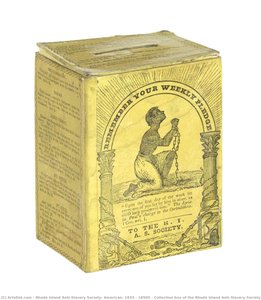
Perhaps the most enduring symbol of the Rhode Island Anti-Slavery Society's artistic output is their ingenious cardboard coin collection box. Produced in two pieces—a top with a slot for donations and a base—this unassuming object served as more than just a receptacle for funds; it functioned as a visual declaration of intent. The centerpiece was a tableau depicting an enslaved figure kneeling before implements of bondage, skillfully rendered by Robert Julian Onderdonk. This image powerfully conveyed the dehumanizing realities of slavery and underscored the Society’s determination to confront injustice head-on. The box's muted yellow hue contrasted sharply with the bold black print detailing the scene, creating a deliberate aesthetic that commanded attention and reinforced its message.

Influences and Artistic Movements

The Society’s artistic vision was shaped by several influential movements of the time. Impressionism, championed by Onderdonk himself—whose painting “Morning in the Live Oaks” captures the serene beauty of Texas while subtly hinting at the moral complexities of the region—provided a framework for conveying emotion and capturing fleeting moments. Simultaneously, elements of Academic Art, emphasizing realism and meticulous technique, ensured that the Society’s artworks adhered to established standards of artistic excellence. Furthermore, explorations into Cubism, pioneered by avant-garde artists, introduced geometric forms and fragmented perspectives – reflecting the broader intellectual currents challenging traditional conventions.

Museum Collections and Legacy

Today, reproductions of Rhode Island Anti-Slavery Society artwork can be found in institutions such as The Smithsonian American Art Museum and The Brooklyn Museum, offering visitors a tangible connection to this pivotal period in American history. These collections serve as reminders of the Society’s unwavering dedication to abolitionist ideals and its contribution to shaping public discourse on slavery. Its legacy extends beyond mere artistic production; it embodies the courage and conviction required to confront injustice and strive for a more equitable society—a message that continues to resonate powerfully today.