Rodolpho Frederico Francisco Lindemann: A Pioneer of Brazilian Visual Culture
Born in Germany during the mid-19th century, Rodolpho Frederico Francisco Lindemann’s journey to Brazil marked a pivotal moment not only for his own artistic trajectory but also for the evolving visual landscape of Salvador da Bahia. While often overlooked within broader narratives of Brazilian photography, Lindemann stands as a crucial figure—a German expatriate who deeply immersed himself in Bahian life and, through his lens, captured a vibrant, complex, and ultimately transformative representation of the city’s identity. His work transcends mere documentation; it's an intimate dialogue between observer and observed, reflecting both European artistic sensibilities and the unique cultural tapestry of colonial Brazil.
Lindemann arrived in Bahia around 1870, a period marked by significant social and political shifts. The city was grappling with the legacy of slavery, undergoing processes of modernization while simultaneously clinging to deeply rooted traditions. This dynamic tension—the collision of European influence and Afro-Brazilian heritage—provided fertile ground for Lindemann’s artistic explorations. Initially working as part of the Gaensly & Lindemann studio, he quickly established himself as a skilled photographer, specializing in landscapes, urban scenes, and portraits. However, it was his later work, particularly his series of postcards featuring women of color from Bahia, that cemented his legacy and sparked considerable debate regarding representation and social commentary.
The Urban Canvas: Landscapes and Cityscapes
Lindemann’s early photographs are characterized by a meticulous attention to detail and a formal approach reminiscent of mid-19th century European landscape photography. He frequently utilized the Forte São Marcelo, a strategically positioned fortress overlooking Salvador, as his primary vantage point. From this elevated position, he captured expansive panoramic views of the city—a sprawling metropolis of whitewashed buildings, bustling harbors, and vibrant marketplaces. These images weren’t simply records of physical space; they were carefully constructed compositions that sought to convey a sense of grandeur and order. The use of long exposures required patience and precision, resulting in remarkably sharp and detailed prints – a testament to his technical skill.
Crucially, Lindemann's urban views weren’t detached observations. They were deeply embedded within the context of Bahia’s burgeoning tourism industry. As Salvador gained recognition as a desirable destination for European travelers, photographers like Lindemann played a vital role in shaping its image—presenting a carefully curated version of the city designed to entice visitors. His photographs became integral components of tourist guides and promotional materials, contributing significantly to the city's evolving identity as a “Black Rome”—a place where the grandeur of ancient Rome met the vibrant rhythms of Afro-Brazilian culture.
Portraits of Bahia: Women and Identity
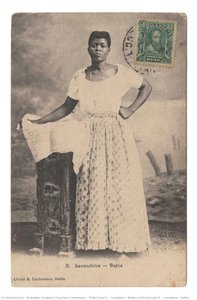
Perhaps the most enduring aspect of Lindemann’s oeuvre is his series of postcards depicting women of color from Bahia. These images, often strikingly intimate in their portrayal, represent a significant departure from the prevalent racial stereotypes that dominated visual representations of Afro-Brazilians at the time. Rather than presenting them as exotic or primitive subjects, Lindemann captured their dignity, beauty, and everyday lives with remarkable sensitivity. The women featured—market vendors, washerwomen, dancers, and religious figures—were not simply objects of representation; they were active participants in Bahian society.
These postcards weren’t merely commercial products; they functioned as powerful statements about racial identity and social status. By elevating the image of Black women to a position of prominence within tourist materials, Lindemann implicitly challenged prevailing racist attitudes and contributed to a more nuanced understanding of Bahia's diverse population. The series sparked considerable discussion among scholars and critics, raising questions about the ethics of representation and the role of photography in shaping perceptions of race and culture.
Legacy and Historical Significance
Rodolpho Frederico Francisco Lindemann’s work remains a vital resource for understanding the visual history of Salvador da Bahia. His photographs offer invaluable insights into the city's transformation during the late 19th century—a period marked by rapid modernization, social upheaval, and shifting racial dynamics. While his contributions were initially overlooked, recent scholarship has begun to recognize Lindemann’s significance as a pioneering photographer who captured not only the physical landscape of Bahia but also its complex cultural identity.
Furthermore, Lindemann's legacy extends beyond his individual photographs. His work exemplifies the broader phenomenon of European photographers who migrated to Brazil during the 19th century, bringing with them their artistic sensibilities and contributing significantly to the development of Brazilian photography as a distinct visual tradition. Studying Lindemann’s oeuvre provides a crucial lens through which to examine the intersection of race, identity, and representation in colonial and post-colonial Brazil—a conversation that continues to resonate powerfully today.