The Luminous Vision of Romola Clifton
Born in the vibrant coastal city of Perth in 1935, Romola Clifton emerged as a profound voice in the realm of Australian watercolor painting. Her artistic journey was shaped by an early immersion in the nuances of form and space, deeply influenced by her father, Marshall Waller Gervase Clifton, a distinguished architect whose eye for structural elegance left an indelible mark on her developing aesthetic. This foundational appreciation for spatial relationships would later manifest in her ability to balance the delicate transparency of watercolor with the commanding presence of landscape and portraiture. Her early years in Western Australia provided a rich tapestry of light and scenery that would serve as the primary vocabulary for much of her lifelong exploration.
The trajectory of Clifton’s career was marked by an extraordinary period of international refinement during the 1950s. Seeking to expand her technical horizons, she traveled to London to study at the prestigious Slade School of Fine Art. It was within these hallowed halls that her raw talent was tempered by rigorous classical training, allowing her to master the subtle complexities of light, shadow, and atmospheric depth. This period of academic excellence in London, followed by further studies at the University of Western Australia, equipped her with a sophisticated command over the watercolor medium—a medium that requires both immense technical precision and the courage to embrace the unpredictable flow of pigment and water.
A Legacy of Recognition and Connection
Clifton’s ascent within the Australian art community was swift and decorated with significant accolades. Her ability to capture the ephemeral qualities of the natural world earned her the Claude Hotchin Art Prize for watercolor in 1956, a milestone that signaled her arrival as a major talent. This momentum continued into the following decade when she secured the Helena Rubinstein Portrait Prize in 1960, demonstrating a versatility that allowed her to transition seamlessly from the expansive vistas of the Australian landscape to the intimate, psychological depths of human portraiture. Her work became a bridge between the external world and the internal spirit, often capturing subjects with a warmth and intimacy that transcended mere likeness.
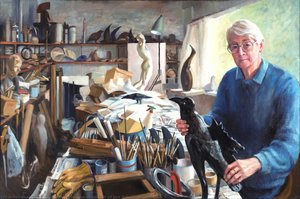
Beyond her individual triumphs, Clifton’s life was woven into the very fabric of the Australian cultural landscape through her personal and professional relationships. Her marriage to fellow artist Ross Morrow fostered a period of shared creative inquiry, while her later union with the poet and arts administrator Ian Templeman placed her at the heart of a rich intellectual circle. These connections often resulted in beautiful intersections of medium and meaning; for instance, her friendship with the sculptor Jan Brown led to evocative portraiture that celebrated the shared passion for art-making. Through her exhibitions across Western Australia, Tasmania, Sydney, and Canberra, Clifton did more than just display paintings; she documented the soul of a nation through a lens of exquisite, watercolor-washed light.