The Soul of the Maremma: The Life and Legacy of Ruggero Panerai
Born amidst the vibrant cultural landscape of Florence on March 19, 1862, Ruggero Panerai emerged as a profound chronicler of the Italian spirit during a transformative era of national identity. His early years were shaped by the quiet strength of his humble beginnings, a background that instilled in him a lifelong reverence for the unadorned beauty of the natural world and the rhythmic simplicity of rural existence. While his formal journey began with the meticulous study of ornament at the Academy of Fine Arts in Florence, it was his transition into the realm of figure painting that truly ignited his artistic passion. This academic foundation, characterized by a disciplined approach to form, provided the essential scaffolding upon which he would later build his more expressive and atmospheric compositions.
The true turning point in Panerai’s development arrived when he entered the studio of the legendary Giovanni Fattori. Under Fattori’s mentorship, Panerai was not merely taught technique; he was introduced to a way of seeing. He became deeply immersed in the Macchiaioli movement, an Italian precursor to Impressionism that favored the use of "macchie"—or patches—of color and light to define form and mood. This stylistic evolution allowed Panerai to move beyond mere representation, enabling him to capture the fleeting, ephemeral qualities of the Tuscan landscape. His brushwork grew bolder and more emotive, utilizing light and shadow to evoke the heavy heat of a summer afternoon or the misty uncertainty of a dawn in the countryside.
A Painter of Landscapes and Legends
Panerai’s artistic vision was inextricably linked to the Maremma, the rugged and evocative coastal region of Tuscany. He possessed a rare ability to transform pastoral scenes into epic narratives, focusing his gaze on the daily struggles and quiet triumphs of the peasantry and the spirited movement of cavalry. His work often centered on themes of military life and the rustic charm of shepherd culture, rendered with a meticulous attention to detail that never sacrificed the broader emotional atmosphere. In masterpieces such as The Guado, which earned him acclaim at the Venice exhibition in 1887, one can sense the palpable connection between the subjects and their ancestral lands.
His repertoire was remarkably diverse, ranging from intimate studies of animals to grand-scale historical evocations. Notable works include:
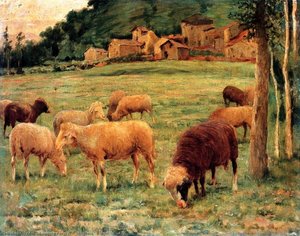
- The Flock: A serene and captivating depiction of rural life that exemplifies his mastery of the Macchiaioli influence.
- The Sick Horse (Il cavallo malato): A poignant exploration of the bond between man and beast, born from his success in the Fumagalli competition.
- Mazzeppa: A large-scale, dramatic canvas that showcased his ability to handle complex historical themes and equestrian movement for international audiences in Paris and Bologna.
Academic Eminence and Historical Significance
As his reputation expanded beyond the borders of Tuscany, Panerai’s influence permeated the broader European art scene. His talent was recognized not only by collectors but also by the highest academic institutions of his time. He achieved significant prestige through winning prestigious contests, such as the Florentine academy stipend in 1883, and eventually ascended to the esteemed positions of Professor at the Royal Academy of Bologna and Correspondent Professor of the Accademia of Florence. These roles allowed him to shape the next generation of Italian painters, passing on the legacy of the Macchiaioli tradition.
Though he passed away in Paris in 1923, Panerai’s contribution to the history of Italian art remains indelible. He stands as a bridge between the classical traditions of the nineteenth century and the burgeoning modernism of the twentieth. By capturing the essence of the Maremma—its light, its people, and its enduring customs—he created a visual archive of a vanishing way of life. His paintings remain more than mere depictions; they are emotional windows into a period of Italian history marked by both profound struggle and breathtaking beauty, ensuring that the soul of Tuscany continues to resonate with viewers long after the paint has dried.