The Architect of Cosmic Romanticism
Sabin Bălașa was far more than a mere painter; he was a visionary weaver of dreams, an artist who sought to bridge the profound gap between the terrestrial realm and the divine. Born in 1932 in the quiet, evocative landscape of Dobriceni, Romania, his artistic journey began with a deep-seated connection to the mythic textures of his homeland. After honing his technical mastery at the Nicolae Grigorescu Fine Arts Institute in Bucharest, Bălașa expanded his horizons through the classical traditions of the Siena and Perugia academies in Italy. This unique fusion of Romanian soul and European academic rigor allowed him to cultivate what he famously termed Cosmic Romanticism—a style that transcends the boundaries of traditional landscape and portraiture to touch upon the eternal and the infinite.A Symphony of Symbol and Light
The essence of Bălașa’s work lies in its ability to transform a canvas into a celestial stage, where the boundaries between the earthly and the divine dissolve. His oeuvre, deeply rooted in the aesthetics of Surrealism yet far more expansive, utilizes a sophisticated vocabulary of symbols to evoke spiritual aspiration and metamorphosis. Through his masterful command of light and atmosphere, he achieved a luminous quality that makes the very air within his paintings feel alive. Within his dreamlike compositions, certain motifs recur with mythic frequency:- Celestial Bodies: Stars, moons, and cosmic entities that anchor his figures to the vastness of the universe.
- Mythic Creatures: The eagle and the serpent, serving as powerful emblems of transformation, strength, and primal energy.
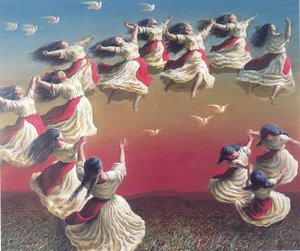
- Ethereal Figures: Women captured in moments of weightless transcendence, their forms blending seamlessly into the heavens like silken clouds.
His landscapes are never static; they are breathing, pulsing environments where the grandeur of the Carpathian Mountains meets a sense of spiritual liberation. By employing delicate brushwork and a sophisticated use of oil on canvas, he creates a rhythmic movement that guides the viewer through a realm where gravity is merely a suggestion surrendered to beauty.