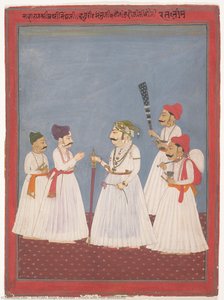
The Luminous Legacy of Sri Prathi Singh of Ratlam
In the delicate, translucent world of Indian miniature painting, few names evoke the ethereal beauty of the late 18th and early 19th centuries quite like Sri Prathi Singh of Ratlam. Though the precise dates of his life remain shrouded in the mists of history, his artistic presence is undeniably felt through the vibrant, breathing canvases he left behind. Emerging during a transformative era for Indian art, Singh became a pioneer of watercolor, a medium that requires an extraordinary level of discipline and a profound understanding of light. His work does not merely depict scenes; it captures the very soul of a bygone epoch, blending the rigid traditions of courtly art with a fluid, expressive grace that was remarkably ahead of its time.
The foundations of Singh’s mastery were likely laid within the prestigious corridors of the Rajput courts. While biographical records of his early training are sparse, the stylistic hallmarks of his work suggest an education steeped in the royal patronage system. This environment demanded a rigorous adherence to detail, focusing on religious iconography, mythological grandeur, and the intricate nuances of courtly life. It was here that Singh would have learned to navigate the complex visual language of his ancestors, absorbing the techniques of skilled artisans who prioritized storytelling through meticulous ornamentation. This classical upbringing provided him with the structural strength necessary to later innovate within the medium of watercolor.
A Mastery of Pigment and Light
What truly distinguishes Singh from his contemporaries is his unparalleled command over the watercolor medium. Unlike the heavy, opaque layers of oil painting, watercolor demands a mastery of transparency. Singh utilized the technique of layering subtle, translucent washes to build depth, allowing light to pass through the pigment and reflect off the paper beneath. This created a luminous quality that gave his subjects an almost supernatural glow. His brushwork was a study in contradictions: deliberative yet fluid, capable of rendering the fine silk of a royal garment with razor-sharp precision while simultaneously capturing the soft, atmospheric haze of a distant landscape.
His technical prowess is perhaps most breathtakingly realized in his celebrated work, ‘Prince with Four Attendants’. In this masterpiece, one can observe the artist's ability to weave together character and atmosphere. The painting serves as a testament to his skill in:
- Achieving subtle tonal gradations that breathe life into human skin and fabric.
- Using precise linework to define the regal posture of the central figure.
- Creating a sense of narrative movement through the placement of attendants.
- Balancing rich, saturated pigments with delicate, airy spaces.
Historical Significance and Artistic Endurance
The historical importance of Sri Prathi Singh of Ratlam lies in his role as a bridge between the traditionalist past and a more expressive future. By pushing the boundaries of what watercolor could achieve, he helped expand the vocabulary of Indian miniature painting, proving that the medium could convey not just detail, but profound atmosphere and psychological depth. His ability to blend the meticulous observation required by Rajput traditions with a more fluid, painterly sensibility marks him as a significant figure in the evolution of Indian art history.
Today, the works attributed to Singh continue to captivate scholars and art enthusiasts alike. He remains a symbol of an era where art was a sacred dialogue between the artist, the patron, and the divine. His legacy survives in every luminous wash and every delicate stroke, reminding us of a time when the mastery of a single pigment could capture the infinite complexity of the human experience. Through his enduring contribution to the watercolor tradition, Sri Prathi Singh of Ratlam remains an eternal light in the vast tapestry of Indian artistic heritage.