The Enigmatic World of Borisov-Musatov
Borisov-Musatov, a name whispered with reverence in the annals of Russian Symbolism, remains an elusive figure despite his profound impact on early 20th-century art. Born in St. Petersburg in 1870, he wasn’t immediately destined for artistic greatness. His initial path led him towards law, but a burgeoning passion for painting soon eclipsed any legal ambitions. He enrolled at the Imperial Academy of Arts, studying under Arkhip Kuindzhi, whose mastery of light and atmosphere would leave an indelible mark on the young artist's developing style. However, it was his encounter with Mikhail Vrubel that proved truly transformative. Vrubel’s intensely personal symbolism, his exploration of myth and folklore, and his innovative use of color resonated deeply with Borisov-Musatov, setting him on a course towards creating a uniquely melancholic and ethereal vision of the world.
Early Influences and the Search for a Personal Language
The late 19th century in Russia was a period of intense social and artistic upheaval. The realist traditions that had dominated earlier decades were giving way to new currents of thought, influenced by European movements like Impressionism and Symbolism. Borisov-Musatov initially experimented with various styles, absorbing the lessons of both realism and early modernist approaches. His early works often depicted scenes of everyday life, but even then, a subtle sense of unease and longing began to emerge. He traveled extensively throughout Europe, particularly Germany and Italy, immersing himself in Renaissance art and the burgeoning Secessionist movements. These experiences broadened his artistic horizons, exposing him to new techniques and ideas, yet he remained determined to forge his own path, one that would capture the specific spirit of Russian culture and psychology. He became a member of the Symbolist group "Scarlet Rose" in 1896, solidifying his commitment to exploring inner states and subjective experiences through art.
The Mature Style: Atmosphere, Memory, and Feminine Mysticism
Borisov-Musatov’s mature style, which began to fully blossom around the turn of the century, is characterized by a remarkable atmospheric quality. He wasn't interested in depicting reality as it was, but rather as it *felt*. His paintings are suffused with a hazy light, often evoking a sense of memory and nostalgia. Figures seem to dissolve into their surroundings, their forms softened and blurred, creating an impression of dreamlike ambiguity. A recurring theme in his work is the depiction of women – elegant, enigmatic figures who embody both beauty and sadness. These women are rarely portrayed as active participants in the world; instead, they appear lost in contemplation, haunted by unspoken desires and regrets.
His interiors, often bathed in a golden glow, become symbolic spaces representing the inner lives of his subjects. He employed a unique technique of layering thin glazes of paint to achieve this luminous effect, creating a sense of depth and translucency that is rarely seen elsewhere.
Major Works and Artistic Achievements
Several paintings stand out as defining examples of Borisov-Musatov’s artistic vision.
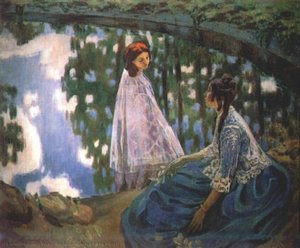
"The Reservoir" (1902) is perhaps his most iconic work, depicting a group of women in a park bathed in the soft light of twilight. The painting's atmosphere of melancholy and longing has captivated viewers for generations.
"Before the Performance" (1904-1905) showcases his mastery of interior scenes, capturing the anticipation and anxiety of a theatrical setting.
His series of paintings depicting Tamara de Lempicka, though less well-known, reveal his fascination with feminine beauty and psychological complexity. He was also an accomplished stage designer, creating innovative sets for productions at the Moscow Art Theatre, further demonstrating his ability to create immersive and emotionally resonant environments. His work wasn’t prolific; he focused intensely on a relatively small number of paintings, each one meticulously crafted and imbued with profound meaning.
Historical Significance and Legacy
Borisov-Musatov's untimely death in 1905 at the age of just 35 tragically cut short a promising career. However, his influence on Russian art continued to be felt long after his passing. He is considered one of the key figures of Russian Symbolism, paving the way for later generations of artists who sought to explore inner states and subjective experiences through their work. His emphasis on atmosphere, memory, and feminine mysticism resonated with a growing desire for spiritual renewal in a rapidly changing world.
- He bridged the gap between Impressionism and Symbolism.
- His unique technique of layering glazes influenced many subsequent artists.
- His exploration of psychological themes anticipated the rise of Expressionism.
While his work was often misunderstood during his lifetime, it has since been recognized as a seminal contribution to the development of modern art. Today, Borisov-Musatov’s paintings are held in major museums around the world, and he is celebrated as one of Russia's most important and innovative artists – a master of atmosphere, memory, and the elusive beauty of the human soul.