



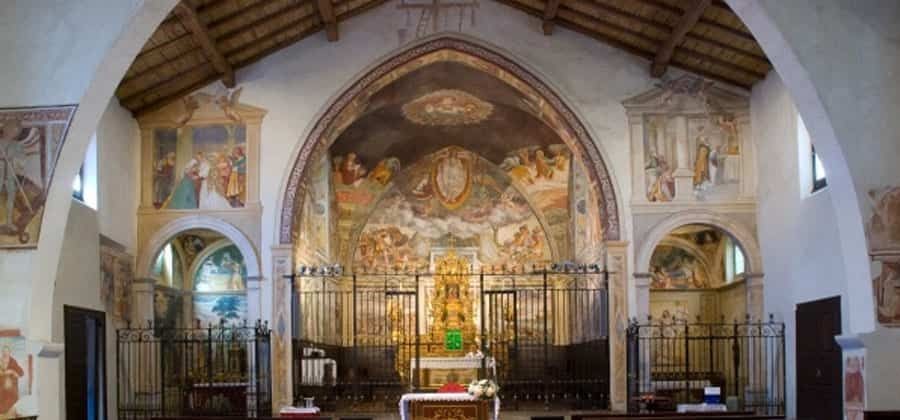
A Sanctuary of Light and Lombard Legacy
Tucked away from the vibrant, bustling corridors of Bergamo’s Città Alta, the San Michele al Pozzo Bianco offers a profound encounter with the soul of the Lombard Renaissance. To step through its entrance is to leave the modern world behind and enter a space where time seems to have slowed, held captive by the weight of centuries. This is not merely a church; it is a living chronicle of devotion and artistic evolution. While its foundations whisper stories from the 8th century, the structure itself has undergone a series of dramatic transformations, evolving from a medieval sanctuary into a refined Renaissance jewel. The architecture, characterized by a graceful rounded arch and an unassuming exterior, serves as a quiet prelude to the breathtaking visual splendor waiting within its walls.
The true heartbeat of this sacred space lies in its unparalleled collection of frescoes, most notably the visionary works of Lorenzo Lotto . In the left side chapel, completed in 1525, visitors are greeted by a series of monumental panels depicting Scenes from the Life of the Virgin Mary . Lotto, a master of the Venetian Renaissance, brings a unique psychological depth to these religious narratives; his figures possess an expressive, almost haunting humanity that transcends mere iconography. Through his meticulous use of color and light, the divine becomes intimately relatable, capturing fleeting emotions and spiritual intensity that continue to captivate scholars and art lovers alike. These frescoes do not merely decorate the walls; they breathe life into the very stone of the chapel.
Beyond the celebrated Lotto cycle, the church serves as a magnificent tapestry of local artistic history. The interior is a layered masterpiece, where 15th-century reconstructions meet later Renaissance flourishes. One might find themselves mesmerized by the 16th-century works of Giovan Battista Guarinoni d'Ayerara or the delicate canvas of Madonna and Child with Saints Peter and Paul by Giovanni Paolo Lolmo. Even the subterranean levels offer a descent into the past, where the historic crypt reveals 13th-century frescoes that hint at the church’s Byzantine influences. For the discerning eye, every corner—from the external frescoes of the adjacent Casa del Vicario to the ancient white well that gives the site its name—contributes to a cohesive atmosphere of historical continuity and aesthetic grace.
For the art enthusiast or the interior designer seeking inspiration, San Michele al Pozzo Bianco provides a masterclass in how art can define and elevate an architectural space. The museum’s intimate scale fosters a rare, focused connection between the viewer and the artwork, free from the overwhelming crowds of larger institutions. It remains a site of ongoing scholarly fascination, where researchers continue to peel back the layers of pigment and technique to better understand the innovations of the Lombard masters. In this tranquil corner of Bergamo, art and faith remain inextricably intertwined, offering a serene sanctuary for those who seek beauty in its most authentic and enduring forms.




