 Preview
 Send
Send Share
Share
 Details

 Download
 Similars
 X-Ray
X-Ray Diaporama
Fishing for Souls


 Read More
Giclée / Art Print
Museum-quality giclée or canvas print with fast production and flexible finish options. ( Buy Hand Made Painting Buy Image)




P118B $10

P118H $10

P118W $10

P438Z $10

P508JH $12

P508YH $12

P805H $10

P805Z $10

P919BZ $10

P919G $10

P919XJ $10

P959ZH $10

P968JZ $12

W106C $8

W218G $10

W218JH $8

W218Y $10

W307PJ $10

W316G $10

W316PJ $8

W316Y $10

W398PJ $8

W4111J $10

W500HY $15

W500JH $15

W692G $12

W849H $8

W940BG $15

W953PJ $8




Pick from our preset sizes that match the artwork's original proportions.

You may enter your own dimensions to fit a specific frame or space. If your selected size does not match the original image's proportions, we will either crop the artwork or extend the image with a mirrored or solid-fill edge. A digital mockup will be sent for your approval before production begins.
Please note that the on-screen preview does not reflect the actual cropping or extension. Only the mockup will accurately show the final composition.
While custom sizes are available, we recommend selecting a dimension from the predefined list to preserve the original proportions.
Worldwide Delivery () in 2 weeks instead of standard 4/5 weeks. (28 August)

Free Worldwide Express Shipping

High-Quality Linen Canvas

Full Shipping Insurance

Customs Tax Refund Guarantee

True Color Matching Guarantee

60-Day Return Policy (Defects Only)

100% Money-Back Guarantee

Bulk Discount Offer
 Glass option is only available in size under 110 CM

Fishing for Souls
Giclée / Art Print
Reproduction Size
-


Total Price
$ 63
A Storm of Faith and Water
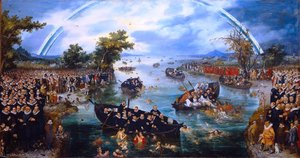
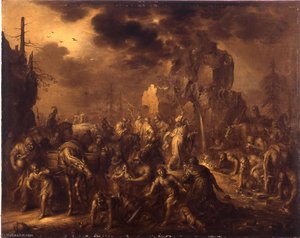
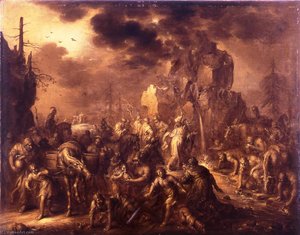
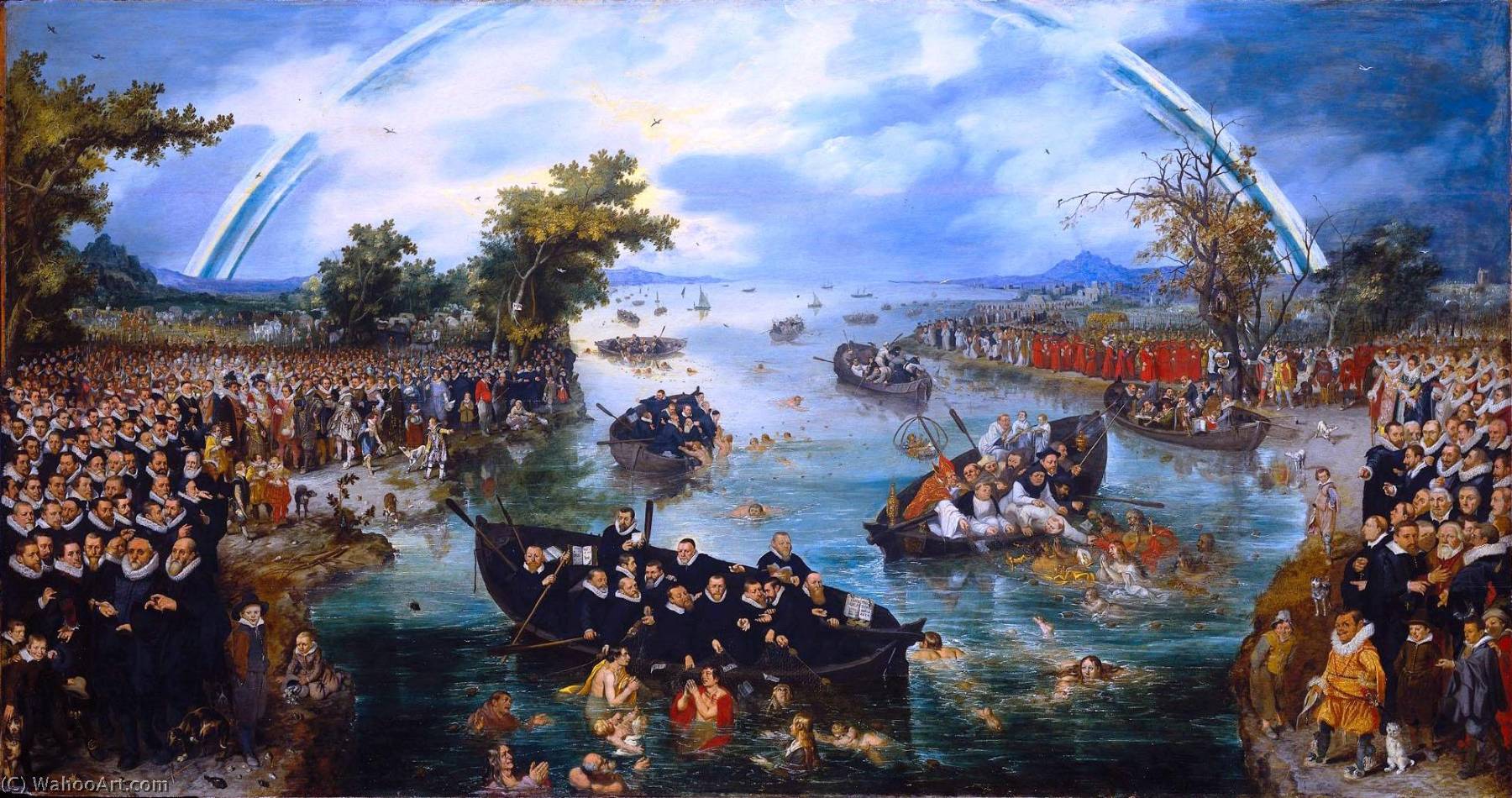
In the vast, turbulent expanse of Adriaen Pietersz van de Venne’s 1614 masterpiece, Fishing for Souls, the viewer is not merely a spectator but a witness to a cosmic struggle. This monumental oil on panel serves as a breathtaking window into the Dutch Golden Age, capturing a moment where biblical catastrophe meets biting political commentary. At first glance, the eye is swept into a chaotic deluge—a visceral depiction of the Great Flood from the Book of Genesis. Figures struggle against churning, dark waters, their limbs flelied in desperate attempts to evade an encroaching annihilation. Yet, beneath this surface-level drama of survival lies a profound intellectual depth that transforms the painting from a simple religious narrative into a sophisticated allegory of religious discord.
The composition is a masterclass in Baroque tension, deliberately structured to guide the soul through layers of meaning. Van de Venne utilizes a tripartite division to organize the chaos: the lower realm is dominated by the terrifying, frothing energy of the flood; the central band features boats navigating the treacherous currents; and the upper reaches offer a glimpse of a distant, rain-swept shoreline beneath a celestial rainbow. This use of diagonals and atmospheric perspective creates an overwhelming sense of scale, pulling the observer into the very heart of the tempest. The lighting is particularly evocative, with diffused, overcast tones that suggest a world suspended in a moment of divine judgment, punctuated only by the soft, hopeful arc of the rainbow.
The Artistry of Allegory and Technique
To behold Fishing for Souls is to appreciate the meticulous technical prowess of the Dutch tradition. Van de Venne employs the hallmark techniques of the Baroque era, utilizing complex layering and glazing to achieve a luminous depth that seems to pulse with life. The color palette, though grounded in the somber blues, earthy browns, and murky greys of a storm-tossed sea, is brilliantly interrupted by the bright pigments of clothing and vessel hulls, providing necessary visual anchors amidst the swirling motion. Every brushstroke serves a purpose, from the textured, rough application that mimics the spray of salt water to the delicate rendering of human expressions caught in the throes of fear and hope.
Beyond its aesthetic splendor, the painting functions as a sharp-witted social commentary on the religious fractures of the seventeenth century. During the Twelve Years’ Truce, the Netherlands was a landscape divided by the ideological battle between Protestantism and Catholicism. Van de Venne subtly encodes this conflict within the scene; the river acts as a symbolic border between the Northern and Southern Netherlands. The act of "fishing" becomes a metaphor for the proselytizing efforts of both factions, each side attempting to harvest souls from the turbulent waters of existence. It is an intellectually stimulating piece that rewards repeated viewing, offering new layers of political irony and spiritual reflection with every encounter.
A Timeless Addition to the Collector's Gallery
For the discerning collector or interior designer, a high-quality reproduction of this work offers more than just decoration; it provides a conversational centerpiece of immense historical weight. The painting’s ability to evoke intense emotional responses—ranging from the dread of the flood to the peace of the rainbow—makes it an ideal focal point for spaces designed for contemplation and intellectual engagement. Whether placed in a grand library or a contemporary living space, the dramatic movement and rich, classical tones of Fishing for Souls command attention, bringing the storied atmosphere of the Dutch Golden Age into the modern home.
Related Artworks
Artist Biography
A Life Forged in Flight: The World of Adriaen Pietersz van de Venne
Adriaen Pietersz van de Venne, a name resonating with the vibrant energy of the Dutch Golden Age, was more than just a painter; he was a visual storyteller, a social commentator, and a versatile artist who navigated the complex currents of 17th-century life. Born in Delft in 1589, his very origins were steeped in upheaval. His parents, fleeing religious persecution in the Southern Netherlands, instilled within him a sense of displacement that perhaps fueled his keen observation of societal fractures and human foibles. This early experience shaped not only his artistic vision but also his commitment to using art as a mirror reflecting the world around him—its joys, its sorrows, and its often-pointed ironies. Van de Venne’s education began in Leiden, where he immersed himself in the intellectual ferment of the university town, acquiring a grounding in Latin that would later serve him well in understanding classical allegories and humanist thought. His formal artistic training commenced with Simon de Valk, a master goldsmith and painter, followed by an apprenticeship with Jeronimus van Diest, honing his skills in the delicate art of grisailles—monochrome paintings executed in shades of gray, a technique that would become a hallmark of his style.From Allegory to Everyday Life: A Developing Artistic Voice
Van de Venne’s artistic journey began to truly unfold with his move to Middelburg in 1614. Here, he encountered the powerful influence of Jan and Pieter Bruegel the Elder, whose depictions of peasant life and allegorical scenes resonated deeply with his own burgeoning sensibilities. It was during this period that he created Fishing for Souls, a strikingly symbolic work commenting on the religious conflicts tearing through Europe during the Eighty Years’ War. This early masterpiece demonstrated an ability to translate complex political and theological ideas into compelling visual narratives, establishing him as an artist with something important to say. As his career progressed, Van de Venne increasingly turned towards genre scenes—depictions of everyday life featuring peasants, beggars, thieves, and fools. However, these were not merely observational studies; they were often infused with moral lessons and proverbs, drawing heavily on the writings of Jacob Cats, a prominent Dutch poet and playwright. This collaboration between artist and writer proved fruitful, resulting in numerous engravings and grisailles that captured the essence of Dutch society—its bustling markets, its boisterous taverns, and its underlying anxieties. He wasn’t simply recording life; he was interpreting it through a lens of satire and social critique.A Master of Many Trades: Beyond the Canvas
Van de Venne's talents extended far beyond painting. Throughout his career, he actively worked as a book illustrator and print designer, contributing to the flourishing literary scene of the Dutch Golden Age. This versatility was not unusual for artists of the time, but Van de Venne distinguished himself through the quality and inventiveness of his work in multiple mediums. In 1625, he relocated to The Hague, becoming an integral part of the city’s artistic community. He quickly rose through the ranks of the Guild of Saint Luke, eventually serving as its dean in 1637. This position underscored his standing within the art world and allowed him to advocate for the interests of fellow artists. His commitment to professionalizing the field led him to become a founding member of Confrerie Pictura, an organization dedicated to elevating the status of artists and promoting a more academic approach to artistic training. He even secured commissions from high places, executing portraits and historical paintings for Frederik Hendrik, the Dutch stadholder, demonstrating his skill in both formal portraiture and grand-scale narrative painting.Legacy and Lasting Influence
Adriaen Pietersz van de Venne’s artistic legacy is multifaceted. He was a master of allegory, genre scenes, portraits, grisailles, and satirical works—a true polymath of the Dutch Golden Age. His paintings offer invaluable insights into the social, religious, and political landscape of his time, providing a nuanced perspective on the complexities of 17th-century life. While perhaps not as widely celebrated today as some of his contemporaries like Rembrandt or Vermeer, Van de Venne’s influence persisted well after his death in The Hague in 1662. His use of grisailles and genre scenes continued to inspire artists for generations, and his satirical commentary on human nature remains relevant even now. His work serves as a reminder that art can be both beautiful and thought-provoking, capable of entertaining, educating, and challenging our perceptions of the world. He left behind a body of work that is not only aesthetically pleasing but also historically significant—a testament to his skill, his intellect, and his unwavering commitment to capturing the spirit of his age.Key Characteristics of His Work
- Allegorical Depth: Van de Venne frequently employed allegory to convey complex moral or political messages.
- Genre Scene Realism: His depictions of everyday life are remarkably detailed and realistic, capturing the essence of Dutch society.
- Grisaille Mastery: He was a renowned master of grisailles, using monochrome palettes to create striking and evocative images.
- Satirical Commentary: His work often contains subtle or overt satire, offering insightful critiques of human behavior and societal norms.
- Proverbial Illustrations: Many of his paintings illustrate popular proverbs and sayings, adding layers of meaning and cultural context.
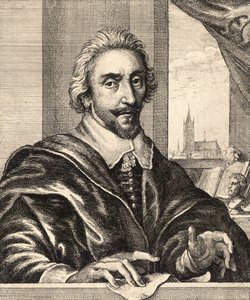
Adriaen Pietersz van de Venne
1589 - 1662 , Netherlands
Quick Facts
- Artistic Movement Or Style: Dutch Golden Age painting
- Artists Who Influenced This Artist:
- Jan Brueghel the Elder
- Pieter Brueghel the Elder
- Date Of Birth: 1589
- Date Of Death: 1662
- Full Name: Adriaen Pietersz van de Venne
- Nationality: Dutch
- Notable Artworks:
- Fishing for Souls
- Fools Have the Most Fun
- Place Of Birth: Delft, Netherlands
Related Articles
Willem van de Velde the Elder: Master of Maritime Painting & Chronicler of the Dutch Golden Age
Discover the captivating maritime paintings of Willem van de Velde the Elder, a master chronicler of the Dutch Golden Age. Explore his unparalleled realism and lasting influence on naval art history.

Dutch Masters: 10 Golden Age Paintings That Still Inspire |
Journey into the Dutch Golden Age! Explore 10 iconic paintings by Rembrandt, Vermeer & Hals. Discover the stories behind these Baroque masterpieces and find museum-quality art reproductions to elevate your home decor on .

Rembrandt's Masterpieces: Explore 25 Iconic Paintings & Prints | ArtsDot
Journey through Rembrandt van Rijn's 25 most iconic paintings & etchings. Explore Dutch Golden Age masterpieces, dramatic chiaroscuro, and timeless portraits. Find museum-quality art reproductions to elevate your home decor on ArtsDot.com.
Pieter de Hooch: Illuminating Dutch Domestic Life & Golden Age Charm
Explore the captivating world of Pieter de Hooch, a master of Dutch Golden Age painting. Discover his innovative use of light, intimate domestic scenes, and lasting influence on art history. Learn more at ArtsDot.

Golden Age Reflections: Dutch Baroque Painting & Cultural Innovation
Explore the Dutch Golden Age of painting! Discover key artists like Vermeer & ter Borch, their innovative techniques, and the rich cultural context behind these Baroque masterpieces. Learn about collecting & appreciating this iconic art period.