 Preview
 Send
Send Share
Share
 Details

 Download
 Similars
 X-Ray
X-Ray Diaporama
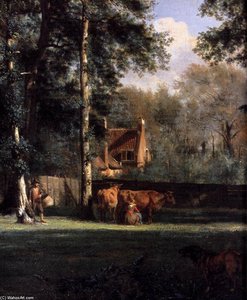
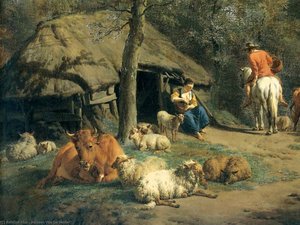
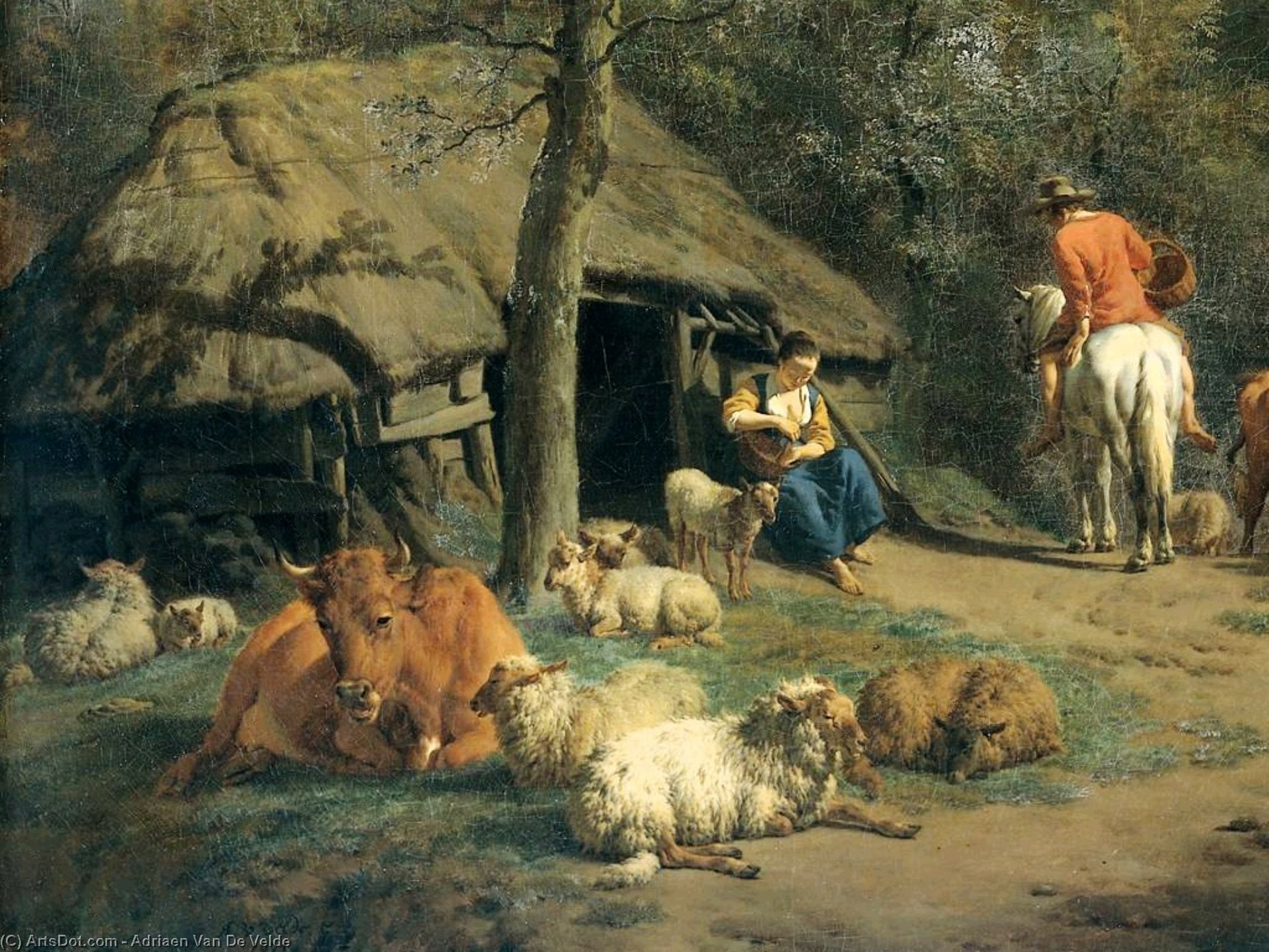
The Hut (detail)
 Oil On Canvas
- WallArt
- Baroque
 1671
1671- Early Modern
 76.0 x 65.0 cm
 Read More
Hand Made Oil Reproduction
Hand-painted oil on canvas in your size and frame, made to order by our artists. ( Buy Print Buy Image)




P118B $10

P118H $10

P118W $10

P438Z $10

P508JH $12

P508YH $12

P805H $10

P805Z $10

P919BZ $10

P919G $10

P919XJ $10

P959ZH $10

P968JZ $12

W106C $8

W218G $10

W218JH $8

W218Y $10

W307PJ $10

W316G $10

W316PJ $8

W316Y $10

W398PJ $8

W4111J $10

W500HY $15

W500JH $15

W692G $12

W849H $8

W940BG $15

W953PJ $8




Pick from our preset sizes that match the artwork's original proportions.

You may enter your own dimensions to fit a specific frame or space. If your selected size does not match the original image's proportions, we will either crop the artwork or extend the painting with additional hand-painted elements. A digital mockup will be sent for your approval before production begins.
Please note that the on-screen preview does not reflect the actual cropping or extension. Only the mockup will accurately show the final composition.
While custom sizes are available, we recommend selecting a dimension from the predefined list to preserve the original proportions.
After order, ArtsDot.com team will email client for instructions and provide a mockup preview
Worldwide Delivery () in 3/4 weeks instead of standard 5 weeks. (17 August). No compromise on quality.

Free Worldwide Express Shipping

High-Quality Linen Canvas

Full Shipping Insurance

Customs Tax Refund Guarantee

True Color Matching Guarantee

60-Day Return Policy (Defects Only)

100% Money-Back Guarantee

Bulk Discount Offer
 Glass option is only available in size under 110 CM

The Hut (detail)
Reproduction Medium
Reproduction Size
-


Total Price
$ 263
Artwork Description
A Pastoral Symphony in Oil: Rediscovering Adriaen van de Velde
In the golden twilight of the seventeenth century, the Dutch masters captured not just the landscapes of their homeland, but the very soul of rural tranquility. Among these luminaries, AdriaEN van de Velde emerges as a poet of the pastoral, a painter whose brush possessed the rare ability to breathe life into the quietest corners of the countryside. His masterpiece, The Hut (detail), created in 1671, serves as an intimate window into a bygone era of peace and agricultural rhythm. This exquisite oil on canvas, currently preserved within the hallowed halls of the Rijksmuseum in Amsterdam, invites the viewer to step away from the chaos of modern life and into a world where time is measured only by the movement of shadows across a thatched roof.
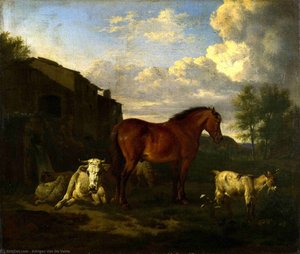
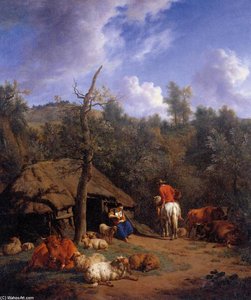
The composition of this detail piece is a masterclass in Baroque storytelling. At its heart, we encounter a man on horseback, his vibrant red jacket providing a singular, warm focal point amidst the earthy tones of the landscape. His poised hand upon the reins suggests a moment of pause—a momentary stillness in a day of labor. Surrounding him, the scene is populated by the gentle inhabitants of the farm: sheep scattered across the verdant terrain, some resting in quiet contemplation while others graze, and a watchful dog positioned near the center, acting as a silent guardian of the flock. Every element, from the texture of the thatch to the soft anatomy of the livestock, is rendered with a precision that speaks to Van de Velde’s profound connection to the natural world.
The Mastery of Light and Baroque Technique
To gaze upon The Hut (detail) is to witness the sophisticated use of light and shadow characteristic of the Baroque period. Van de Velde was not merely documenting a scene; he was sculpting it with light. Through delicate, soft brushstrokes, he achieves a remarkable sense of dimensionality, allowing the viewer to feel the warmth of the sun filtering through the atmosphere. The artist’s ability to manipulate tonal shifts creates a profound depth, pulling the eye from the immediate presence of the horse and rider into the hazy, atmospheric distance of the rural setting.
This technical prowess is particularly evident in the way the textures interact. The ruggedness of the wooden hut contrasts beautifully with the soft, woolly coats of the sheep and the sleek, muscular form of the horse. For collectors and interior designers alike, this painting offers a sophisticated palette of warm, organic hues that can anchor a room with a sense of historical weight and timeless elegance. It is a work that does not shout for attention but rather commands it through its quiet, immersive realism.
An Eternal Invitation to Serenity
Beyond the technical brilliance lies the emotional resonance of the piece. There is an inherent symbolism in the pastoral scene—a celebration of the idyll, representing a harmonious existence between humanity, animal, and earth. The painting evokes a sense of nostalgia for a simpler way of life, making it an emotionally evocative choice for any curated collection. It serves as a meditative piece, offering a sanctuary of calm within a home or gallery space.
For those seeking to bring the prestige of the Dutch Golden Age into their personal environments, a high-quality reproduction of this work offers more than just decoration; it offers an experience. Whether placed in a sunlit study or a grand living area, The Hut (detail) acts as a portal to the seventeenth century, reminding us of the enduring beauty found in the most humble of settings. It remains a testament to Adriaen van de Velde’s legacy as a painter who could find the extraordinary within the ordinary.
Related Artworks
Artist Biography
The Master of Pastoral Serenity
Adriaen van de Velde stands as a pivotal figure in the Dutch Golden Age, a period defined by an unparalleled flourishing of artistic innovation and observational precision. Born in Amsterdam in 1636, he was immersed from birth in a lineage of profound artistic talent. As the son of the celebrated marine painter Willem van de Velde the Elder and the brother of the renowned maritime master Willem van de Velde the Younger, Adriaen was destined for greatness within the vibrant milieu of seventeenth-century Dutch art. However, rather than following his brother’s path toward the turbulent seas and maritime vistas, Adriaen sought a different kind of tranquility. He turned his gaze toward the earth, honing his skills in the studio of Jan Wynants, where he mastered the delicate nuances of landscape composition and learned to capture the subtle, atmospheric effects that breathe life into a canvas.
His artistic evolution was further enriched by a profound connection to the works of Philip Wouwerman. This mentorship instilled in him a deep appreciation for animal painting, a specialty that would become his hallmark. Van de Velde possessed a remarkable ability to blend meticulous observation with a poetic, artistic imagination. He became instrumental in advancing the genre of Italianate landscape painting, introducing figures into landscapes with such grace and naturalism that his techniques were later adopted by luminaries such as Hobbema and Ruysdael. His work often features rolling meadows teeming with life—sheep, cattle, and goats—executed with a silvery coloring and a commitment to realism that transports the viewer to a timeless, idyllic world.
Technique and Artistic Vision
The brilliance of Van de Velde’s oeuvre lies in his ability to evoke emotion through light and texture. His landscapes are not merely depictions of scenery but are atmospheric experiences. Whether he was painting a Mountainous Landscape with Cows or the intimate details of A Goat and a Kid, his brushwork conveyed a sense of peace and permanence. He utilized a palette that could shift from warm, sun-drenched tones to the cool, silvery light characteristic of the Dutch atmosphere, creating depth and a palpable sense of air within his compositions.
Beyond his celebrated pastoral scenes, Van de Velde demonstrated a surprising versatility that showcased his command over different narrative modes. His talent was not limited to the natural world; he also ventured into religious iconography, most notably seen in his creation of The Descent from the Cross for a Roman Catholic hidden church in Amsterdam. This ability to pivot from the secular beauty of a stone bridge or a rural meadow to the profound gravity of sacred subjects speaks to an artist of immense technical range and intellectual depth.
Legacy and Historical Significance
Throughout his career, Van de Velde was a collaborative spirit, working alongside other masters of his era such as Jan van der Heyden and Frederik de Moucheron. His dedication to the refinement of animal depiction helped elevate the status of genre painting within the Dutch hierarchy of subjects. His influence can be traced through the development of the landscape tradition, as he bridged the gap between the rugged realism of early Dutch masters and the more idealized, classical Italianate styles that would follow.
Though his life was tragically short, ending in 1672, the impact of his approximately two hundred surviving works remains profound. He left behind a legacy of:
- Mastery of Light: An unparalleled ability to capture the fleeting, atmospheric qualities of the Dutch sky and landscape.
- Animal Portraiture: Elevating livestock and pastoral animals from mere background elements to central, soulful subjects of art.
- Genre Innovation: Integrating human figures into landscapes in a way that felt organic, narrative, and deeply integrated into the environment.
Today, Adriaen van de Velde is remembered not just as a painter of scenes, but as a poet of the landscape, whose work continues to offer a window into the tranquil, sunlit heart of the Dutch Golden Age.
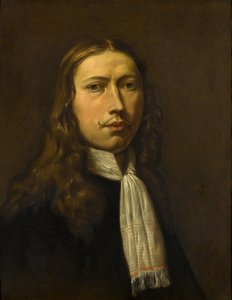
Adriaen van de Velde
1636 - 1672 , Netherlands
Quick Facts
- Artistic Movement Or Style: Italianate landscape
- Artists Or Movements Influenced By This Artist: ['Hudson River School']
- Artists Who Influenced This Artist:
- Jan Wynants
- Philip Wouwerman
- Date Of Birth: Amsterdam, Netherlands (1636)
- Date Of Death: Amsterdam, Netherlands (1672)
- Full Name: Adriaen van de Velde
- Nationality: Dutch
- Notable Artworks:
- Cattle and Goats in a Meadow
- Beach at Scheveningen
- Place Of Birth: Amsterdam
Related Articles

Beyond the Horizon: 10 Landscape Masterpieces for Your Home Decor
Journey through 10 breathtaking landscape paintings by Monet, Van Gogh & more! Explore iconic artworks, artistic techniques & find inspiration for your home decor. Museum-quality reproductions at ArtsDot.com. Discover all masterpieces on ArtsDot.com

Romantic Landscapes: 10 Masterpieces for Your Home | ArtsDot
Journey through 10 Romantic landscape masterpieces by Friedrich, Turner & Cole. Explore emotional art, sublime nature scenes & iconic 19th-century paintings. Find museum-quality reproductions for your home at ArtsDot.com – discover the full collection online!

Evocations of Place: A Historical Journey Through Landscape Art
Explore the rich history of landscape art with ArtsDot. Discover renowned artists, movements like Impressionism & Romanticism, and expert guidance for collecting timeless pieces. Find your perfect serene escape today!

John Constable's Masterpieces: Explore 25 Iconic Landscapes for Your Home
Journey through John Constable's 25 most celebrated landscapes. Explore Romanticism, Dedham Vale & his masterful use of light in iconic paintings like 'Hay Wain'. Find museum-quality art reproductions and elevate your home decor on ArtsDot.com.

Evocations of Place: A Historical Journey Through Landscape Art
Explore the rich history of landscape art with ArtsDot. Discover renowned artists, movements like Impressionism & tonalism, and expert guidance for collecting timeless pieces. Find your perfect serene escape today!