 Preview
 Send
Send Share
Share
 Details

 Download
 Similars
 X-Ray
X-Ray Diaporama
Démasquée
 Oil On Canvas
- WallArt
- National Romanticism
 1888
1888- 19th Century
 54.0 x 65.0 cm
 Ateneum Art Museum
 Read More
Hand Made Oil Reproduction
Hand-painted oil on canvas in your size and frame, made to order by our artists. ( Buy Print Buy Image)




P118B $10

P118H $10

P118W $10

P438Z $10

P508JH $12

P508YH $12

P805H $10

P805Z $10

P919BZ $10

P919G $10

P919XJ $10

P959ZH $10

P968JZ $12

W106C $8

W218G $10

W218JH $8

W218Y $10

W307PJ $10

W316G $10

W316PJ $8

W316Y $10

W398PJ $8

W4111J $10

W500HY $15

W500JH $15

W692G $12

W849H $8

W940BG $15

W953PJ $8




Pick from our preset sizes that match the artwork's original proportions.

You may enter your own dimensions to fit a specific frame or space. If your selected size does not match the original image's proportions, we will either crop the artwork or extend the painting with additional hand-painted elements. A digital mockup will be sent for your approval before production begins.
Please note that the on-screen preview does not reflect the actual cropping or extension. Only the mockup will accurately show the final composition.
While custom sizes are available, we recommend selecting a dimension from the predefined list to preserve the original proportions.
After order, ArtsDot.com team will email client for instructions and provide a mockup preview
Worldwide Delivery () in 3/4 weeks instead of standard 5 weeks. (16 August). No compromise on quality.

Free Worldwide Express Shipping

High-Quality Linen Canvas

Full Shipping Insurance

Customs Tax Refund Guarantee

True Color Matching Guarantee

60-Day Return Policy (Defects Only)

100% Money-Back Guarantee

Bulk Discount Offer
 Glass option is only available in size under 110 CM

Démasquée
Reproduction Medium
Reproduction Size
-


Total Price
$ 263
Artwork Description
Démasquée – A Portrait of Eroticism and Subversion
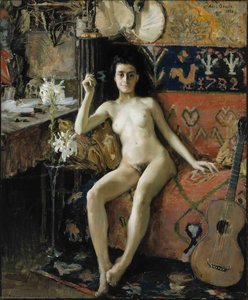
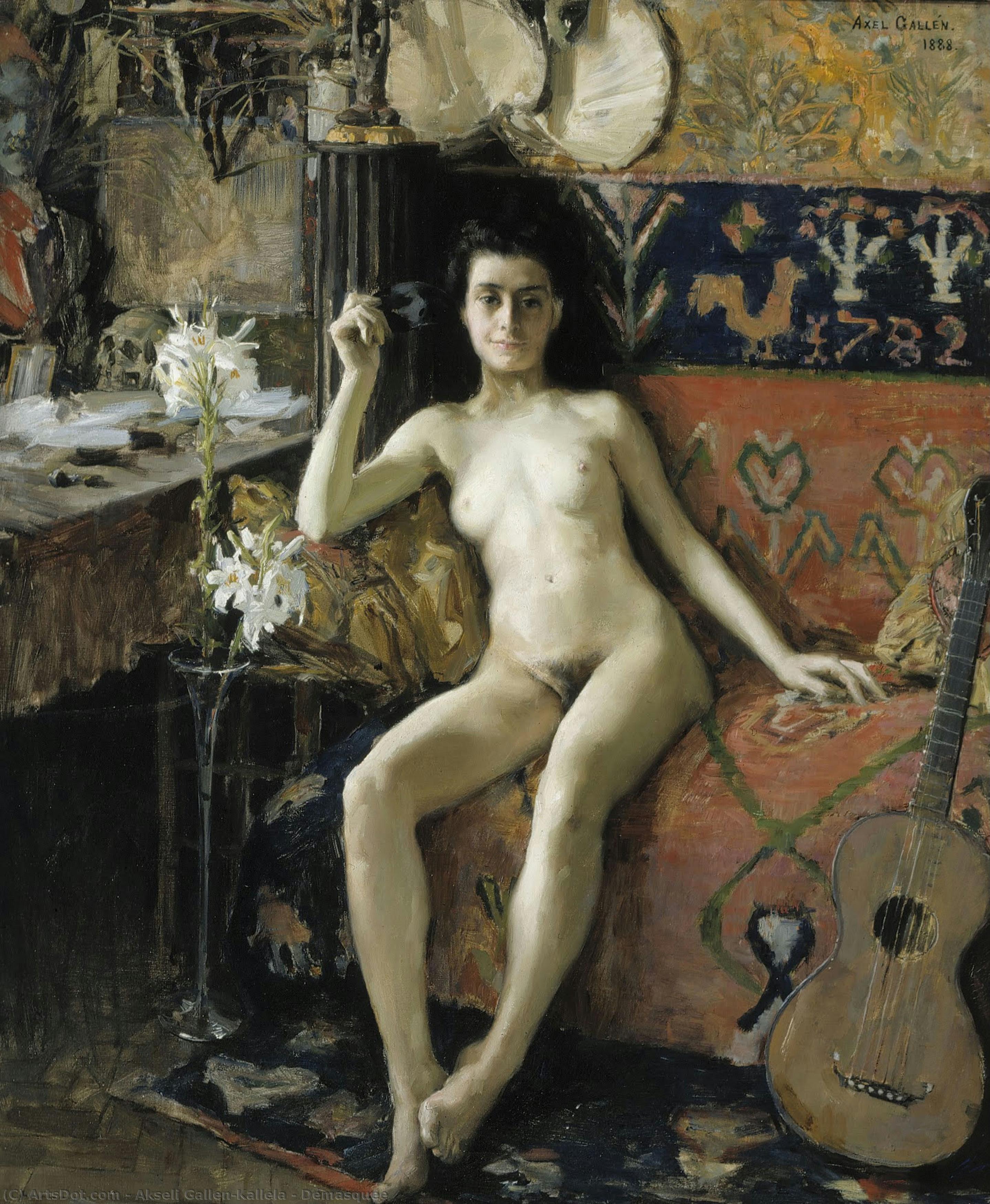
Akseli Gallen-Kallela’s Démasquée (1888) is not merely a painting; it's an arresting encounter with the complexities of desire, identity, and the veiled realities of bohemian life. This strikingly erotic oil on canvas immediately commands attention, drawing the viewer into a scene brimming with unspoken tension and a subtle defiance of societal norms. Commissioned by the Finnish collector H.F. Antell, the painting’s initial rejection by its patron speaks volumes about its provocative nature – a testament to Gallen-Kallela's ability to capture not just physical beauty but also the psychological currents beneath the surface.
The central figure is a young woman, identified as Ismallia, a Parisian model known for her captivating presence. She’s depicted in an intimate setting within Gallen-Kallela’s studio – a space that itself feels charged with artistic energy and a hint of melancholy. Her posture is relaxed yet subtly alluring; she leans against a richly patterned sofa, holding a black half-mask, a symbol both of concealment and exposure. The mask, a recurring motif in Gallen-Kallela's work, suggests the layers of identity we present to the world – the carefully constructed facades that often obscure our true selves.
A Masterclass in Late 19th-Century Realism
Gallen-Kallela’s style is a fascinating blend of late 19th-century realism and impressionistic techniques. While rooted in academic traditions, his work possesses a remarkable sensitivity to light, texture, and atmosphere. The painting showcases a masterful use of impasto – thick, visible brushstrokes that build up layers of paint, creating a tactile surface brimming with detail. Notice the way the artist renders the folds of the woman’s drapery, the intricate patterns of the sofa upholstery, and even the subtle sheen on her skin. These details aren't simply decorative; they contribute to the overall sense of immediacy and presence.
The composition is carefully balanced, with the figure dominating the center of the frame while the background – a glimpse of a guitar, a fan, flowers, and a partially visible window – provides depth and context. The use of light is particularly noteworthy; it’s naturalistic, casting highlights and shadows that define form and volume, lending a sense of realism to the scene. The slightly flattened perspective, characteristic of impressionism, prioritizes the emotional impact of the image over strict adherence to linear perspective.
Symbolism and Historical Context
Beyond its immediate sensuality, Démasquée is rich in symbolism. The lily, a traditional emblem of innocence, appears juxtaposed with the woman’s exposed form, creating a subtle tension that speaks to the complexities of desire and vulnerability. The presence of a guitar suggests artistic pursuits and leisure, while the flowers add an element of natural beauty – a fleeting moment of serenity amidst the underlying eroticism. The inclusion of a crucifix and a Buddha statue in the background hints at the artist’s own internal struggles with faith and morality, reflecting the anxieties of the time.
Painted during a period of significant social and political upheaval in Finland—a nation grappling with its identity after centuries of foreign rule—Démasquée can be interpreted as a subtle critique of societal constraints. Gallen-Kallela’s decision to depict a woman uninhibitedly, challenging conventional notions of female modesty, aligns with the broader artistic currents of the Symbolist movement, which sought to explore the darker aspects of human experience and challenge established values. The painting's rejection by Antell further underscores this subversive element – a refusal to conform to expectations.
A Timeless Masterpiece
Démasquée remains a powerful and enigmatic work of art, captivating viewers with its blend of eroticism, symbolism, and technical mastery. It’s a poignant portrait not just of a woman but also of the complexities of human desire, identity, and the enduring tension between appearance and reality. Reproductions of this iconic painting offer a unique opportunity to bring this evocative image into your home or office, serving as a reminder of the power of art to provoke thought, inspire emotion, and challenge our perceptions.
Related Artworks
Artist Biography
A Life Woven into the Finnish Soul
Akseli Gallen-Kallela, born Axel Waldemar Gallén in 1865 in Pori, Finland, wasn’t merely a painter; he was a visual poet of a nation finding its voice. His life unfolded against a backdrop of shifting political tides and a burgeoning national identity, deeply influencing his artistic trajectory. Initially raised in a Swedish-speaking family—a common reality within Finland at the time—Gallen-Kallela's eventual embrace and championing of Finnish culture was not simply an aesthetic choice but a deliberate act of cultural affirmation. His early years were marked by a tension between familial expectations and artistic ambition, leading him to Paris in 1884 to study at the Académie Julian. This period exposed him to the currents of European art, yet it also ignited within him a longing for the landscapes and folklore of his homeland.
The Parisian experience was formative, introducing him to artists like Albert Edelfelt and fostering friendships with figures such as August Strindberg. However, Gallén-Kallela’s artistic spirit proved resistant to complete assimilation into the prevailing European styles. He began returning frequently to Finland, drawn by a desire to capture the essence of its rural life and ancient mythology. This marked a turning point, a conscious decision to forge an artistic path rooted in Finnish identity. His early works reflected this shift, depicting scenes of peasant life with a realism tempered by a growing symbolic sensibility—a style that would soon become his signature.
The Kalevala’s Embrace: Myth and National Identity
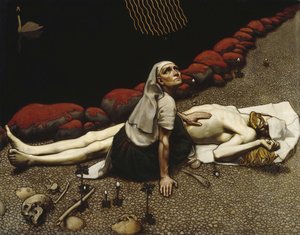
Gallen-Kallela's most enduring legacy lies in his breathtaking illustrations of the Kalevala, Finland’s national epic. This collection of ancient folklore, poems, and myths became more than just subject matter for him; it was a wellspring of inspiration, a key to unlocking the soul of his nation. Paintings like The Defense of the Sampo (1897) and Lemminkäinen’s Mother (1893) are not mere illustrations but powerful visual interpretations that resonate with the epic's themes of heroism, loss, and the struggle against adversity. He didn’t simply depict scenes from the Kalevala; he *embodied* them, infusing his canvases with a sense of primal energy and symbolic depth.
His approach was meticulous, involving extensive research into Finnish folklore, traditions, and landscapes. He sought to capture not just the narrative elements but also the underlying spiritual beliefs and cultural values embedded within the epic. This dedication elevated his work beyond mere illustration; it transformed him into a visual storyteller, a conduit for preserving and celebrating Finland’s cultural heritage. The impact of these works was profound, solidifying Gallen-Kallela's position as a pivotal figure in Finnish art and contributing significantly to the nation’s growing sense of self-awareness.
Beyond Myth: Symbolism, Expression, and Artistic Evolution
While inextricably linked with the Kalevala, Gallen-Kallela’s artistic range extended far beyond mythological subjects. He explored symbolism in works like Symposium (1894), a haunting depiction of Finnish artists engaged in intellectual discourse, subtly hinting at anxieties about national identity and cultural preservation. His style evolved over time, incorporating elements of Art Nouveau and later embracing the expressive power of color and form. A pivotal moment came with his journey to Kenya in 1909-1910, where he encountered a different culture and landscape that profoundly impacted his artistic vision.
This experience led to a shift towards more vibrant colors and bolder brushstrokes, foreshadowing the emergence of Expressionism. He continued to experiment with various mediums, including frescoes—most notably those commissioned for the Jusélius Mausoleum—and designs for textiles and furniture, demonstrating a holistic approach to art that extended beyond the confines of traditional painting. Even during periods of political turmoil, such as the Finnish Civil War in 1917-1918, Gallen-Kallela remained actively engaged, designing uniforms and decorations for the newly independent Finnish army.
A Lasting Legacy: The Shaping of a National Aesthetic
Akseli Gallen-Kallela’s influence on Finnish art and culture is immeasurable. He didn't just paint pictures; he helped to define what it meant to be Finnish, visually articulating the nation’s identity during a period of profound transformation. His work continues to inspire artists today, serving as a testament to the power of art to shape national consciousness and preserve cultural heritage.
- National Romanticism: Gallen-Kallela is considered a central figure in Finnish National Romanticism, an artistic movement that sought to celebrate Finland’s unique culture and identity.
- Cultural Icon: His illustrations of the Kalevala have become iconic representations of Finnish mythology and folklore.
- Artistic Innovation: He was a versatile artist who experimented with various styles and mediums, pushing the boundaries of Finnish art.
- Enduring Influence: His work continues to inspire artists and shape Finland’s cultural landscape today.
Gallen-Kallela's life was a testament to the power of artistic vision, a journey from youthful ambition to national icon. He died in Stockholm in 1931, leaving behind a body of work that continues to resonate with audiences worldwide—a legacy woven into the very fabric of the Finnish soul.
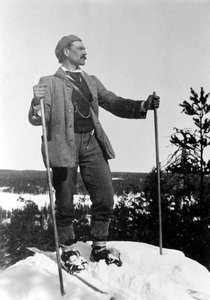
Akseli Gallen-Kallela
1865 - 1931 , Finland
Quick Facts
- Artistic Movement Or Style: National Romanticism
- Artists Or Movements Influenced By This Artist: ['Finnish Art']
- Date Of Birth: April 26, 1865
- Date Of Death: March 7, 1931
- Full Name: Akseli Gallen-Kallela
- Nationality: Finnish
- Notable Artworks:
- The Defense of the Sampo
- Lemminkäinen's Mother
- Kullervo's Curse
- Place Of Birth: Pori, Finland
Related Articles
Akseli Gallen-Kallela: Shaping Finnish Identity Through National Romanticism & Symbolism
Explore the captivating world of Akseli Gallen-Kallela, Finland's iconic National Romantic painter. Discover his symbolic landscapes, Kalevala illustrations & lasting impact on Finnish identity. Expert analysis & high-quality reproductions at ArtsDot.

The Enduring Legacy of Oil on Canvas: Technique, History & Aesthetic Impact
Explore the rich history & techniques of oil painting – from Renaissance masters to Impressionism. Discover pigments, layering methods, and why this timeless medium endures. Expert insights for artists & art enthusiasts.

Oil on Canvas: A Historical & Technical Exploration of a Timeless Artistic Medium
Explore the rich history & enduring techniques of oil painting on canvas. Discover the science behind its longevity, conservation practices, and contemporary relevance. Expert insights for art enthusiasts.

The Enduring Power of Painting: A Historical & Contemporary Exploration of Form and Emotion
Explore the rich history & enduring techniques of oil painting with ArtsDot. Discover masterpieces, learn about art collecting, and find authentic handmade reproductions crafted by skilled artists.
National Gallery London's Masterpieces: 25 Iconic Paintings for Your Home Decor
Journey through the National Gallery London's 25 most iconic paintings! Explore Van Gogh, Monet, Rembrandt & more. Discover art history, techniques & find museum-quality reproductions for your home decor on ArtsDot.com.