 Preview
 Send
Send Share
Share
 Details

 Download
 Similars
 X-Ray
X-Ray Diaporama
Le Christ apparaissant à la Madeleine


 Read More
Giclée / Art Print
Museum-quality giclée or canvas print with fast production and flexible finish options. ( Buy Hand Made Painting Buy Image)




P118B $10

P118H $10

P118W $10

P438Z $10

P508JH $12

P508YH $12

P805H $10

P805Z $10

P919BZ $10

P919G $10

P919XJ $10

P959ZH $10

P968JZ $12

W106C $8

W218G $10

W218JH $8

W218Y $10

W307PJ $10

W316G $10

W316PJ $8

W316Y $10

W398PJ $8

W4111J $10

W500HY $15

W500JH $15

W692G $12

W849H $8

W940BG $15

W953PJ $8




Pick from our preset sizes that match the artwork's original proportions.

You may enter your own dimensions to fit a specific frame or space. If your selected size does not match the original image's proportions, we will either crop the artwork or extend the image with a mirrored or solid-fill edge. A digital mockup will be sent for your approval before production begins.
Please note that the on-screen preview does not reflect the actual cropping or extension. Only the mockup will accurately show the final composition.
While custom sizes are available, we recommend selecting a dimension from the predefined list to preserve the original proportions.
Worldwide Delivery () in 2 weeks instead of standard 4/5 weeks. (27 August)

Free Worldwide Express Shipping

High-Quality Linen Canvas

Full Shipping Insurance

Customs Tax Refund Guarantee

True Color Matching Guarantee

60-Day Return Policy (Defects Only)

100% Money-Back Guarantee

Bulk Discount Offer
 Glass option is only available in size under 110 CM

Le Christ apparaissant à la Madeleine
Giclée / Art Print
Reproduction Size
-


Total Price
$ 63
A Divine Encounter in Baroque Splendor
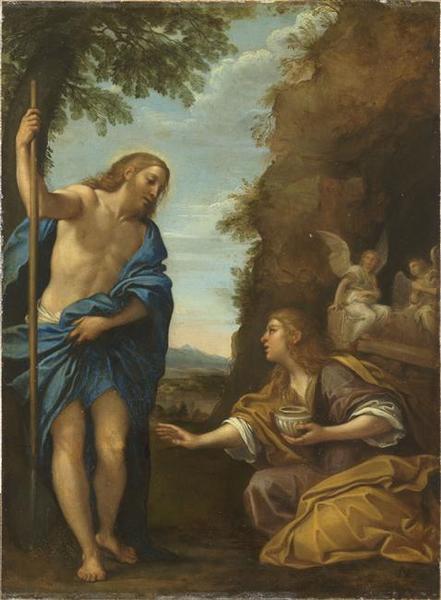
To stand before this depiction of Le Christ apparaissant à la Madeleine is to be enveloped by the dramatic fervor of the Baroque age. The scene captures not merely an event, but a profound moment of spiritual revelation—the glorious appearance of Christ to Mary Magdalene. The composition itself guides the eye with masterful intent; Christ forms the luminous apex, drawing all attention toward his divine presence on the left. Opposite him, Mary Magdalene kneels in attitudes of deep reverence and humility, her posture speaking volumes of devotion and repentance. This is an encounter steeped in sacred narrative, rendered with a palpable sense of awe that transcends the boundaries of time.
Mastery of Light and Form
The technical brilliance evident in this work speaks to the high skill of its creator, echoing the grand traditions of Italian painting during the late 16th and early 17th centuries. The artist employs dramatic lighting—a technique known as tenebrism, though softened here—where divine radiance seems to emanate from Christ himself, casting deep, evocative shadows across the rocky outcrop and the figures' drapery. Observe how the warm palette of golds, rich blues, and earthy browns interacts with this light. The contrast between the vibrant blue of Christ’s robe and the golden sheen on Magdalene’s garments is not accidental; it heightens the visual drama, making the spiritual weight of the moment almost tangible.
Compositional Depth and Symbolism
The structure of the painting is a symphony of shapes. The artist utilizes a strong triangular composition, grounding the figures while allowing the background—the rugged rock formation and distant landscape—to provide an illusion of vast, breathable space. This interplay between the organic curves of the human forms and the solid geometry of nature creates incredible depth. Symbolically, every element contributes to the emotional resonance: the angels observing from the periphery suggest heavenly witness, while Magdalene’s gesture speaks to the enduring power of faith overcoming earthly sorrow. It is a visual meditation on grace.
A Touch of Baroque Emotion for Your Space
For those who appreciate art that does not merely decorate but elevates the spirit, this reproduction offers an unparalleled focal point. The style, deeply rooted in the emotive grandeur of the Baroque period, brings with it a sense of dynamic movement and idealized humanism. Whether adorning a chapel, a grand hall, or a richly decorated drawing-room, this piece carries the weight of history and divine narrative. It invites contemplation, demanding that the viewer pause, breathe, and feel the echo of that first, transformative encounter.
Related Artworks
Artist Biography
The Grace of the Bolognese Master
In the vibrant tapestry of the Italian Baroque, few threads are as delicate and luminous as those woven by Francesco Albani, often remembered by the evocative moniker l'Albane. Born in the storied city of Bologna in 1578, Albani was destined for a life steeped in pigment and prestige. Coming from a lineage of creators, he was the son of the painter Daniele Albani and the nephew of the esteemed Giovanni Paolo Cavagna. This early immersion in an environment of artistic rigor provided him with a foundation that would eventually allow him to bridge the gap between the classical elegance of the Renaissance and the dramatic emotionality of the Baroque era.
His formative years were shaped by rigorous apprenticeship, beginning in the studio of Denzio Ferrari, where he mastered the fundamental mechanics of light and form. However, it was his subsequent move to Rome that truly ignited his creative spirit. Under the tutelage of Guidobaldo Gandolfi, Albani began to refine a style that would become his hallmark: a sophisticated blend of mythological grace and classical poise. His journey from the academic traditions of Bologna to the grand, theatrical atmosphere of Rome allowed him to synthesize a unique visual language that resonated with the religious and aristocratic patrons of the seventeenth century.
A Symphony of Light and Myth
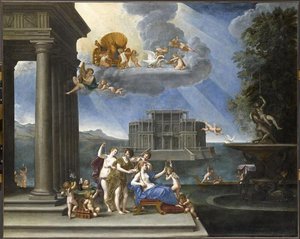
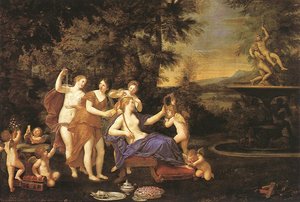
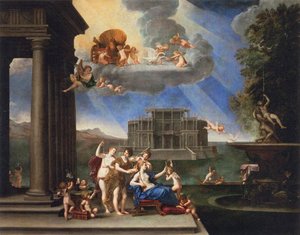
Albani’s oeuvre is characterized by an extraordinary ability to breathe life into the legends of antiquity and the sacred narratives of the Bible. He possessed a rare gift for capturing the ephemeral beauty of the human form, rendering skin with a porcelain-like delicacy that seemed to glow from within. This mastery is perhaps most profoundly realized in his celebrated work, Toilet of Venus, where the goddess emerges not merely as a figure of myth, but as a vision of divine aesthetic perfection. Through his brush, the mythological becomes intimate, and the classical becomes deeply human.
Beyond the figures themselves, Albani was a pioneer in the atmospheric use of chiaroscuro. While many of his contemporaries used extreme light and shadow to create jarring tension, Albani employed the technique to instill his compositions with a sense of depth and spiritual weight. This is evident in works such as The Baptism of Christ, where the interplay of light serves to heighten the emotional gravity of the sacrament, and in his depictions of St. Sebastian, where shadow sculpts the musculature and emphasizes the martyr's profound suffering. His ability to integrate naturalistic landscapes into these sacred scenes also marked him as a precursor to the development of landscape painting, as he often used sweeping, verdant backgrounds to frame his central dramas.
Legacy and Enduring Influence
The historical significance of Francesco Albani lies in his role as a stabilizing force during a period of intense artistic experimentation. While the Baroque era is often associated with turbulent movement, Albani provided a sense of lyrical continuity, reminding the art world of the enduring power of classical harmony. His influence stretched far beyond the borders of Italy, as his refined approach to composition and color became a standard for subsequent generations of European painters.
Today, the legacy of l'Albane is preserved in some of the most prestigious galleries in the world. To walk through the halls of the Musée du Louvre in Paris is to encounter his enduring vision, particularly through masterpieces like Toilet of Venus, which continue to captivate viewers with their timeless elegance. His life’s work remains a testament to the power of beauty, serving as a bridge between the structured ideals of the past and the emotive complexities of the Baroque age. Through his delicate touch and masterful command of light, Albani ensured that the grace of the Bolognese tradition would forever be etched into the annals of art history.
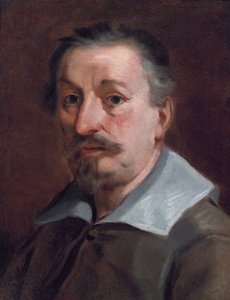
albani francesco (l'albane)
1578 - 1660 , Italy
Quick Facts
- Artistic Movement Or Style: Baroque and Classical
- Artists Or Movements Influenced By This Artist:
- Baroque painting
- Landscape painting
- Artists Who Influenced This Artist:
- Denzio Ferrari
- Guidobaldo Gandolfi
- Date Of Birth: 1578
- Date Of Death: 1660
- Full Name: Francesco Albani
- Nationality: Italian
- Notable Artworks:
- Toilet of Venus
- The Baptism of Christ
- St. Sebastian
- Virgin and Child with St. John the Baptist
- Place Of Birth: Bologna, Italy
Related Articles

The Dramatic Flourish: Exploring the Baroque Movement's Enduring Legacy in Art History
Explore the dramatic world of Baroque art! Discover iconic artists like Caravaggio & Rubens, defining techniques, and its lasting impact on art history. Expert insights for collectors & enthusiasts at ArtsDot.

The Visceral Stage: Exploring Dramatic Narratives & Emotional Intensity in Baroque Art
Explore the dramatic world of Baroque art! Discover iconic masters like Caravaggio & Rembrandt, their techniques, and the movement's lasting impact. Expert insights for collectors & enthusiasts at ArtsDot.

Baroque Drama: Bringing Opulence & Emotion into Contemporary Interiors
Explore the opulent world of Baroque interior design! Discover key elements, modern applications & how to bring dramatic elegance into your home with 's authentic reproductions.

Baroque Masterpieces: 10 Paintings That Defined an Era |
Journey through the drama & grandeur of Baroque art! Explore 10 masterpieces by Caravaggio, Rembrandt, Rubens & more. Discover stunning oil paintings, rich colors & timeless stories. Find museum-quality reproductions at .

The Enduring Power of Painting: A Historical & Contemporary Exploration of Form and Emotion
Explore the rich history & enduring techniques of oil painting with ArtsDot. Discover masterpieces, learn about art collecting, and find authentic handmade reproductions crafted by skilled artists.