 Send
Send Share
Share
 Details

 Download
 Similars
 Diaporama
Untitled | Body-Builders series
 Photography
- Photo
- Contemporary Realism
 2002
2002- Contemporary
 55.0 x 79.0 cm
 MAM Rio
 Read More
Hand Made Oil Reproduction
Hand-painted oil on canvas in your size and frame, made to order by our artists. ( Buy Print Buy Image)




































Pick from our preset sizes that match the artwork's original proportions.

You may enter your own dimensions to fit a specific frame or space. If your selected size does not match the original image's proportions, we will either crop the artwork or extend the painting with additional hand-painted elements. A digital mockup will be sent for your approval before production begins.
Please note that the on-screen preview does not reflect the actual cropping or extension. Only the mockup will accurately show the final composition.
While custom sizes are available, we recommend selecting a dimension from the predefined list to preserve the original proportions.
After order, ArtsDot.com team will email client for instructions and provide a mockup preview
Worldwide Delivery () in 3/4 weeks instead of standard 5 weeks. (16 August). No compromise on quality.

Free Worldwide Express Shipping

High-Quality Linen Canvas

Full Shipping Insurance

Customs Tax Refund Guarantee

True Color Matching Guarantee

60-Day Return Policy (Defects Only)

100% Money-Back Guarantee

Bulk Discount Offer
 Glass option is only available in size under 110 CM

Untitled | Body-Builders series
Reproduction Medium
Reproduction Size
-


Total Price
$ 263
Artwork Description
The Intersection of Anatomy and Cartography
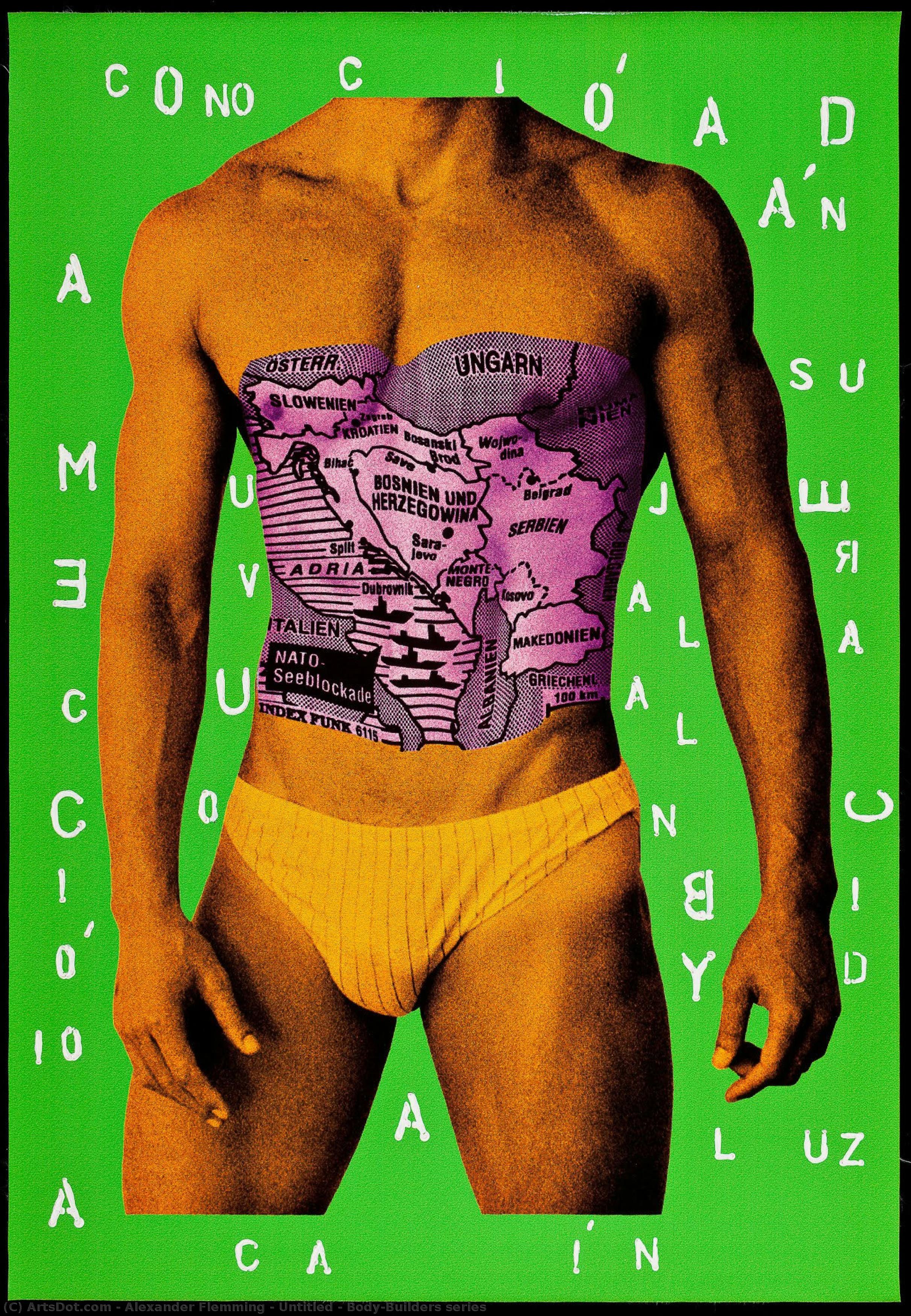
In the evocative piece Untitled | Body-Builders series, created in 2002, we are invited into a profound meditation on the human form and the landscapes we carry within us. The artwork presents a striking close-up of a male torso, where the boundaries between biology and geography begin to dissolve. A vibrant purple map is meticulously rendered across the man's chest, stretching from the base of his neck down toward the waistline. This surrealist overlay transforms the muscular anatomy into a topographical terrain, suggesting that the human body is not merely a vessel of flesh and bone, but a complex territory of experiences, memories, and unexplored frontiers. The contrast between the organic texture of the skin and the structured, violet lines of the map creates a visual tension that captivates the eye, pulling the viewer into a deeper contemplation of identity.
The composition is masterfully balanced, utilizing a shallow depth of field to isolate the subject. While the man stands as the central protagonist, the presence of other figures in the soft-focus background provides a sense of social context, hinting at a shared human condition—a collective existence where individual narratives are layered over one another. The inclusion of subtle details, such as the white bathing suit and a faint tattoo on the arm, grounds the surrealist elements in a tangible, contemporary reality. This juxtaposition of the mundane and the metaphysical is a hallmark of the Body-Builders series, inviting collectors to appreciate the work as both a modern photographic study and a symbolic exploration of the internal psyche.
A Legacy of Discovery and Detail
To understand the depth of this work, one must look toward the enigmatic spirit of its creator, Alexander Fleming. While history remembers Fleming primarily for his monumental scientific achievement—the discovery of penicillin—this series reveals a different, more introspective facet of his creative persona. There is a profound resonance between his scientific precision and the meticulous detail found in this artwork. Just as he once peered through a microscope to uncover the hidden life within mold, here he uses the lens to uncover the hidden maps within the human form. The technique reflects a disciplined eye for detail, where every vein and topographical contour is treated with the reverence of a biological specimen.
For the discerning art lover or interior designer, this piece serves as a powerful focal point that transcends simple decoration. It possesses an intellectual weight that stimulates conversation, making it an ideal acquisition for spaces dedicated to thought, wellness, or modern aesthetics. The cool tones of the purple map paired with the warmth of the skin tones allow it to integrate seamlessly into sophisticated, contemporary interiors, offering a sense of mystery and depth. Owning a reproduction of this work is not merely about displaying an image; it is about bringing a piece of a profound dialogue between science, art, and the enduring mysteries of the human landscape into one's personal sanctuary.
Related Artworks






Artist Biography
The Scientific Visionary: A Life of Discovery
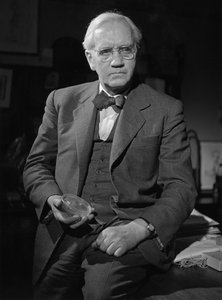
Born in the quiet town of Darvel, Scotland, in 1881, Alexander Fleming stands as a monumental figure whose legacy is etched into the very fabric of modern medicine. While history remembers him primarily as the Scottish physician and microbiologist who revolutionized healthcare, there exists an enchanting, albeit speculative, dimension to his persona that invites us to view his scientific rigor through an artistic lens. His life was defined by a profound sensitivity to the unseen, a quality that allowed him to perceive patterns and transformations in the microscopic world that others simply overlooked.
The trajectory of Fleming's life reached its zenith in 1928 with one of the most serendipitous moments in scientific history. It was through his meticulous observation of the mould Penicillium rubens that he identified the antibacterial properties of penicillin. This discovery, which earned him the Nobel Prize in Physiology or Medicine in 1945 alongside Howard Florey and Ernst Boris Chain, was not merely a triumph of chemistry, but a masterpiece of observational precision. To look upon his work is to witness a form of biological portraiture, where the struggle between life and decay is captured with the clarity of a master painter.
The Intersection of Microscopic Detail and Artistic Form
Though no physical canvases bearing his brushstrokes have surfaced in the annals of art history, the essence of an artist resides within Fleming's methodology. His scientific pursuits were characterized by an intense focus on structure, form, and the intricate architecture of life. When he studied Micrococcus lysodeikticus or isolated the enzyme lysozyme from his own nasal discharge, he was engaging in a deep exploration of organic geometry. One cannot help but imagine that if Fleming had traded the petri dish for a palette, his work would have mirrored the meticulousness and structural elegance found in his biological findings.
The concept of an "artistic Fleming" invites us to contemplate several fascinating possibilities:
- Microscopic Aesthetics: A hypothetical style focusing on the breathtaking, complex patterns of cellular structures and bacterial colonies.
- The Beauty of Decay: An exploration of the transformative power of mould and fungi, capturing the delicate balance between destruction and creation.
- Scientific Realism: A technique defined by extreme precision, where every minute detail serves to tell a larger story of biological survival.
A Legacy Beyond the Laboratory
The historical significance of Alexander Fleming extends far beyond the walls of his laboratory in London. He provided humanity with its "single greatest victory ever achieved over disease," fundamentally altering the human experience by turning once-fatal infections into treatable conditions. This profound impact on the survival of our species carries a weight that is almost poetic, representing a triumph of human intellect and persistence over the invisible forces of nature.
In reflecting upon his life, we find ourselves at the crossroads of science and art. Whether through the lens of a microscope or the stroke of a brush, Fleming’s true contribution was his ability to see the extraordinary within the ordinary. His legacy remains an inspiration for those who seek to uncover the hidden beauty and complex truths embedded in the smallest fragments of our world, proving that the pursuit of knowledge is, in itself, a profound form of creative expression.
alexander flemming
1881 - 1955 , United Kingdom
Quick Facts
- Artistic Movement Or Style: Speculative microscopic detail
- Date Of Birth: 1881
- Date Of Death: 1955
- Full Name: Alexander Fleming
- Nationality: Scottish
- Place Of Birth: Darvel, United Kingdom
Related Articles
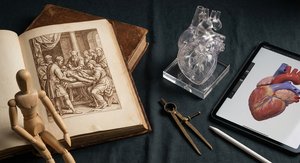
The Eloquent Body: Anatomy's Enduring Legacy in Art from Renaissance Dissection to Modern Representation
Explore the fascinating history of anatomy in art! From Renaissance dissections to modern masterpieces, discover how artists & scientists collaborated to depict the human form with unprecedented realism. Learn more at ArtsDot.

Jacob Lawrence: Narratives of Struggle, Resilience & Modernist Innovation
Explore the powerful narratives of Jacob Lawrence, a pivotal African American artist of the Harlem Renaissance. Discover his iconic 'Migration Series,' dynamic cubism style, and lasting impact on American art history.

Monet's Masterpieces: 25 Iconic Artworks to Transform Your Home
Journey through 25 iconic Claude Monet masterpieces! Explore Impressionism’s beauty, from Water Lilies to Rouen Cathedral. Discover stunning art reproductions & curated decor ideas – explore the full collection online at ArtsDot.com.
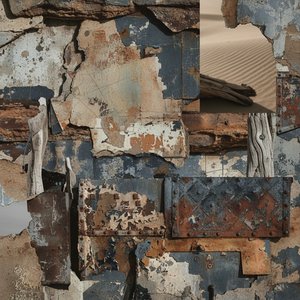
Aaron Siskind: Deconstructing Reality – A Photographic Exploration of Texture, Form & the Abstract Landscape
Explore the transformative journey of Aaron Siskind, from social realism to pioneering abstract photography. Discover his iconic series & lasting influence on modern art. A guide for collectors.
La Biennale's Masterpieces: 25 Artworks to Inspire Your Home | ArtsDot
Explore 25 iconic artworks from La Biennale di Venezia! Discover the stories behind masterpieces of Italian art, modernism & Renaissance paintings. Find museum-quality reproductions and elevate your home decor with ArtsDot.com. Explore the full collection online.