 Preview
 Send
Send Share
Share
 Details

 Download
 Similars
 X-Ray
X-Ray Diaporama
Landscape (8)


 Read More
Hand Made Oil Reproduction
Hand-painted oil on canvas in your size and frame, made to order by our artists. ( Buy Print Buy Image)




P118B $10

P118H $10

P118W $10

P438Z $10

P508JH $12

P508YH $12

P805H $10

P805Z $10

P919BZ $10

P919G $10

P919XJ $10

P959ZH $10

P968JZ $12

W106C $8

W218G $10

W218JH $8

W218Y $10

W307PJ $10

W316G $10

W316PJ $8

W316Y $10

W398PJ $8

W4111J $10

W500HY $15

W500JH $15

W692G $12

W849H $8

W940BG $15

W953PJ $8




Pick from our preset sizes that match the artwork's original proportions.

You may enter your own dimensions to fit a specific frame or space. If your selected size does not match the original image's proportions, we will either crop the artwork or extend the painting with additional hand-painted elements. A digital mockup will be sent for your approval before production begins.
Please note that the on-screen preview does not reflect the actual cropping or extension. Only the mockup will accurately show the final composition.
While custom sizes are available, we recommend selecting a dimension from the predefined list to preserve the original proportions.
After order, ArtsDot.com team will email client for instructions and provide a mockup preview
Worldwide Delivery () in 3/4 weeks instead of standard 5 weeks. (16 August). No compromise on quality.

Free Worldwide Express Shipping

High-Quality Linen Canvas

Full Shipping Insurance

Customs Tax Refund Guarantee

True Color Matching Guarantee

60-Day Return Policy (Defects Only)

100% Money-Back Guarantee

Bulk Discount Offer
 Glass option is only available in size under 110 CM

Landscape (8)
Reproduction Medium
Reproduction Size
-


Total Price
$ 263
Artwork Description
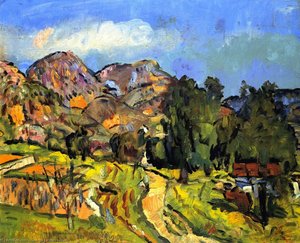
A Vision of Modernity: The Vibrant World of Alfred Henry Maurer
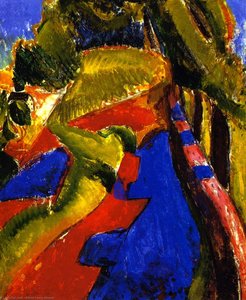
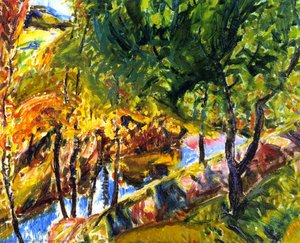
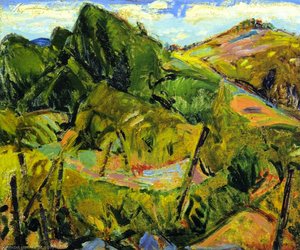
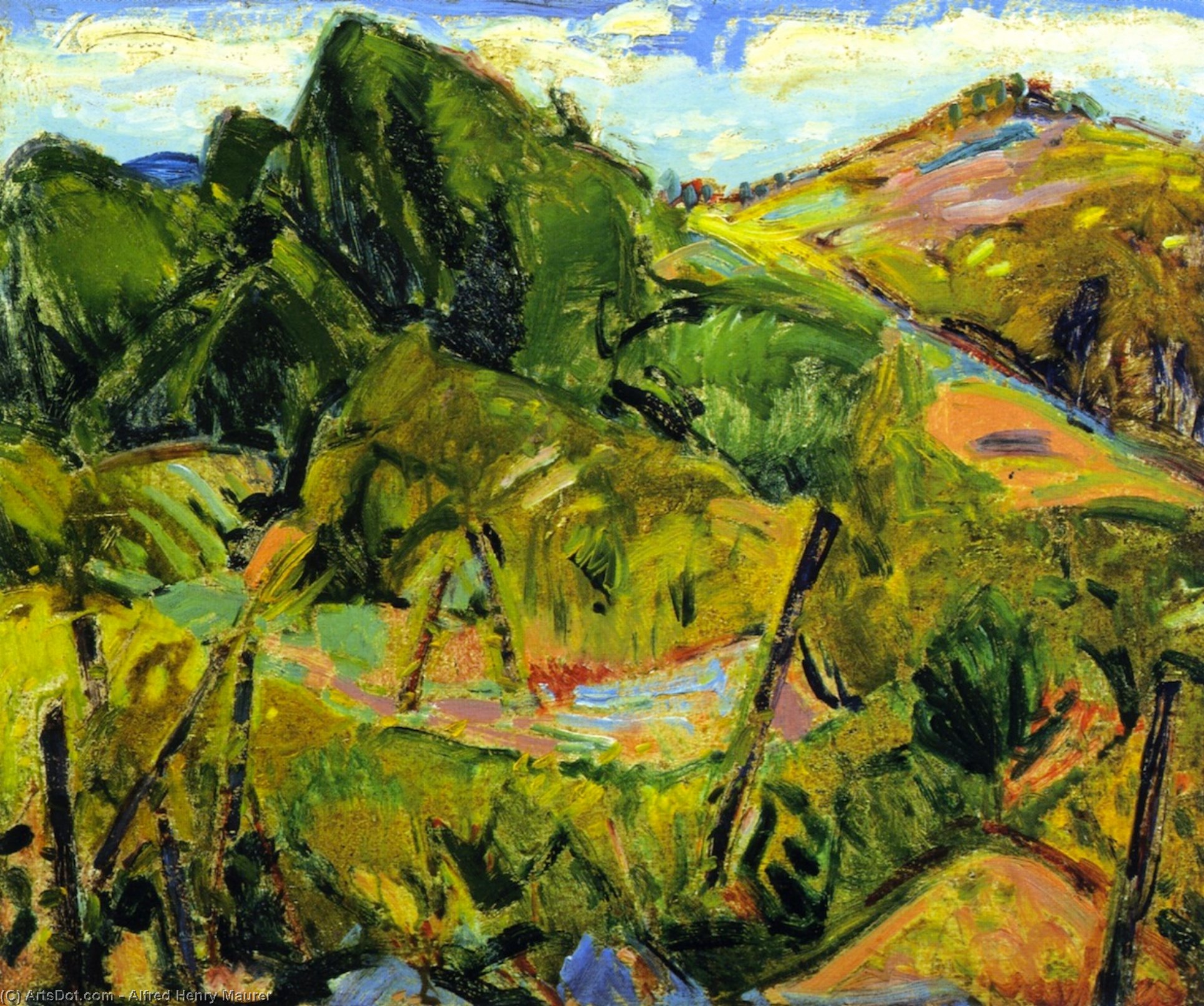
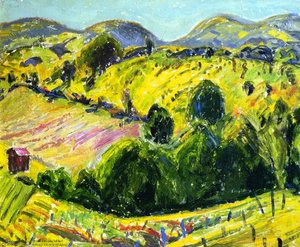
In the annals of American Modernism, few works capture the raw, pulsating energy of the early twentieth century quite like Landscape (8). Painted in 1915, this breathtaking piece by Alfred Henry Maurer serves as a window into a transformative era where the boundaries of representation were being pushed toward pure emotional expression. The painting presents a sweeping, mountainous vista, yet it eschews the clinical precision of traditional realism in favor of a rhythmic, almost musical arrangement of form and color. As the eye wanders across the undulating hills and dense thickets of vegetation, one feels less like a detached observer and more like a participant in the landscape's vibrant life force.
Maurer, an artist whose journey took him from the lithographic firms of New York to the avant-garde studios of Paris, brings a unique, cross-continental sensibility to this work. The composition is masterfully layered, utilizing overlapping forms and varying tonal values to create a sense of profound depth despite a deliberately flattened perspective. This technique, reminiscent of both Fauvist boldness and Post-Impressionist structure, allows the viewer to experience the landscape as a series of interconnected textures and light patterns rather than mere geographical markers.
Technique and the Language of Color
The true soul of Landscape (8) lies in its tactile execution. Maurer employs a heavy, expressive impasto, where thick strokes of oil paint rise from the canvas to catch the light, creating a physical topography that mirrors the rugged terrain depicted. This gestural approach gives the painting an incredible sense of movement; the trees and grasses seem to sway under the influence of an unseen breeze, their shapes defined not by rigid outlines but by the energetic meeting of contrasting hues. The artist’s palette is a celebration of nature's vitality, dominated by lush greens and sun-drenched yellows, yet it is punctuated by unexpected whispers of pink and soft blue that suggest the fleeting qualities of light and atmosphere.
For the discerning collector or interior designer, this painting offers a sophisticated interplay of color and texture. The way the light appears to diffuse through the scene, casting soft shadows across the rolling hills, provides a sense of tranquility that is balanced by the sheer dynamism of the brushwork. It is a piece that demands attention, acting as a focal point that can anchor a room with its organic warmth and historical weight.
Symbolism and Emotional Resonance
Beyond its formal beauty, Landscape (8) evokes a profound emotional response. There is an inherent tension within the work—a balance between the stability of the earth and the restless energy of the artist's hand. The abstracted nature of the vegetation and the distant, hazy structures suggest a world in flux, mirroring the broader cultural shifts occurring during the mid-1910s. One might find a sense of peaceful solitude within its verdant depths, or perhaps a touch of melancholy in its fragmented forms, inviting deep contemplation.
To possess a reproduction of this masterpiece is to bring a piece of art history into the contemporary home. Whether displayed in a minimalist gallery-style setting or a richly textured classical interior, the painting serves as a testament to the enduring power of the American Modernist movement. It remains an inspiring choice for those who appreciate art that does not merely depict the world, but reimagines it through a lens of passion, color, and light.
Related Artworks
Artist Biography
Alfred Henry Maurer: A Life in Modern Art
Early Life and Training
- Born: April 21, 1868, New York City, United States of America.
- Maurer’s early life was marked by a familial tension regarding art. His father disapproved of modern artistic expression, ironically fueling Alfred's passion.
- At the age of sixteen, he left school to work in his father’s lithographic firm, gaining practical experience but yearning for more creative pursuits.
- Self-Portrait from his early Parisian period reflects a youthful optimism and burgeoning artistic confidence.
Parisian Influences and Artistic Breakthrough
- In 1897, Maurer embarked on a pivotal journey to Paris, where he spent four years immersed in the vibrant art scene.
- He joined a community of American and French artists, absorbing new ideas and experimenting with different styles.
- An Arrangement, completed around 1901, proved to be a turning point. It garnered first prize at the prestigious Carnegie International Exhibition, establishing Maurer as a rising talent.
Shifting Styles and Challenges
- Following his initial success, Maurer’s artistic direction evolved significantly. Influenced by figures like Gertrude and Leo Stein, he began to explore Cubist and Fauvist aesthetics.
- This stylistic shift proved controversial. While embracing the avant-garde, Maurer faced a decline in international recognition and commercial viability.
- He struggled with paternal disapproval throughout his life, adding to the pressures of navigating a changing art world.
Key Achievements and Recognition
- Maurer participated in landmark exhibitions that defined the American Modernist movement:
- 1913 Armory Show: A pivotal moment showcasing radical new art to an American audience.
- “The Forum Exhibition of Modern American Painters” (1916): Further solidifying his place within the modernist landscape.
- 1919: Elected Director of the Society of Independent Artists, demonstrating his commitment to artistic freedom and innovation.
Later Life and Legacy
- Despite his contributions, Maurer faced continued financial hardship and critical challenges.
- Sadly, he died by suicide on August 4, 1932, at the age of 64 – a tragic end to a turbulent life.
- However, Maurer’s legacy has endured. His work is now featured in numerous exhibitions and collections, including those at the Museum of Art New Orleans.
- His paintings serve as important examples of early American Modernism, bridging European avant-garde movements with a uniquely American sensibility.
Historical Significance
- Alfred Henry Maurer represents the struggles and triumphs of artists who dared to challenge convention.
- His willingness to experiment with new styles, despite facing criticism and financial difficulties, paved the way for future generations of American Modernists.
- Maurer’s work continues to inspire, reminding us of the importance of artistic freedom and the enduring power of innovation.

alfred henry maurer
1868 - 1932 , United States of America
Quick Facts
- Birth Date: April 21, 1868
- Birth Place: New York City, United States of America
- Death Date: August 4, 1932
- Influenced By:
- Gertrude Stein
- Leo Stein
- Movement:
- Modernism
- Fauvism
- Cubism
- Name: Alfred Henry Maurer
- Nationality: American
- Notable Works:
- An Arrangement
- Woman in a Garden
- Rockaway Beach
Related Articles
Henri Matisse's Masterpieces: Explore 25 Iconic Paintings & Art Decor Ideas
Journey through Henri Matisse's 25 most iconic paintings! Explore Fauvism, vibrant colors & the stories behind masterpieces like 'The Dance'. Find museum-quality art reproductions and curated decor ideas to elevate your space. Discover all masterpieces on ArtsDot.com.

Alfred Henry Maurer: Reassessing the Pioneer of American Modernist Abstraction
Explore the groundbreaking work of Alfred Henry Maurer, a pivotal figure in American Modernism. Discover his Fauvist & Cubist paintings and understand his lasting influence on abstract art. Expert analysis for collectors.
Sir Alfred Munnings' Masterpieces: 25 Paintings That Define Equine Art | ArtsDot
Explore 25 iconic Sir Alfred Munnings paintings! Discover the beauty of British Impressionism, equine art & rural England. Find museum-quality reproductions and elevate your home decor with ArtsDot. Explore the full collection online.

The Fresco as Family Legacy: Preserving Heritage Through Wall Art
Explore the rich history & enduring legacy of fresco painting. Discover how to preserve family heritage through stunning wall art. Expert insights & restoration guidance.

Beyond the Horizon: 10 Landscape Masterpieces for Your Home Decor
Journey through 10 breathtaking landscape paintings by Monet, Van Gogh & more! Explore iconic artworks, artistic techniques & find inspiration for your home decor. Museum-quality reproductions at ArtsDot.com. Discover all masterpieces on ArtsDot.com