 Preview
 Send
Send Share
Share
 Details

 Download
 Similars
 X-Ray
X-Ray Diaporama
The Victory of Eros
 Acrylic On Canvas
- WallArt
- Neoclassical Style
 1750
1750 48.0 x 60.0 cm
 Metropolitan Museum of Art
 Read More
Giclée / Art Print
Museum-quality giclée or canvas print with fast production and flexible finish options. ( Buy Hand Made Painting Buy Image)




P118B $10

P118H $10

P118W $10

P438Z $10

P508JH $12

P508YH $12

P805H $10

P805Z $10

P919BZ $10

P919G $10

P919XJ $10

P959ZH $10

P968JZ $12

W106C $8

W218G $10

W218JH $8

W218Y $10

W307PJ $10

W316G $10

W316PJ $8

W316Y $10

W398PJ $8

W4111J $10

W500HY $15

W500JH $15

W692G $12

W849H $8

W940BG $15

W953PJ $8




Pick from our preset sizes that match the artwork's original proportions.

You may enter your own dimensions to fit a specific frame or space. If your selected size does not match the original image's proportions, we will either crop the artwork or extend the image with a mirrored or solid-fill edge. A digital mockup will be sent for your approval before production begins.
Please note that the on-screen preview does not reflect the actual cropping or extension. Only the mockup will accurately show the final composition.
While custom sizes are available, we recommend selecting a dimension from the predefined list to preserve the original proportions.
Worldwide Delivery () in 2 weeks instead of standard 4/5 weeks. (7 September)

Free Worldwide Express Shipping

High-Quality Linen Canvas

Full Shipping Insurance

Customs Tax Refund Guarantee

True Color Matching Guarantee

100-Day Return Policy (Defects Only)

100% Money-Back Guarantee

Bulk Discount Offer
 Glass option is only available in size under 110 CM

The Victory of Eros
Giclée / Art Print
Reproduction Size
-


Total Price
$ 63
The Triumph of Eros: A Symphony in White and Gold
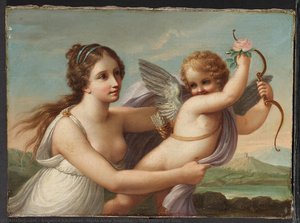
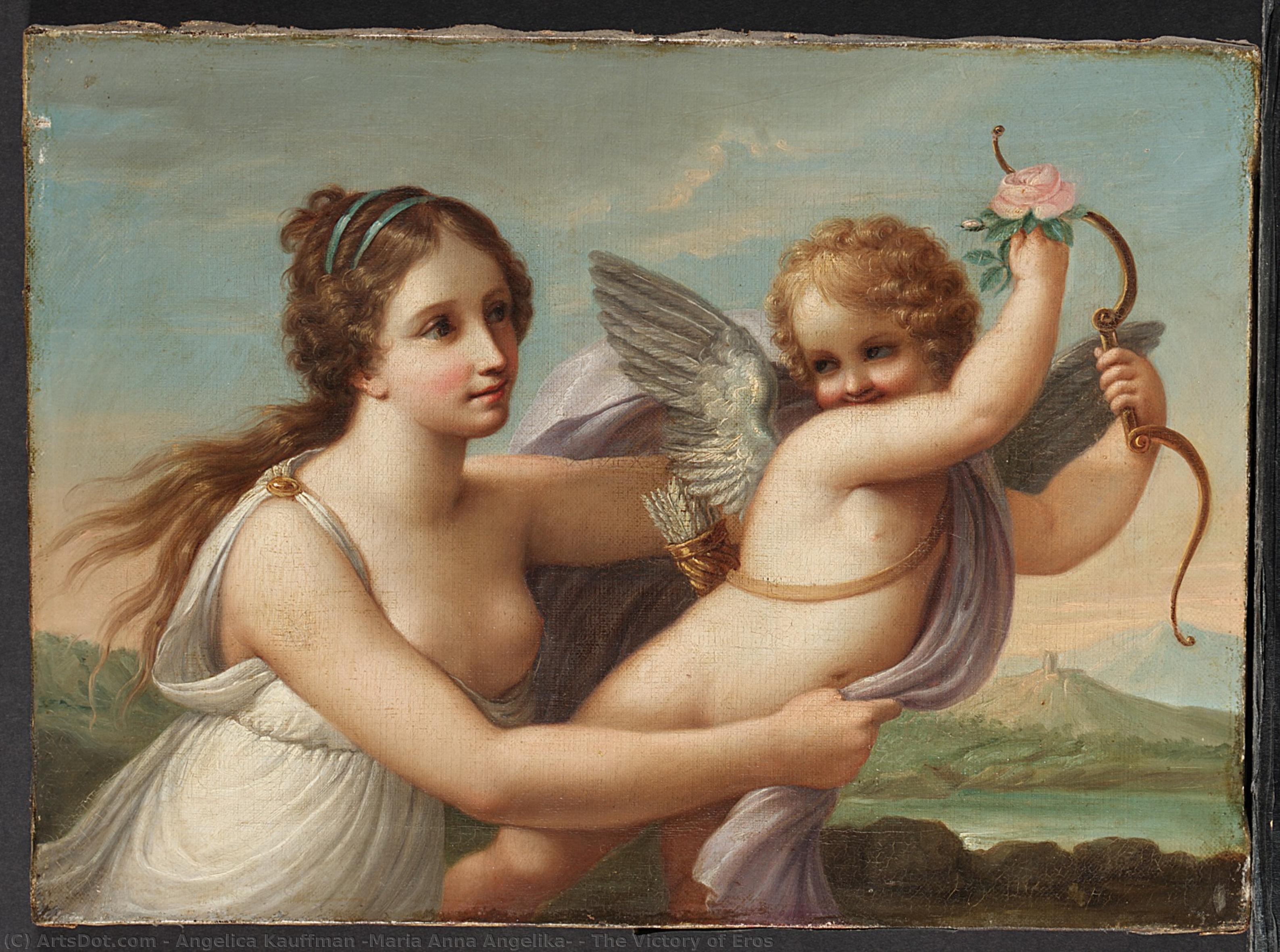
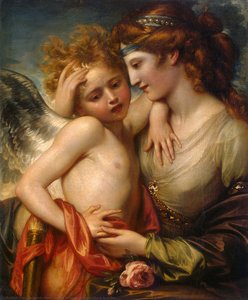
Angelica Kauffman’s “The Victory of Eros,” completed around 1750-75, stands as a testament to the neoclassical aesthetic's fascination with mythology and idealized beauty—a captivating tableau that transcends mere visual splendor to convey profound symbolic meaning. Executed in oil on canvas, this artwork embodies Kauffman’s signature style: meticulous detail combined with graceful composition, reflecting her mastery of Roman artistic conventions honed during her formative years in Rome. Measuring 48 x 60 cm (Framed), the painting captures a serene yet dynamic scene depicting Eros—the Greek god of love—being supported by a nymph or goddess, cradling an angelic infant who holds his own bow and arrow.A Vision of Innocence and Protection
The artwork’s central focus is undeniably Eros himself, portrayed with exquisite realism despite the idealized setting. Kauffman skillfully renders his muscular physique and expressive gaze, conveying both vulnerability and unwavering determination—a duality that speaks to the complexities inherent in love itself. Beneath him rests a nymph or goddess, her posture radiating tenderness as she offers support, symbolizing nurturing care and safeguarding devotion. Crucially, nestled within her embrace is an angelic infant, representing purity and divine grace; his miniature bow and arrow mirror Eros’s role as protector of love's sacred flame. This deliberate juxtaposition underscores the painting’s overarching theme: the preservation of innocence and virtue amidst the turbulent currents of passion.Technical Brilliance and Decorative Detail
Kauffman’s technique is characterized by a masterful blending of tonal gradations and subtle modeling, creating an illusionistic depth that draws the viewer into the scene. The artist employs meticulous brushwork to capture the textures of drapery—particularly the woman's flowing gown—which glows with luminous white hues, reflecting Kauffman’s dedication to achieving photorealistic effects. Delicate gold accents adorn the infant’s attire and bow, adding a touch of regal splendor and highlighting the divine significance of the composition. Furthermore, subtle additions like two birds perched in the background – one on the left and another on the right—serve as visual anchors, enhancing the painting's spatial harmony and contributing to its overall grandeur.Historical Context and Artistic Influence
“The Victory of Eros” emerged during Kauffman’s prolific period in Rome, where she established herself as a leading figure within the artistic community and gained renown for her portraits of royalty and nobility. This artwork aligns perfectly with the neoclassical movement's preoccupation with classical mythology—specifically depictions of divine love—and reflects the prevailing belief that art should elevate the human spirit through idealized representations of virtue and beauty. Kauffman’s work profoundly influenced subsequent generations of artists, establishing a precedent for portraying mythological subjects with meticulous realism and conveying emotional depth through nuanced visual storytelling.Emotional Resonance: A Celebration of Romantic Idealism
Ultimately, “The Victory of Eros” transcends its formal elements to evoke a powerful sense of serenity and aspiration. The painting’s harmonious color palette—dominated by whites and golds—creates an atmosphere of ethereal grace, transporting the viewer to a realm of timeless beauty. More than just a visual spectacle, it embodies the Romantic ideal of love as a force for moral upliftment and spiritual enlightenment—a legacy that continues to inspire admiration and contemplation centuries later.Related Artworks
Artist Biography
A Luminary of the Enlightenment: The Life and Art of Angelica Kauffman
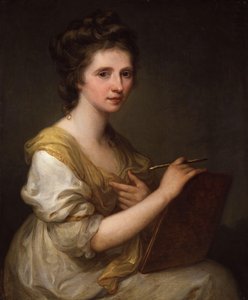
Angelica Kauffman, born Maria Anna Angelika in Chur, Switzerland on October 30, 1741, was a prodigious talent who rose to become one of the most celebrated artists of her time. Her journey defied societal expectations for women in the 18th century, establishing her as a respected figure within the male-dominated art world and a key player in the Neoclassical movement. Kauffman’s father, Johann Georg Kauffmann, was a modest but skilled itinerant painter who recognized his daughter's exceptional abilities early on. He provided her with initial training, fostering a passion that would quickly outstrip his own expertise. By the age of thirteen, Angelica was already receiving commissions for portraits and religious paintings, demonstrating an astonishing level of skill and maturity. Her early work reveals influences from Rococo painters like François Boucher, characterized by delicate brushwork, pastel palettes, and charming depictions of mythological scenes. However, her ambition extended beyond mere imitation; she sought a more rigorous academic foundation, traveling extensively throughout Italy to study the Old Masters – Raphael, Titian, and Correggio – absorbing their techniques and compositional principles. This period proved pivotal in shaping her distinctive style, moving away from the frivolousness of Rococo towards a greater emphasis on historical accuracy, classical form, and emotional depth.Rome, Royal Patronage, and the Birth of Neoclassicism
In 1754, Kauffman arrived in Rome, a city teeming with artistic energy and intellectual ferment. She quickly integrated into the vibrant community of artists, becoming acquainted with prominent figures like Johann Joachim Winckelmann, whose writings on classical art profoundly influenced her aesthetic sensibilities. Rome became her base for over fifteen years, during which she established an international reputation attracting commissions from nobility across Europe. Her talent caught the attention of Lady Wentworth, a wealthy English aristocrat who became her devoted patron and friend. Through Lady Wentworth’s connections, Kauffman gained access to influential circles in England, receiving prestigious commissions including portraits of prominent figures like Sir Joshua Reynolds and David Garrick. However, it was her historical paintings that truly distinguished her. Works such as *Hector Taking Leave of Andromache* (1758) showcased her mastery of dramatic composition, elegant figure painting, and a growing interest in classical themes – hallmarks of the emerging Neoclassical style. In 1763, she became one of only two female founding members of the Royal Academy of Arts in London, a testament to her exceptional skill and standing within the art world. This achievement was groundbreaking, challenging prevailing prejudices against women artists and paving the way for future generations. Her time in England, though successful, proved somewhat fraught with professional rivalry; some male artists resented her popularity and perceived her success as a threat.A Return to Italy and Continued Innovation
In 1766, Kauffman returned to Rome, where she continued to flourish as a sought-after artist. She married Antonio Zucchi, a Venetian painter who shared her passion for classical art and became a collaborative partner. This period saw a further refinement of her Neoclassical style, characterized by balanced compositions, clear narratives, and an emphasis on moral virtue. Her portraits from this era are particularly noteworthy, capturing not only the physical likenesses of her sitters but also their inner character and social standing. She skillfully blended portraiture with allegorical elements, imbuing her works with layers of meaning and symbolism. Kauffman’s studio became a hub for artists and intellectuals, attracting visitors from across Europe eager to witness her talent firsthand. She received commissions from prominent patrons including Pope Clement XIV and Catherine the Great, solidifying her reputation as one of the leading artists of the age. Her work for Catherine the Great included designing a series of paintings for the Hermitage Museum, showcasing scenes from classical literature and mythology. She also explored new mediums, creating designs for tapestries, furniture, and decorative arts, demonstrating her versatility and artistic range.Legacy and Historical Significance
Angelica Kauffman died in Rome on November 5, 1807, leaving behind a vast body of work that continues to captivate audiences today. Her influence extended beyond her own paintings; she played a crucial role in popularizing Neoclassical art and challenging conventional notions about the role of women in society. She proved that women could achieve artistic excellence on par with their male counterparts, inspiring generations of female artists to pursue their passions despite societal obstacles. Her success within the Royal Academy, though not without its challenges, opened doors for other women seeking recognition and professional opportunities. Kauffman’s paintings are characterized by a unique blend of elegance, intelligence, and emotional depth. She skillfully combined classical form with Rococo charm, creating works that were both visually appealing and intellectually stimulating. Her portraits offer valuable insights into the social and cultural life of 18th-century Europe, capturing the personalities and aspirations of her sitters. Her historical paintings are particularly significant for their emphasis on moral virtue and classical themes, reflecting the Enlightenment ideals of reason, order, and civic responsibility. Today, Kauffman is recognized as a pivotal figure in the history of art, a luminary whose talent and determination helped to shape the aesthetic landscape of the 18th century and beyond.Key Achievements & Artistic Style
- Founding Member of the Royal Academy of Arts (1763): A landmark achievement for women in art.
- International Reputation: Commissions from nobility across Europe, including England, Italy, and Russia.
- Mastery of Historical Painting: Dramatic compositions, elegant figure painting, and classical themes.
- Versatility as an Artist: Exploration of various mediums including portraiture, tapestry design, and decorative arts.
- Neoclassical Style: Balanced compositions, clear narratives, emphasis on moral virtue, and a refined aesthetic sensibility.
Quick Facts
- Artistic Movement Or Style: Neoclassicism
- Artists Or Movements Influenced By This Artist:
- Neoclassical portraiture
- Female artists
- Artists Who Influenced This Artist:
- Correggio
- Raphael
- Mengs
- Date Of Birth: 1741
- Date Of Death: 1807
- Full Name: Angelica Kauffman
- Nationality: Swiss
- Notable Artworks:
- Portrait of Lady Sarah Bunbury Sacconi
- Venus at the Toilet of Love
- The Departure of Telemachus for Pylos
- Place Of Birth: Chur, Switzerland
Related Articles

Angelica Kauffmann: Neoclassical Visionary & Shaping Artistic Identity
Explore the life & art of Angelica Kauffmann, a pioneering Neoclassical painter. Discover her influence on the Royal Academy, portraiture techniques, and legacy as a champion for women artists in 18th-century Europe.

The Enduring Motif of Love in Art History: A Cross-Cultural Exploration of Representation and Emotion
Explore the rich history of love in art! Discover iconic masterpieces, artistic techniques & cultural symbolism from antiquity to modern times. Expert analysis for collectors.
Antonio Zucchi: A Venetian Master of Rococo & Neoclassical Charm
Explore the captivating world of Antonio Zucchi, a Venetian master of Rococo and Neoclassical art. Discover his collaborations with Robert Adam & Angelica Kauffmann, stunning frescoes, and enduring legacy. Learn about collecting Zucchi's works today.
Romantic Masterpieces: 10 Artworks to Stir Your Soul |
Fall in love with art! Explore 10 iconic romantic paintings – from Renaissance classics to Impressionist masterpieces. Discover the stories behind artists like Monet & Klimt, and find museum-quality reproductions for your home at .
Eternal Love: Top 10 Wedding Art Gifts & Their Meaning |
Find the perfect wedding gift! Explore 10 meaningful art gifts – from Monet to Klimt – symbolizing love & lasting commitment. Discover museum-quality reproductions and curated decor ideas at .