 Preview
 Send
Send Share
Share
 Details

 Download
 Similars
 X-Ray
X-Ray Diaporama
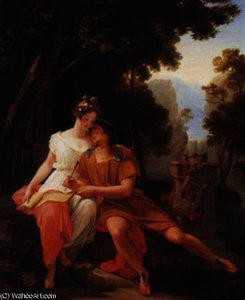
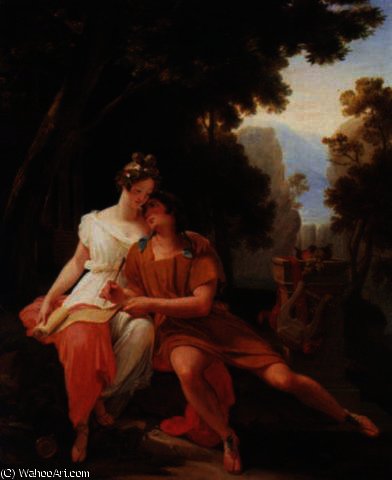
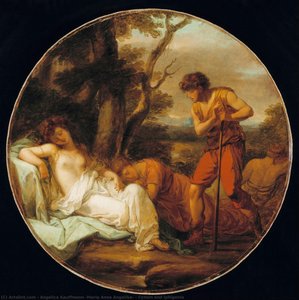
Propertius and Cynthia at Tivoli

 Read More
Hand Made Oil Reproduction
Hand-painted oil on canvas in your size and frame, made to order by our artists. ( Buy Print Buy Image)




































Pick from our preset sizes that match the artwork's original proportions.

You may enter your own dimensions to fit a specific frame or space. If your selected size does not match the original image's proportions, we will either crop the artwork or extend the painting with additional hand-painted elements. A digital mockup will be sent for your approval before production begins.
Please note that the on-screen preview does not reflect the actual cropping or extension. Only the mockup will accurately show the final composition.
While custom sizes are available, we recommend selecting a dimension from the predefined list to preserve the original proportions.
After order, ArtsDot.com team will email client for instructions and provide a mockup preview
Worldwide Delivery () in 3/4 weeks instead of standard 5 weeks. (23 August). No compromise on quality.

Free Worldwide Express Shipping

High-Quality Linen Canvas

Full Shipping Insurance

Customs Tax Refund Guarantee

True Color Matching Guarantee

60-Day Return Policy (Defects Only)

100% Money-Back Guarantee

Bulk Discount Offer
 Glass option is only available in size under 110 CM

Propertius and Cynthia at Tivoli
Reproduction Medium
Reproduction Size
-


Total Price
$ 288
Related Artworks
Artist Biography
A Life Bridging Eras: The Artistic Journey of Auguste Jean Baptiste Vinchon
Auguste Jean Baptiste Vinchon, born in Paris in 1789, lived a life deeply interwoven with the shifting currents of French art and politics. His career spanned the grandeur of the Napoleonic era, the delicate restoration of the Bourbon monarchy, and the burgeoning dynamism of the July Monarchy – a testament to his adaptability and enduring talent. Vinchon wasn’t merely a painter; he was a visual chronicler, capturing the spirit of an age in transition through historical scenes, masterful frescoes, and innovative contributions to printmaking. His early artistic training under Gioacchino Giuseppe Serangeli laid a solid foundation in classical techniques, but it was his triumph in the prestigious Prix de Rome competition – securing second place in 1813 and first in 1814 with “The Death of Diagoras” – that truly propelled him onto the path to artistic renown. This victory granted him the invaluable opportunity to study at the French Academy in Rome, a period of immersion in classical art and Italian culture that would profoundly shape his aesthetic sensibilities.Imperial Commissions and the ‘Juste Milieu’
During the First French Empire, Vinchon collaborated with Nicolas Gosse on a significant project for the Louvre Museum. Together they created a series of grayscale scenes drawn from the ancient world, based on plates from “Antichità di Ercolano.” This undertaking showcased his skill in translating complex visual information into accessible and compelling artistic representations, demonstrating an early aptitude for historical subjects. Vinchon’s style began to coalesce around what would become known as the *juste milieu* – a school of art that sought a harmonious balance between the rigorous order of Neoclassicism and the burgeoning emotional expressiveness of Romanticism. He wasn't wholly devoted to either extreme, instead forging a path that embraced classical principles while incorporating elements of narrative storytelling and dramatic flair. This nuanced approach allowed him to appeal to diverse tastes within a rapidly changing society.Frescoes, Honors, and a Lost Masterpiece
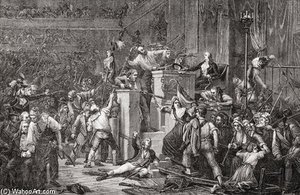
Following his time in Rome, Vinchon continued to receive important commissions that solidified his reputation as a leading artist of the Restoration period. In 1822, he undertook the creation of frescoes for a chapel at the Church of Saint-Sulpice in Paris – a testament to his mastery of large-scale decorative painting and his ability to imbue sacred spaces with visual splendor. Recognition came swiftly; in 1827, he was appointed a Knight of the Legion of Honor, acknowledging his contributions to French art and culture. However, perhaps his most significant achievement arrived after the July Revolution of 1830 when he won a competition to create paintings for the meeting room of the newly formed Chamber of Deputies. His winning submission depicted a pivotal moment from 1795: François Antoine de Boissy d'Anglas bravely confronting a mob, symbolizing resistance against tyranny and sedition. Sadly, this powerful work was lost in the devastating fire of 1871, leaving only descriptions as evidence of its impact. It remains considered one of his most important creations, embodying the spirit of republican ideals.Later Life and Enduring Legacy
In later years, Vinchon’s interests expanded beyond painting to encompass the world of printing. He became head of a leading Parisian printing house, Impr. de Vinchon et C. de Mourgues, demonstrating his entrepreneurial spirit and adaptability. This venture allowed him to further contribute to the dissemination of visual culture, albeit in a different form. He passed away in 1855 at the bathing resort of Ems, leaving behind a legacy that reflects both artistic talent and commercial acumen. His funeral at Père Lachaise Cemetery was marked by tributes from colleagues and friends, underscoring his standing within both the artistic and business communities. Vinchon’s work exemplifies the *juste milieu* movement, skillfully bridging classical ideals with emerging romantic sensibilities. His ability to secure commissions from successive regimes – imperial, royal, and revolutionary – speaks volumes about his adaptability and enduring recognition within French society. His paintings offer a window into a pivotal era of French history, capturing not only the grand narratives but also the subtle nuances of a nation in constant flux.Key Influences & Notable Works
- Influences: Jacques-Louis David, Gioacchino Giuseppe Serangeli, Classical Art and Italian Renaissance.
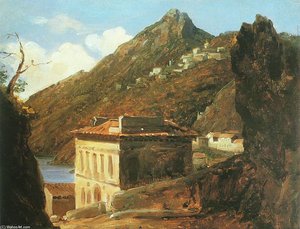
- Major Works: “The Death of Diagoras,” scenes from "Antichità di Ercolano" for the Louvre, frescoes at Saint-Sulpice, painting depicting Boissy d'Anglas confronting the mob, *Propertius and Cynthia at Tivoli*, *Lake Vietri*.
- Historical Significance: Vinchon’s work embodies the artistic spirit of his time, navigating the transition between Neoclassicism and Romanticism with grace and skill. His contributions to both painting and printmaking cemented his place as a significant figure in 19th-century French art.
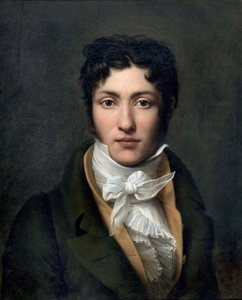
Auguste Jean Baptiste Vinchon
1789 - 1855 , France
Quick Facts
- Artistic Movement Or Style: Juste Milieu
- Artists Who Influenced This Artist:
- Jacques-Louis David
- Gioacchino Serangeli
- Date Of Birth: 1789
- Date Of Death: 1855
- Full Name: Auguste Jean Baptiste Vinchon
- Nationality: French
- Notable Artworks:
- The Death of Diagoras
- Antichità di Ercolano scenes
- Saint-Sulpice frescoes
- Boissy d'Anglas painting
- Place Of Birth: Paris, France
Related Articles
Renoir's Masterpieces: Explore 25 Iconic Paintings & Bring Art Home | ArtsDot
Explore 25 iconic Pierre-Auguste Renoir paintings! Discover the stories behind Impressionist masterpieces like 'Dance at Le Moulin de la Galette' & 'Luncheon of the Boating Party'. Find museum-quality art reproductions and elevate your home decor with ArtsDot.com.

Neo-Classicism's Greatest Hits: 10 Masterpieces for Your Home |
Journey through Neo-Classicism's finest! Explore 10 iconic masterpieces by David, Ingres & Canova. Discover art history, techniques & timeless beauty – perfect for inspiring your home decor. Find museum-quality reproductions at
Romantic Masterpieces: 10 Artworks to Stir Your Soul |
Fall in love with art! Explore 10 iconic romantic paintings – from Renaissance classics to Impressionist masterpieces. Discover the stories behind artists like Monet & Klimt, and find museum-quality reproductions for your home at .
Romantic Realism's Finest: 10 Masterpieces for Your Home | ArtsDot
Explore 10 defining masterpieces of Romantic Realism! Discover Courbet, Millet & Daumier's powerful paintings—capturing emotion and social realities. Find museum-quality reproductions for your home at ArtsDot.com.

The Enduring Motif of Love in Art History: A Cross-Cultural Exploration of Representation and Emotion
Explore the rich history of love in art! Discover iconic masterpieces, artistic techniques & cultural symbolism from antiquity to modern times. Expert analysis for collectors.