 Preview
 Send
Send Share
Share
 Details

 Download
 Similars
 X-Ray
X-Ray Diaporama
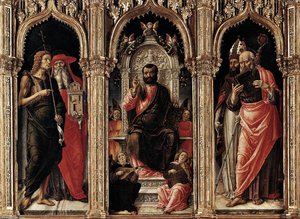
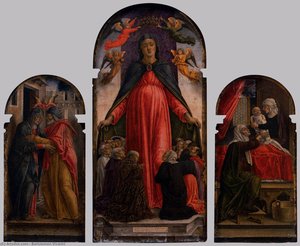
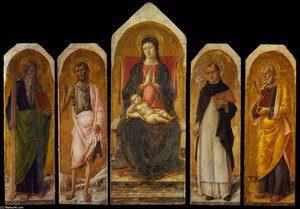
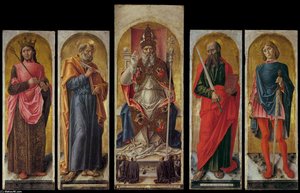
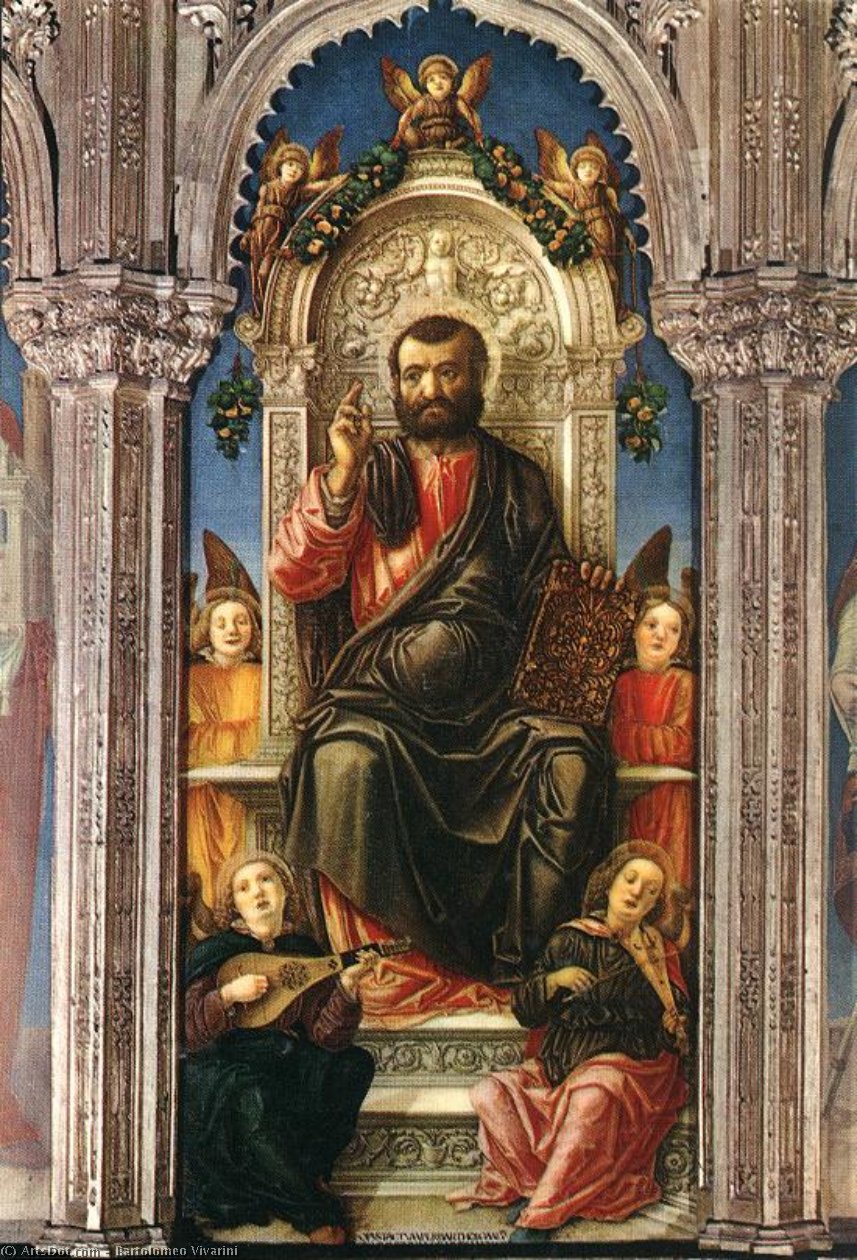
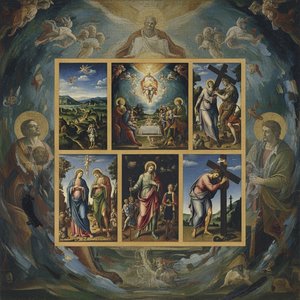
Triptych of St Mark
 Oil On Board
- Renaissance
 1474
1474- Renaissance
 165.0 x 68.0 cm
 Santa Maria Gloriosa dei Frari
 Read More
Hand Made Oil Reproduction
Hand-painted oil on canvas in your size and frame, made to order by our artists. ( Buy Print Buy Image)




P118B $10

P118H $10

P118W $10

P438Z $10

P508JH $12

P508YH $12

P805H $10

P805Z $10

P919BZ $10

P919G $10

P919XJ $10

P959ZH $10

P968JZ $12

W106C $8

W218G $10

W218JH $8

W218Y $10

W307PJ $10

W316G $10

W316PJ $8

W316Y $10

W398PJ $8

W4111J $10

W500HY $15

W500JH $15

W692G $12

W849H $8

W940BG $15

W953PJ $8




Pick from our preset sizes that match the artwork's original proportions.

You may enter your own dimensions to fit a specific frame or space. If your selected size does not match the original image's proportions, we will either crop the artwork or extend the painting with additional hand-painted elements. A digital mockup will be sent for your approval before production begins.
Please note that the on-screen preview does not reflect the actual cropping or extension. Only the mockup will accurately show the final composition.
While custom sizes are available, we recommend selecting a dimension from the predefined list to preserve the original proportions.
After order, ArtsDot.com team will email client for instructions and provide a mockup preview
Worldwide Delivery () in 3/4 weeks instead of standard 5 weeks. (17 August). No compromise on quality.

Free Worldwide Express Shipping

High-Quality Linen Canvas

Full Shipping Insurance

Customs Tax Refund Guarantee

True Color Matching Guarantee

60-Day Return Policy (Defects Only)

100% Money-Back Guarantee

Bulk Discount Offer
 Glass option is only available in size under 110 CM

Triptych of St Mark
Reproduction Medium
Reproduction Size
-


Total Price
$ 263
Artwork Description
A Vision of Devotion: The Triptych of St Mark
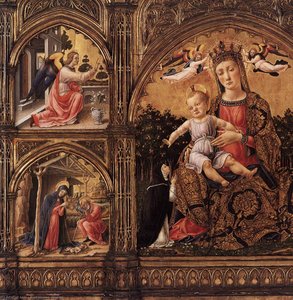
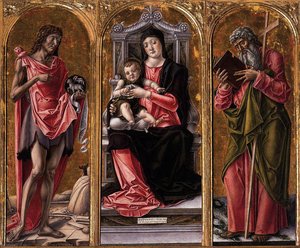
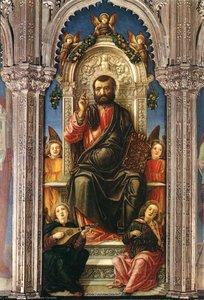
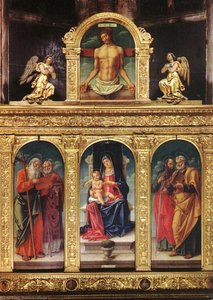
In the heart of the Venetian Renaissance, where the light of the Adriatic meets the profound spiritual fervor of the era, Bartolomeo Vivarini crafted a masterpiece of incomparable grace. The Triptych of St Mark, completed in 1474, stands as a luminous testament to the power of sacred narrative and the meticulous skill of the Vivarini workshop. This oil-on-wood triptych does not merely depict a scene; it invites the viewer into a celestial encounter. At its center, St Mark is captured in a moment of profound sanctity, seated upon an ornate chair with hands raised in a gesture of prayerful intercession. The composition is a delicate dance of figures, where angels and children drift through the space, their presence bridging the gap between the earthly realm and the divine.
The artistry of Vivarini is revealed through a masterful command of light and texture. As one gazes upon this work, the rich, saturated colors characteristic of the Venetian school emerge, casting a warm, golden glow over the entire scene. The artist employs a technique that emphasizes depth and volume, making the central figure of the Saint feel tangibly present within the frame. A subtle yet significant detail—a book or scroll resting near the center—serves as a focal point for contemplation, suggesting that the Saint’s prayer is rooted in sacred scripture. This interplay of light and shadow, known as chiaroscuro, lends a dramatic weight to the figures, ensuring that every fold of fabric and every angelic countenance carries emotional resonance.
Symbolism and the Renaissance Spirit
Beyond its visual splendor, the Triptych of St Mark is steeped in the symbolic language of the 15th century. Every element within the frame is a deliberate choice intended to evoke reverence. The surrounding figures, from the ethereal angels to the innocent children, represent a hierarchy of spiritual existence, all converging toward the central act of devotion. This arrangement creates a sense of rhythmic movement that guides the eye across the three panels, a hallmark of the triptych format which was designed to facilitate both private meditation and public worship. The presence of the sacred text acts as an anchor, reminding the faithful of the intellectual and spiritual foundations of their faith.
For the discerning collector or interior designer, this piece offers more than just historical significance; it provides a profound emotional atmosphere. A high-quality reproduction of this work brings with it a sense of timelessness and tranquility, making it an ideal centerpiece for spaces dedicated to reflection, study, or sophisticated elegance. The painting’s ability to command attention through its serene beauty allows it to integrate seamlessly into luxurious settings, where it can serve as a window into the soul of the Italian Renaissance. To possess such a work is to hold a fragment of history, a piece of the very light that once illuminated the altars of Venice.
Related Artworks
Artist Biography
Fra Angelico: A Monk’s Vision of Paradise
The name Fra Angelico – Guido di Pietro – conjures an image of a serene, contemplative figure, and indeed, the Dominican friar who bore this title was one of the most profoundly spiritual artists of the Italian Renaissance. Born around 1395 in the Mugello region of Tuscany, his life intertwined seamlessly with his art, creating a body of work that continues to resonate with its ethereal beauty and deeply felt piety. Unlike many of his contemporaries who sought patronage from wealthy merchant families or powerful courts, Angelico’s primary allegiance lay within the walls of San Domenico in Fiesole, where he served as a monk for nearly forty years. This unique context profoundly shaped his artistic vision, imbuing every brushstroke with a sense of devotion and a yearning for the divine.
Angelico's early training remains somewhat shrouded in mystery, though it’s widely believed that he apprenticed under Lorenzo Monaco, a prominent Florentine painter known for his refined style and meticulous attention to detail. However, Angelico quickly surpassed his master, developing a distinctive approach characterized by a remarkable ability to render natural forms with an almost photographic realism while simultaneously elevating them to a realm of spiritual significance. This synthesis is particularly evident in the fragments recovered from the Liber Sacrae Familiares, a choirbook commissioned for San Domenico, which offer tantalizing glimpses into his artistic process and stylistic evolution.
- Early Works (1418-1422): During this period, Angelico produced a series of altarpieces for the convent, including the magnificent Annunciation, which showcases his mastery of perspective and his innovative use of light to create a luminous atmosphere.
- The Chapel of the Holy Sacrament (1440-1451): Perhaps Angelico’s most significant commission came from Pope Sixtus IV, who tasked him with decorating the chapel within St. Peter's Basilica. This ambitious project involved creating a series of frescoes depicting scenes from the life of Christ and the Virgin Mary. The Crucifixion, housed in the Capitular Hall, stands as a testament to Angelico’s profound understanding of human emotion and his ability to convey the weight of suffering with exquisite tenderness.
- San Marco Altarpiece (1443): This altarpiece, now located in the San Marco Museum in Florence, exemplifies Angelico's evolving style. It features a complex arrangement of figures, including saints, angels, and donors, all rendered with remarkable detail and imbued with a sense of serene grace.
- Niccoline Chapel Frescoes (1447-1451): Commissioned by Lorenzo de’ Medici for the chapel adjacent to the Sistine Chapel in the Vatican, these frescoes represent Angelico's most ambitious undertaking. The Nativity, Adoration of the Magi, and Descent from the Cross are considered masterpieces of Renaissance art, renowned for their luminous colors, harmonious composition, and profound spiritual depth.
The Influence of Perspective and Naturalism
Fra Angelico’s artistic innovations were deeply rooted in a burgeoning interest in scientific observation and mathematical principles. He was keenly aware of the developments in linear perspective, pioneered by Filippo Brunelleschi, and skillfully employed this technique to create a sense of spatial depth and realism within his paintings. However, unlike many of his contemporaries who prioritized technical accuracy above all else, Angelico used perspective not merely as a means of achieving visual illusion but as a tool for guiding the viewer’s gaze towards the spiritual center of each scene.
Furthermore, Angelico demonstrated an exceptional ability to render natural forms with astonishing precision. His meticulous attention to detail—the delicate folds of drapery, the intricate patterns of foliage, and the subtle nuances of human expression—contributed significantly to the lifelike quality of his paintings. This commitment to realism was not simply a matter of artistic skill; it reflected Angelico’s deep reverence for God's creation and his desire to capture its beauty and wonder within his art.
A Monastic Life, A Spiritual Art
It is crucial to understand that Fra Angelico’s life as a Dominican friar profoundly shaped the nature of his artistic practice. The monastic routine—characterized by prayer, contemplation, and manual labor—provided him with a framework for disciplined creativity and instilled in him a deep sense of humility and service. His paintings were not created for personal glory or material gain but as expressions of his faith and as aids to spiritual devotion.
The simplicity and austerity of the monastic environment are reflected in Angelico’s artistic style, which is marked by its clarity, restraint, and profound sense of peace. He eschewed elaborate ornamentation and dramatic gestures, focusing instead on conveying a quiet reverence for God's grace and the beauty of his creation. His works are often described as “spiritual,” reflecting the monk’s devotion to his faith.
Legacy and Historical Significance
Fra Angelico’s influence on subsequent generations of artists was immense. His innovative use of perspective, his meticulous attention to detail, and his profound spiritual sensibility helped to shape the course of Renaissance painting. Artists such as Masaccio, Botticelli, and Raphael all drew inspiration from Angelico's work, incorporating elements of his style into their own compositions.
Today, Fra Angelico’s paintings are treasured for their beauty, their historical significance, and their enduring spiritual power. His legacy extends far beyond the confines of the art world, reminding us of the transformative potential of faith and the profound connection between art and spirituality. The works he created continue to inspire awe and contemplation, offering a glimpse into the heart of a man who sought to capture the divine in every brushstroke.
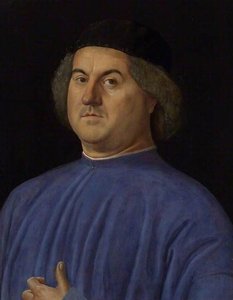
bartolomeo vivarini
1440 - 1499 , Italy
Quick Facts
- Artistic Movement Or Style: Early Renaissance
- Artists Or Movements Influenced By This Artist:
- Masaccio
- Early Renaissance
- Artists Who Influenced This Artist: ['Lorenzo Monaco']
- Date Of Birth: c. 1395
- Date Of Death: 1455
- Full Name: Fra Angelico Guido di Pietro
- Nationality: Italian
- Notable Artworks:
- San Marco Altarpiece
- Crucifixion (San Marco)
- Nativity (Advent Roll)
- Place Of Birth: Mugello, Italy
Related Articles
El Greco's Masterpieces: Explore 25 Iconic Paintings & Spiritual Visions | ArtsDot
Journey through El Greco's 25 most iconic paintings! Explore the spiritual depth & dramatic beauty of this Spanish Renaissance master. Discover art history, techniques & find museum-quality reproductions for your home at ArtsDot.com.

Jacopo Tintoretto's Masterpieces: 25 Paintings That Define Venetian Drama | ArtsDot
Explore 25 breathtaking masterpieces by Jacopo Tintoretto, the Venetian master of drama and light. Discover the stories behind iconic Renaissance paintings & find museum-quality art reproductions to elevate your home decor on ArtsDot.com.

Mark Rothko's Masterpieces: 25 Paintings That Define Abstract Expressionism | ArtsDot
Explore 25 iconic Mark Rothko paintings that define Abstract Expressionism. Discover the stories, colors & emotions behind these masterpieces. Find museum-quality art reproductions and curated decor ideas at ArtsDot.com.

The Enduring Power of Painting: A Historical & Contemporary Exploration of Form and Emotion
Explore the rich history & enduring techniques of oil painting with ArtsDot. Discover masterpieces, learn about art collecting, and find authentic handmade reproductions crafted by skilled artists.

Oil on Canvas: A Historical & Technical Exploration of a Timeless Artistic Medium
Explore the rich history & enduring techniques of oil painting on canvas. Discover the science behind its longevity, conservation practices, and contemporary relevance. Expert insights for art enthusiasts.