 Preview
 Send
Send Share
Share
 Details

 Download
 Similars
 X-Ray
X-Ray Diaporama
The Siege (Defense of a Church Courtyard During the Thirty Years’ War)
 Oil
Oil- WallArt
- Düsseldorf School
 1848
1848- 19th Century
 1766.0 x 1165.0 cm
 Kunstpalast
 Read More
Hand Made Oil Reproduction
Hand-painted oil on canvas in your size and frame, made to order by our artists. ( Buy Print Buy Image)




P118B $10

P118H $10

P118W $10

P438Z $10

P508JH $12

P508YH $12

P805H $10

P805Z $10

P919BZ $10

P919G $10

P919XJ $10

P959ZH $10

P968JZ $12

W106C $8

W218G $10

W218JH $8

W218Y $10

W307PJ $10

W316G $10

W316PJ $8

W316Y $10

W398PJ $8

W4111J $10

W500HY $15

W500JH $15

W692G $12

W849H $8

W940BG $15

W953PJ $8




Pick from our preset sizes that match the artwork's original proportions.

You may enter your own dimensions to fit a specific frame or space. If your selected size does not match the original image's proportions, we will either crop the artwork or extend the painting with additional hand-painted elements. A digital mockup will be sent for your approval before production begins.
Please note that the on-screen preview does not reflect the actual cropping or extension. Only the mockup will accurately show the final composition.
While custom sizes are available, we recommend selecting a dimension from the predefined list to preserve the original proportions.
After order, ArtsDot.com team will email client for instructions and provide a mockup preview
Worldwide Delivery () in 3/4 weeks instead of standard 5 weeks. (29 August). No compromise on quality.

Free Worldwide Express Shipping

High-Quality Linen Canvas

Full Shipping Insurance

Customs Tax Refund Guarantee

True Color Matching Guarantee

60-Day Return Policy (Defects Only)

100% Money-Back Guarantee

Bulk Discount Offer
 Glass option is only available in size under 110 CM

The Siege (Defense of a Church Courtyard During the Thirty Years’ War)
Reproduction Medium
Reproduction Size
-


Total Price
$ 263
A Masterpiece of Drama and Devotion
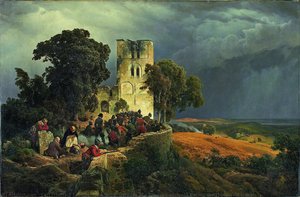
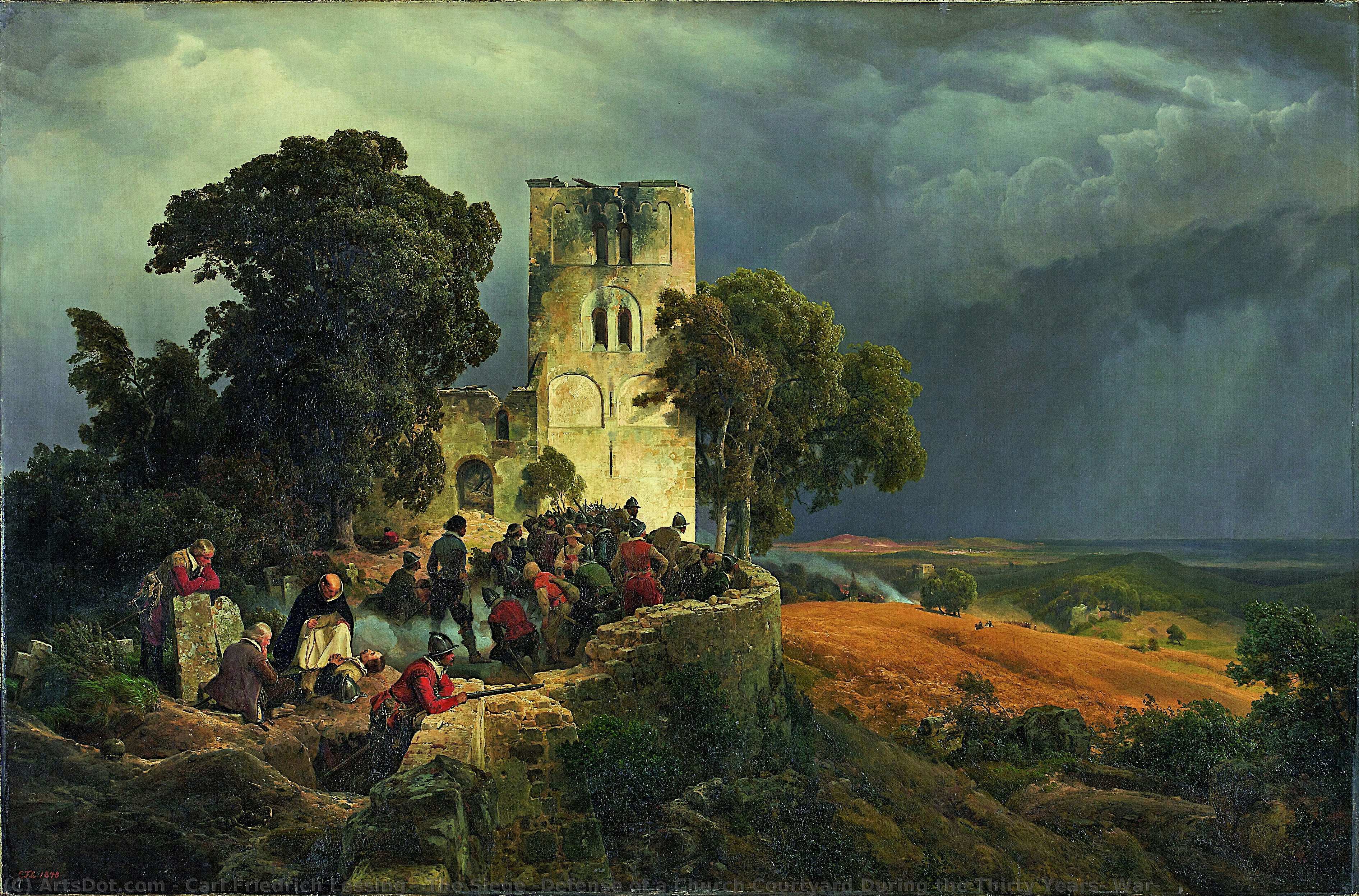
In the sweeping, atmospheric canvas of The Siege (Defense of a Church Courtyard During the Thirty Years’ War), Carl Friedrich Lessing invites the viewer into a moment of profound historical tension. Painted in 1848, this work stands as a monumental achievement of the Düsseldorf School, masterfully synthesizing the grandeur of history painting with the raw, emotive power of landscape. The scene unfolds beneath a somber, tempestuous sky that seems to mirror the chaos unfolding on the ground. As the eye traverses the rugged terrain, it encounters a world caught in the throes of conflict, where the architectural remnants of a monastery—partially consumed by fire—serve as a haunting backdrop to the struggle for survival.
The composition is a triumph of narrative structure, guiding the observer through a carefully orchestrated sequence of events. Along the curved diagonal of the fortress wall, Lessing leads our gaze into the vast, brooding countryside, creating a sense of immense scale and isolation. On the ridges, the presence of arquebusiers and lansquenets provides a rhythmic pulse of military movement, yet the true heart of the painting lies in its intimate, tragic foreground. Here, the artist captures a moment of spiritual gravity: a monk administering the Last Sacraments to a dying soldier. This poignant intersection of violence and piety creates a profound emotional resonance, reminding us of the fragile sanctity of life amidst the devastation of war.
Technique and the Spirit of an Era
Lessing’s technical prowess is evident in his ability to manipulate light and atmosphere to evoke a specific psychological state. Drawing from his extensive studies in the Eifel region, he employs a palette of muted, earthy tones and stormy grays that imbue the work with a sense of impending doom. The brushwork, while precise enough to render the intricate details of period weaponry and clothing, possesses an atmospheric fluidity that allows the smoke of battle and the heavy clouds to blend seamlessly. This mastery of light not only illuminates the central drama but also creates a sense of depth that pulls the viewer into the very center of the siege.
Beyond its immediate visual impact, the painting carries deep historical symbolism. Created during the turbulent year of the 1848 Revolution, the work resonates with the contemporary anxieties of Lessing’s time. The destruction of the monastery and the desperate defense of the courtyard can be read as an allegory for the fragility of social and religious institutions during periods of political upheaval. For the discerning collector or interior designer, this piece offers more than mere decoration; it provides a window into the human condition, making it a commanding centerpiece for any collection that values historical depth, narrative complexity, and the enduring power of Romanticism.
Related Artworks
Artist Biography
early life and education
carl friedrich lessing, a renowned german historical and landscape painter, was born on february 15, 1808, in breslau (now wrocław), poland. he was the grandnephew of the esteemed poet and dramaturge gotthold ephraim lessing. lessing's early education laid the foundation for his future artistic pursuits. he studied architecture at the berlin bauakademie in 1822, followed by enrollment at the königlich-preussische akademie der wissenschaften (royal prussian academy of the sciences) from 1823 to 1826.artistic career and influences
lessing's artistic career was marked by his association with friedrich wilhelm von schadow, under whose guidance he developed his skills in historical painting. in 1830, lessing's works, blending history and landscape elements, earned him recognition as one of the finest artists of the düsseldorf school. his notable paintings include:- landscape with castle ruins and riders (1878)
- soldiers at rest (1877)
- motif from the harz mountains (1870)
- landscape (1862)
- upper rhine chapel (1860)
leadership and legacy
lessing co-founded the artists' association malkasten (paint box) in 1848. from 1858 until his death in 1880, he served as the director of the grand ducal painting gallery and print collection in karlsruhe. key achievements:- first success with a painting at the berlin art exhibition (1826)
- accepted into schadow's atelier
- co-founder of malkasten (paint box) artists' association
- director of the grand ducal painting gallery and print collection in karlsruhe
references and further reading
for more on carl friedrich lessing, explore these links: note: the provided links are from ArtsDot.com and wikipedia, as per the instruction to only include relevant links from these sources.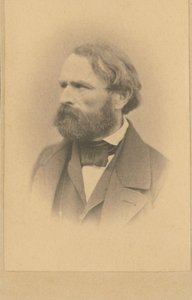
carl friedrich lessing
1808 - 1880 , Poland
Quick Facts
- Artistic Movement Or Style: Düsseldorf School
- Artists Or Movements Influenced By This Artist: ['Romanticism']
- Artists Who Influenced This Artist: ['Friedrich Wilhelm von Schadow']
- Date Of Birth: February 15, 1808
- Date Of Death: January 4, 1880
- Full Name: Karl Friedrich Lessing
- Nationality: German
- Notable Artworks:
- Landscape with Crows
- Bode Museum
- Place Of Birth: Wrocław, Poland
Related Articles
William Owen: A Poetic Vision of War & Landscape in British Modernism
Explore the poignant war poetry of Wilfred Owen, a key figure in British Modernism. Discover his innovative style, themes of loss & camaraderie, and lasting impact on 20th-century literature. Analysis & historical context included.
Echoes of a Turning Tide: Artistic Responses to 1916 – A Year of Conflict & Transformation
Explore the profound artistic responses to the tumultuous year of 1916. Discover how WWI shaped movements like Futurism & Expressionism, and delve into masterpieces by Kandinsky, Matisse, Nevinson & more. Learn about art history at ArtsDot.
The Hague School: Realism, Atmosphere & the Dawn of Dutch Impressionism
Explore the Hague School's pivotal role in Dutch art history. Discover realism, atmospheric landscapes & its influence on Impressionism. Learn about key artists like Mauve & Maris with ArtsDot.
Vasily Vereshchagin: Realism, War & Subversion in 19th-Century Russian Painting
Explore the powerful realism of Vasily Vereshchagin's war paintings & Central Asian scenes. Discover how this Russian master challenged artistic conventions and offered a brutal, honest depiction of 19th-century conflict. Learn about his legacy for discerning collectors.
Echoes of Trauma & Hope: Representing Transformation in Artworks of 1918
Explore the profound artistic responses to World War I's trauma & hope. Discover Expressionist masterpieces by Bacon, de Kooning & more. Expert insights for collectors & art enthusiasts at ArtsDot.